September 30, 2026Position Mechanics
Why Did My Futures Margin Decrease Without Changing My Position?
Your position size, entry price, and leverage can stay unchanged while a margin number still moves. The reason is often somewhere else in the account.
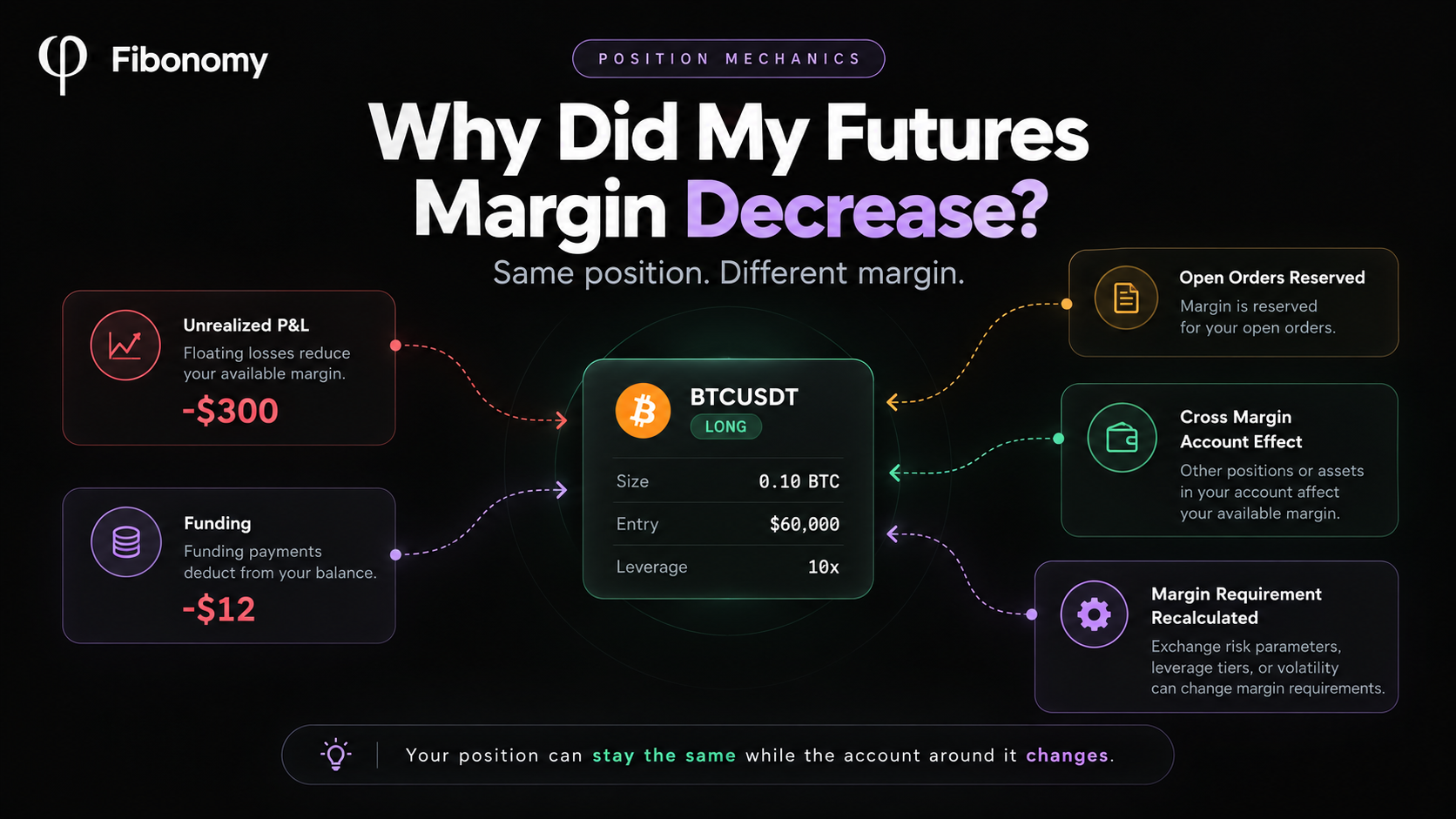
A futures margin decrease can happen even when you did not change your position.
You are LONG BTCUSDT.
Nothing changes for several hours.
Position Size:
0.10 BTC

Average Entry:
$60,000

Leverage:
10x
You did not:
Add to the position

Reduce the position

Change leverage

Move margin manually
But later you look at the account and see that a margin-related number is lower.
Your position still says:
0.10 BTC
Your entry still says:
$60,000
So where did the margin go?
The short answer:
Your position can stay the same while the account around it changes.
And there is another complication:
“Margin” is not one universal number.
You may be looking at Wallet Balance, Margin Balance, Available Margin, Initial Margin, Maintenance Margin, or position-specific margin.
Those fields answer different questions.
So before asking why margin changed, you need to identify which margin number changed.
Quick Answer
A futures margin decrease does not automatically mean that margin was removed from your position.
A margin-related number can change because:
ACCOUNT VALUE CHANGED
        ↓
Unrealized P&L
Funding
Trading fees
Collateral value
or:
ACCOUNT COMMITMENTS CHANGED
        ↓
Open orders
Other positions
Frozen margin
Shared Cross Margin exposure
or:
MARGIN REQUIREMENT CHANGED
        ↓
Mark Price
Leverage
Position notional
Maintenance margin
Risk tier
The important distinction is:
POSITION STATE

≠

ACCOUNT STATE
A position can remain unchanged while the account supporting it does not.
First: Which Margin Number Actually Changed?
Imagine your futures account shows:
| Field | Example |
|---|---|
| Wallet Balance | $5,000 |
| Margin Balance | $4,700 |
| Available Margin | $3,600 |
| Initial Margin | $1,000 |
| Maintenance Margin | $145 |
It is tempting to summarize all of this as:
“I have $X of margin.”
But these numbers do not mean the same thing.
On Binance Futures, for example:
Margin Balance
=
Wallet Balance
+
Unrealized P&L
while Wallet Balance incorporates realized profit, net funding, commissions, and transfers. Binance also calculates available-for-order balance after accounting for margin requirements tied to positions and open orders. Binance
So a lower Margin Balance can come from unrealized loss.
A lower Wallet Balance can come from a funding payment or trading commission.
A lower Available Margin can come from a new commitment such as an open order.
A different Initial Margin or Maintenance Margin can reflect a changed requirement rather than money leaving your account.
That is why the first diagnostic question should always be:
Which field moved?
The Position Is Not the Account
A futures position has one set of variables.
POSITION STATE

Size
Direction
Average Entry
Leverage Setting
Stop
Target
The account supporting it has another.
ACCOUNT STATE

Wallet Balance
Unrealized P&L
Realized P&L
Funding
Fees
Other Positions
Open Orders
Collateral
Margin Requirements
Those two systems interact.
But they are not the same thing.
So this is completely possible:
Position Size     SAME
Entry Price       SAME
Leverage          SAME

Account Equity    CHANGED
Available Margin  CHANGED
Maintenance Req.  CHANGED
That is the foundation for everything that follows.
Unrealized P&L Can Change Margin Balance Without Changing the Position
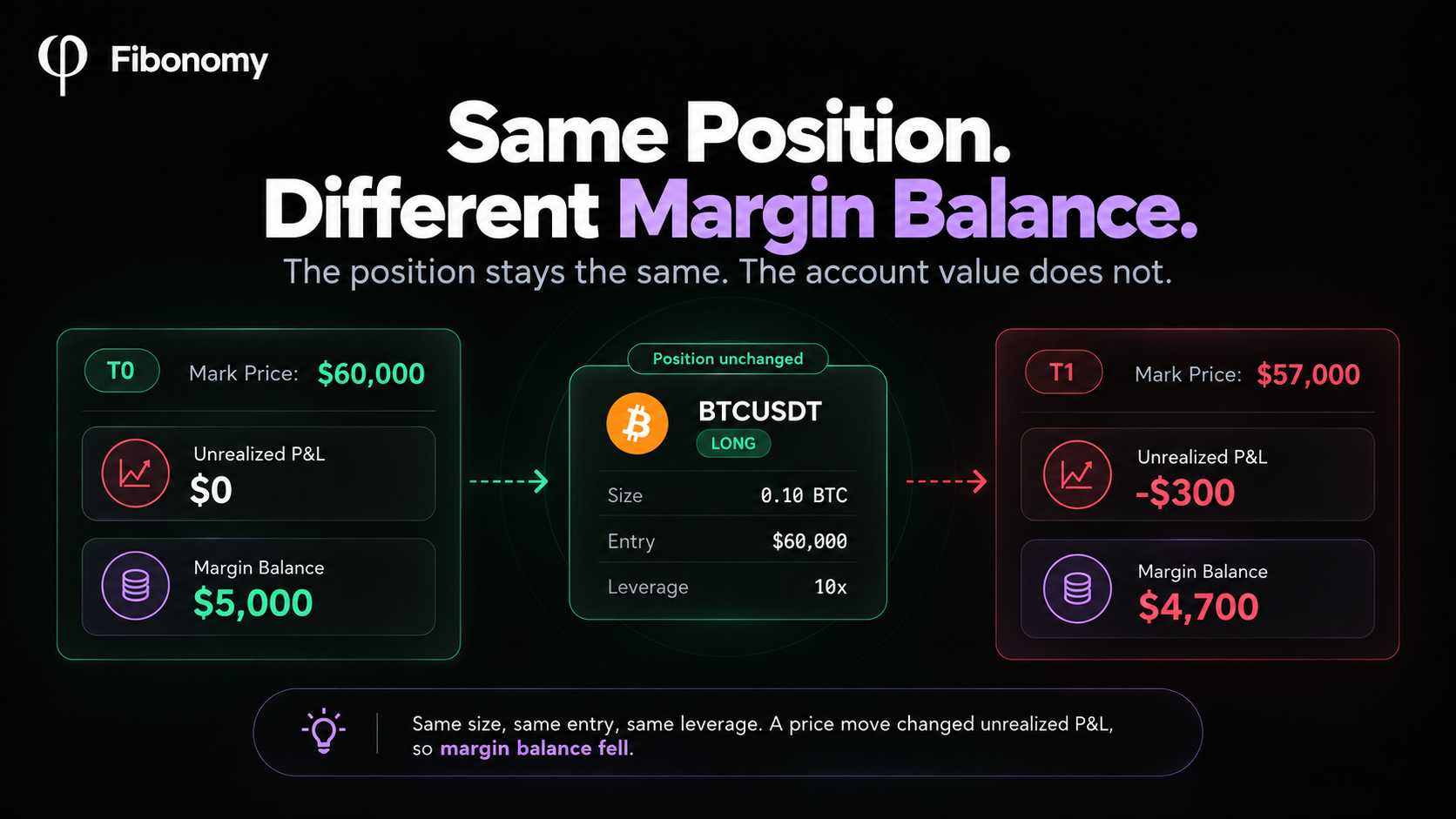
Start with a simple BTCUSDT long.
Position Size:
0.10 BTC

Entry:
$60,000

Leverage:
10x
At the beginning:
Mark Price:
$60,000

Unrealized P&L:
$0

Wallet Balance:
$5,000

Margin Balance:
$5,000
Then BTC falls to:
$57,000
The position quantity is still:
0.10 BTC
The entry is still:
$60,000
But approximate unrealized loss is now:
0.10
×
($57,000 - $60,000)

=

-$300
So conceptually:
Wallet Balance       $5,000

Unrealized P&L        -$300
───────────────────────────

Margin Balance       $4,700
Binance explicitly states that Margin Balance includes unrealized P&L and therefore fluctuates in real time while positions are open. Binance also calculates unrealized P&L using Mark Price. Binance
Nothing needed to happen to your position size.
The market changed the value of the open position.
That changed the account.
A Funding Payment Can Change the Account While the Position Stays Open
Now imagine price does not move at all.
Your position remains:
0.10 BTC LONG
But a funding settlement happens.
Suppose:
Funding Paid:
-$12
You still have the same:
Position Size
Average Entry
Direction
But the funding payment is an account event.
On Binance, net funding fees are included in Wallet Balance accounting. Binance
So conceptually:
BEFORE FUNDING

Wallet Balance:
$5,000


FUNDING EVENT

-$12


AFTER FUNDING

Wallet Balance:
$4,988
The position did not shrink by $12.
Your entry did not change by $12.
The account paid $12 for holding the perpetual position through that funding settlement.
This is exactly why:
POSITION UNCHANGED

does not mean

ACCOUNT UNCHANGED
We reconstructed the full funding lifecycle in:
Where Did My Futures Funding Fee Go? How It Changes P&L
Trading Fees Can Create the Same Confusion
Suppose you compare two screenshots.
In both screenshots you see:
BTCUSDT LONG

0.10 BTC
It looks identical.
But between the two screenshots, perhaps you:
Added 0.05 BTC

then

Reduced 0.05 BTC
You returned to:
0.10 BTC
So the final position looks the same.
But two executions happened.
And both may have generated trading fees.
The current position state does not show you the entire path that created it.
That is an important distinction:
CURRENT STATE

≠

POSITION HISTORY
Binance's current Wallet Balance definition subtracts total commission, so trading activity can change account balance even when the position later returns to the same visible size. Binance
An Open Order Can Reduce Available Margin Without Changing Your Current Position
Now suppose you hold:
ETHUSDT LONG

Position:
1 ETH
You place a limit order:
BUY
1 ETH
at a lower price
The order has not filled.
Your current position is still:
1 ETH
But the account now has an additional potential commitment.
Conceptually:
CURRENT POSITION

1 ETH
unchanged

        +

OPEN BUY ORDER

1 ETH
pending

        ↓

MORE MARGIN
RESERVED / REQUIRED

        ↓

LESS AVAILABLE MARGIN
Binance's available-for-order formula accounts for initial-margin requirements associated with positions and open orders. Binance
CoinEx also separates frozen funds from available Cross Margin. Its current Futures API defines Cross Margin Available using Cross Margin Balance, unrealized P&L, allocated margin, and frozen margin; frozen balance includes funds reserved when an order cannot execute immediately. CoinEx API Docs
So this statement:
“My position didn't change.”
can be true.
And this statement:
“My available margin decreased.”
can also be true.
There is no contradiction.
Cross Margin: Another Position Can Change the Account Supporting This One
Now add a second position.
You hold:
BTCUSDT LONG

and

ETHUSDT LONG
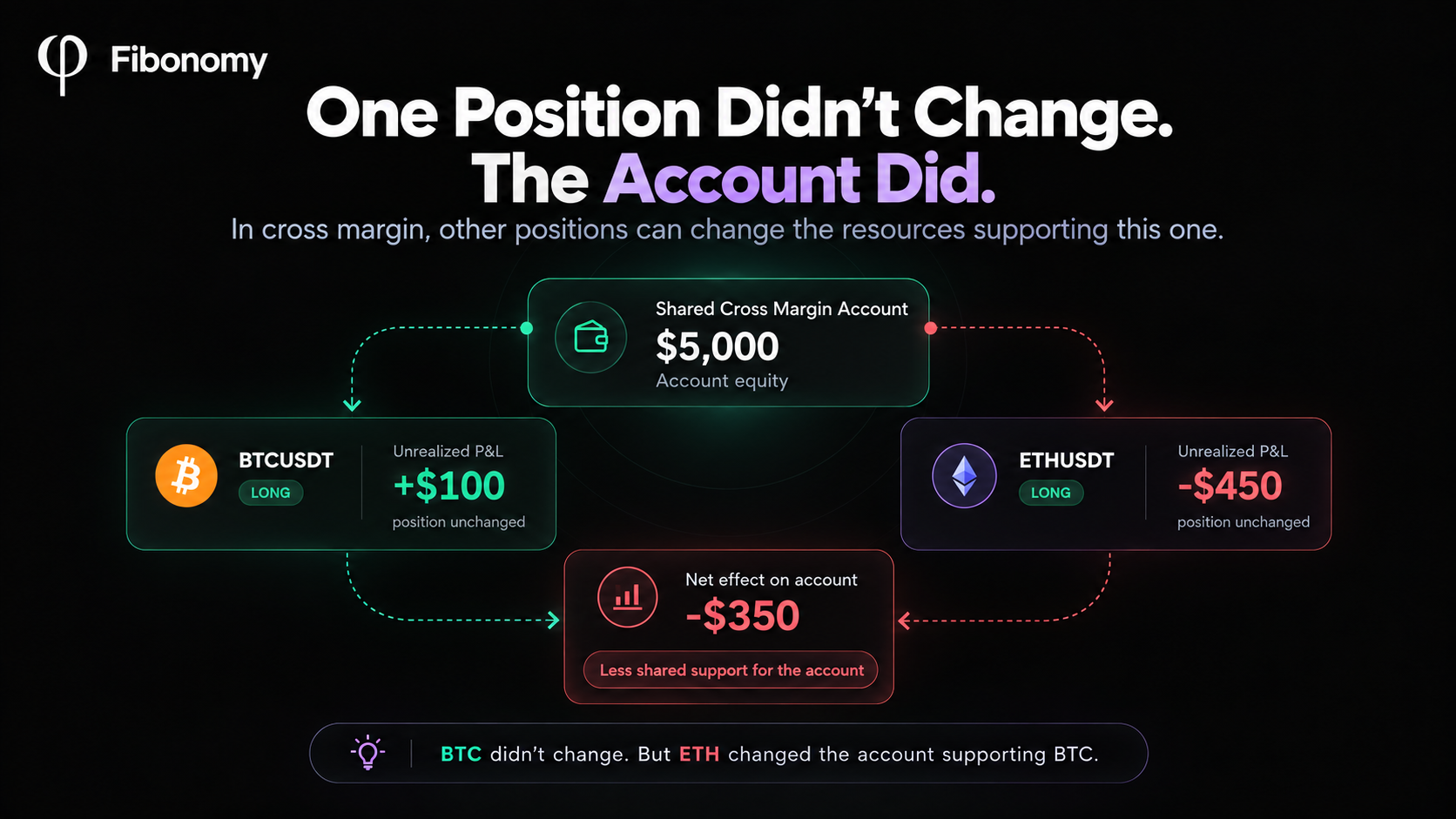
BTC has:
Unrealized P&L:
+$100
ETH has:
Unrealized P&L:
-$450
You are looking only at BTC.
BTC's size has not changed.
Its entry has not changed.
Its leverage has not changed.
But this is a Cross Margin account.
So the important system looks more like this:
  CROSS MARGIN ACCOUNT
                       $5,000
                          │
             ┌────────────┴────────────┐
             │                         │
             ▼                         ▼

       BTC POSITION              ETH POSITION

        UPL +$100                 UPL -$450
        unchanged                 unchanged

             │                         │
             └────────────┬────────────┘
                          │
                          ▼

                 NET OPEN-POSITION P&L

                       -$350

                          │
                          ▼

                 LESS ACCOUNT SUPPORT
The BTC position did not change.
The account supporting BTC did.
Bybit's current Unified Trading Account documentation explicitly defines Cross Margin Margin Balance at the account level as Wallet Balance plus perpetual/futures unrealized P&L, with collateral valuation also affecting the usable account value. Bybit
That is why Cross Margin should not be understood as:
Position A
has Account A

Position B
has Account B
It is closer to:
Position A ─┐
            │
Position B ─┼── Shared Account Resources
            │
Position C ─┘
For the liquidation side of this relationship:
What Actually Triggers Liquidation in Cross Margin?
and:
How Multiple Open Futures Positions Affect Your Liquidation Risk
Collateral Can Change Without the Futures Position Changing
This becomes more important in unified or multi-asset accounts.
Suppose your futures position is unchanged.
But part of the account collateral is BTC.
The BTC collateral itself falls in value.
Now the asset supporting your trading account is worth less.
There may also be a second layer: the exchange may apply a Collateral Value Ratio rather than recognizing 100% of the market value of every asset as margin.
Bybit currently states that supported collateral assets in Unified Trading Accounts are converted using index prices and collateral-value ratios. Its documentation also notes that those ratios can be updated as market conditions change. Bybit
Conceptually:
FUTURES POSITION
unchanged

        │

COLLATERAL ASSET VALUE
$10,000
   ↓
$9,000

        │

RECOGNIZED COLLATERAL
also changes

        │

MARGIN BALANCE
can change
Again:
The futures position did not change.
The resource supporting it did.
Initial Margin Can Change Even When Position Size Does Not
This depends on the exchange and margin mode.
OKX provides a particularly clear example.
For USDT-margined contracts in Cross Margin, OKX currently calculates Initial Margin using Mark Price and explicitly states:
initial margin fluctuates based on Mark Price in cross-margin mode. OKX
Consider:
Position:
0.10 BTC

Leverage:
10x
The position size remains:
0.10 BTC
But:
Mark Price
$60,000
   ↓
$65,000
Current notional changes from approximately:
$6,000
to:
$6,500
At the same leverage:
Initial Margin

$6,000 / 10
=
$600
versus:
$6,500 / 10
=
$650
The position quantity did not change.
The current value of the exposure did.
So the margin requirement changed.
This is one reason the sentence:
“I didn't change the position.”
is not enough to conclude:
“The required margin should not change.”
Maintenance Margin Can Move Too
Initial Margin answers roughly:
How much margin is required to support/open this exposure under the applicable rules?
Maintenance Margin answers a different question:
What minimum margin requirement must be satisfied to keep the position open?
On OKX, maintenance-margin calculations for futures incorporate factors including position size, maintenance-margin ratio, and Mark Price. OKX
CoinEx similarly states for USDⓈ-margined contracts:
Maintenance Margin
=
Mark Price
×
Position Amount
×
Maintenance Margin Rate
and its current position documentation says the risk rate can change in real time with Mark Price, orders, and account funds. CoinEx API Docs
So:
POSITION SIZE
same

        +

MARK PRICE
changed

        ↓

MAINTENANCE REQUIREMENT
can change
That is not necessarily money being deducted.
It can be a requirement changing.
Those are very different events.
Changing Leverage Can Change Margin Without Changing Exposure
Now suppose:
BTCUSDT LONG

Position Value:
$15,000
At:
10x
a simplified initial-margin relationship is:
$15,000
÷
10

=

$1,500
Now change leverage to:
20x
If position value remains $15,000:
$15,000
÷
20

=

$750
Position value:
$15,000
Position quantity:
unchanged
But margin requirement:
changed
OKX explicitly notes that increasing leverage on an existing position reduces the margin required to sustain it, while lowering leverage requires sufficient account funds to cover the increased requirement. OKX
This is the same distinction we explored in:
Why Changing Leverage Doesn't Always Change Risk the Way You Expect
LEVERAGE

≠

POSITION SIZE
Why “Margin Went Down” Can Mean Opposite Things
This is where the word margin becomes dangerous.
Consider two situations.
Situation A
Margin Balance

$5,000
↓
$4,700
because:
Unrealized Loss
-$300
That is generally a deterioration in account support.
Now consider:
Situation B
Initial Margin Requirement

$1,500
↓
$750
because leverage changed from:
10x
→
20x
The number also went down.
But the mechanism is completely different.
So:
MARGIN NUMBER
DOWN
does not tell you:
GOOD

or

BAD
until you know:
WHICH FIELD?
WHY?
WHAT CHANGED?
The direction of the number alone is not enough.
Cross Margin and Isolated Margin Can Tell Different Stories
Suppose you pay:
Funding:
-$20
In Cross Margin, that payment can affect shared account resources.
In Isolated Margin, the consequences can be more position-specific depending on the exchange's implementation.
Similarly:
If another position loses money, the effect depends on the margin mode.
In Cross Margin:
Shared account support can change
In Isolated Margin:
The loss on a separate position does not automatically use
the isolated margin allocated to another independent position.
The exact mechanics differ by platform. Reconstructing margin requires knowing the exchange, account type, and margin mode, not merely the symbol you traded.
A Futures Margin Decrease Can Come From Several Layers at Once
Real accounts rarely change one variable at a time. Suppose you start with:
BTCUSDT LONG
Size:             0.10 BTC
Entry:            $60,000
Leverage:         10x
Wallet Balance:   $4,000
Unrealized P&L:   $0
Margin Balance:   $4,000
Now several events happen.
Event 1: Price Moves Against You
BTC falls. Unrealized P&L becomes -$180. The position remains 0.10 BTC, but Margin Balance moves from $4,000 to $3,820.
Event 2: Funding Settles
You pay $8 in funding. Wallet Balance becomes $3,992. With the same -$180 unrealized P&L, Margin Balance is conceptually $3,812.
Event 3: You Place an Unfilled Add Order
You place a BUY BTC order at a lower price. It remains open. The current 0.10 BTC position is unchanged, but some account capacity may now be required or frozen for that order, reducing Available Margin.
Event 4: Mark Price Changes the Margin Requirement
On an exchange and account mode where current Mark Price feeds into the requirement:
Mark Price changes
        ↓
Position Notional changes
        ↓
Required Margin changes
You have now seen Wallet Balance, Margin Balance, Available Margin, and a margin requirement change while position size stayed at 0.10 BTC. Looking only at the position row cannot reconstruct the account.
A Full Timeline Is More Useful Than Two Screenshots
A trader often compares a screenshot showing $4,000 of margin with another showing $3,700 and asks, “Where did $300 go?” Two snapshots hide everything between them.
T0: Account starts at $4,000
    ↓
Mark Price moves
    ↓
Unrealized P&L: -$180
    ↓
Funding: -$8
    ↓
Open order reserves margin
    ↓
Margin requirement recalculates
    ↓
T1: Different account state
A screenshot gives you state. A timeline gives you cause. The final number may be the result of several independent events.
How to Reconstruct Why Your Futures Margin Changed
When you notice a futures margin decrease, do not begin with “The exchange took margin.” Start by identifying the field that moved.
| Field that changed | Events to check |
|---|---|
| Wallet Balance | Funding, fees, realized P&L, transfers |
| Margin Balance | Unrealized P&L, Wallet Balance, collateral valuation |
| Available Margin | Open orders, frozen funds, other positions, collateral |
| Initial or Maintenance Margin | Mark Price, leverage, position value, risk tier |
Then reconstruct the sequence:
Find the event → Find its timestamp → Compare before and after
→ Identify what changed → Identify what did not
That is the reconstruction.
A Practical Margin Reconstruction Checklist
When two account states do not match, inspect them in this order:
- Confirm the exact margin field that changed.
- Compare Mark Price and unrealized P&L.
- Check funding settlements between the two timestamps.
- Check trading commissions and realized P&L.
- Check open orders and frozen margin.
- Check whether another Cross Margin position changed.
- Check deposits, withdrawals, or internal transfers.
- Check collateral asset prices and collateral-value ratios.
- Check leverage changes.
- Check whether current notional or maintenance-margin requirements changed.
- Check whether the exchange moved the position into another risk or maintenance-margin tier.
- Reconstruct the sequence instead of comparing only the final values.
The point is not to memorize every exchange formula. It is to find the event that connects before to after.
Exchange Interfaces Can Show the Same Problem Differently
The same underlying idea can look different across exchanges.
- Binance: Margin Balance includes Wallet Balance plus unrealized P&L. Funding and commissions feed into Wallet Balance, while available-for-order calculations account for positions and orders. Binance
- Bybit UTA Cross Margin: Margin Balance includes Wallet Balance plus perpetual and futures unrealized P&L. Collateral assets are converted using index prices and collateral-value ratios. Bybit
- OKX Cross Margin: Initial Margin for USDT-margined futures can fluctuate with Mark Price. Maintenance requirements also depend on current position conditions. OKX
- CoinEx: Cross Margin Available incorporates Cross Margin Balance, unrealized P&L, allocated margin, and frozen margin. CoinEx API Docs
Different labels and formulas lead to the same diagnostic rule: identify the field before explaining the change.
The Better Question
Do not ask only, “Why did my margin go down?” Ask:
Which margin-related field changed, what event happened between the two account states, and which parts of my position or account did that event affect?
Position State → Account Event → Which Field Changed?
                                  ↓
Wallet? Margin Balance? Available Margin?
Initial Margin? Maintenance Margin?
                                  ↓
What caused it? What stayed the same? What changed next?
Now the margin move becomes an explainable event, not a mysterious number.
The Bottom Line
A futures margin decrease can happen while your position remains unchanged. A futures position is only one part of a larger account system.
Your position can keep the same size, entry, direction, and leverage while the account experiences unrealized loss, funding, trading fees, open-order commitments, losses in another Cross Margin position, collateral-value changes, Mark Price changes, or changing initial- and maintenance-margin requirements.
Do not treat “position unchanged” as proof that “margin must be unchanged.”
WHAT YOU HOLD
    +
WHAT HAPPENED
    +
WHAT THE ACCOUNT NOW HAS TO SUPPORT
    =
WHAT YOU SEE
When the number changes, reconstruct the event behind it. That is the difference between seeing your trading interface and understanding what happened inside it.
See What Changed Behind the Number
Fibonomy reconstructs the events around your futures positions—position changes, funding, fees, account exposure, margin state, and their effect on capital—so a changed number does not have to remain a mystery.
See your trading as it really is.
Not a signal. Margin terminology, formulas, collateral treatment, account structure, and liquidation mechanics vary by exchange, contract, account type, and margin mode.
Sources
- Binance — How to Check My Futures Account Balance?: Margin Balance, Wallet Balance, unrealized P&L, commissions, funding, and available-for-order calculations.
- Bybit — FAQ: Unified Trading Account: Cross Margin Margin Balance, Available Balance, unrealized P&L, and collateral treatment.
- Bybit — Unified Trading Account Asset Page: Equity, Margin Balance, Cross Margin, and unrealized futures P&L definitions.
- Bybit — Understanding Collateral Value Ratios in Unified Trading Account: How collateral asset prices and collateral-value ratios affect Margin Balance.
- OKX — Futures Margin Calculation Rules: Cross versus Isolated Margin, Initial Margin, Mark Price, open-order requirements, and leverage changes.
- OKX — Futures PnL Calculation Rules: Mark Price, unrealized P&L, Maintenance Margin, and position-level margin calculations.
- CoinEx — Get Balance in Futures Account: Cross Margin Balance, available margin, frozen balance, allocated margin, and unrealized P&L.
- CoinEx — Adjust Position Margin: Allocated margin, Mark Price, Maintenance Margin, risk rate, and Cross and Isolated position mechanics.