October 8, 2026Position Mechanics
What Happens When You Add to a Futures Position?
A filled add changes more than average entry. Follow a BTCUSDT example to see how position size, exposure, stop coverage, and margin can change.
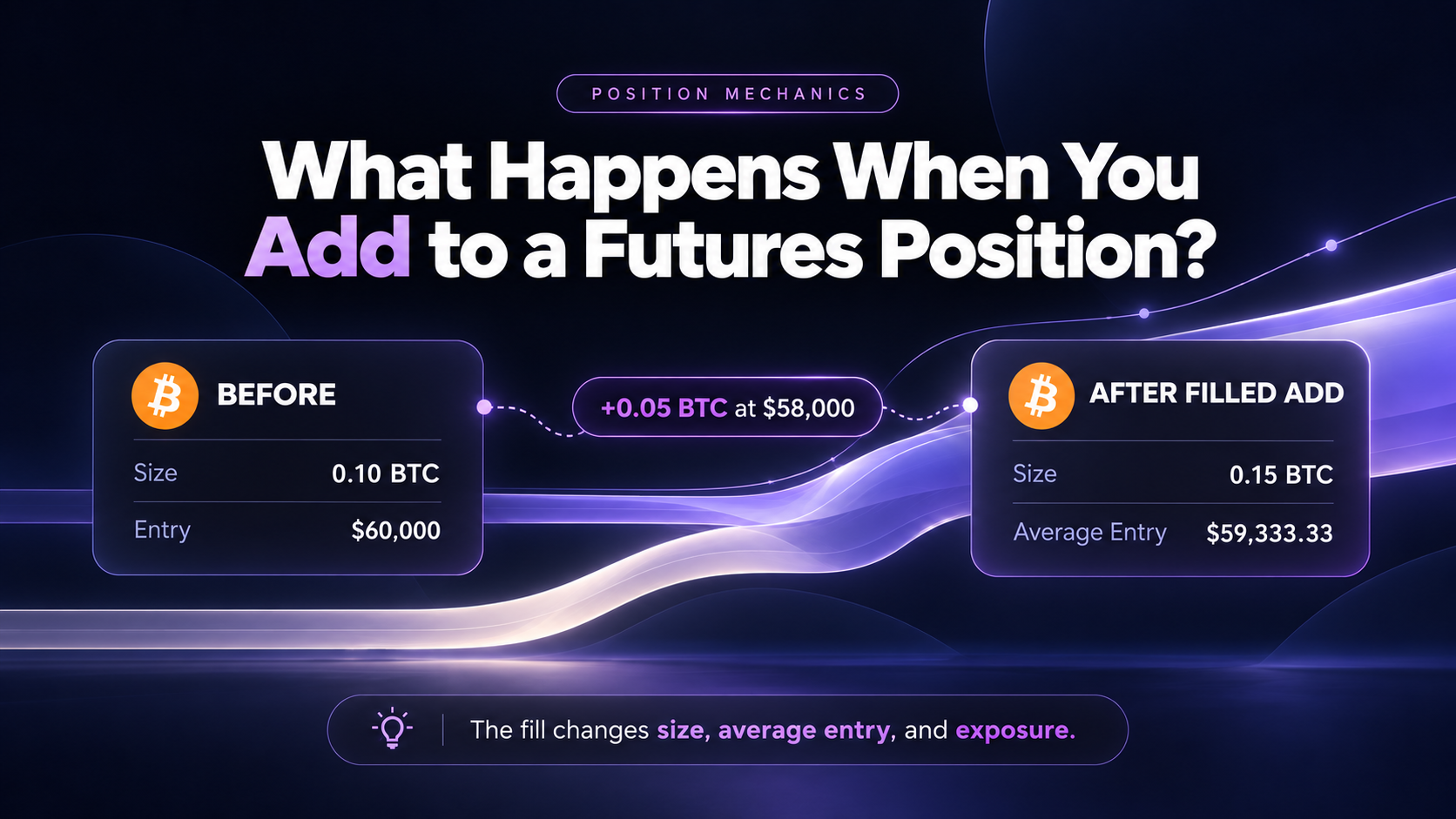
You are LONG BTCUSDT.
Your position shows:
Size:          0.10 BTC
Average entry: $60,000
BTC falls to $58,000. You place another buy order for the same contract.
Now the useful question is not only, “Did my average entry improve?” It is:
What changed between placing that order, getting a fill, and checking the position again?
An add can change size, average entry, exposure, P&L sensitivity, margin requirements, and the quantity covered by a protective order. Those changes do not necessarily appear at the same instant, and they do not all mean the same thing.
This guide follows one illustrative USDT-margined linear BTCUSDT long. Exchange behavior depends on the contract, position mode, margin mode, and order settings. The simple calculations below exclude fees, funding, slippage, and liquidation.
Quick Answer
When a same-direction add fills in a standard one-way position, its filled quantity joins the existing position. For a linear contract, the average entry is recalculated from fill quantities and prices. A larger quantity makes the next price move affect P&L more. The margin requirement may change, and a stop set for the old quantity may need attention.
ORDER PLACED
     ↓
ORDER FILLS
     ↓
POSITION SIZE CHANGES
     ↓
AVERAGE ENTRY AND EXPOSURE CHANGE
     ↓
MARGIN AND PROTECTION NEED A NEW CHECK
The distinction is between an order you intend to add and the quantity that has actually joined the position. A pending order may reserve margin without yet changing the filled position.
First: Did the New Order Actually Fill?
Imagine you enter a limit buy for 0.05 BTC at $58,000 while holding the original 0.10 BTC long. Before execution, the current position is still 0.10 BTC. The exchange may show the extra 0.05 BTC as an open order and reserve margin for it, but the filled position has not become 0.15 BTC.
Once the full order executes in the same direction, the position becomes 0.15 BTC in this one-way example. If only 0.02 BTC executes, the position becomes 0.12 BTC, not 0.15 BTC. The remaining 0.03 BTC is still pending or may be canceled.
Original position       0.10 BTC
Partially filled add   +0.02 BTC
                       ─────────
Current filled size     0.12 BTC

Remaining order         0.03 BTC, not yet in the position
That difference matters when you reconstruct risk. A screenshot of the order ticket tells you what was requested. The execution record and the live position tell you what happened.
Position mode also matters. In hedge mode, an exchange may keep long and short sides separately. An opposite-direction order may reduce a position or open the other side rather than add to the long. Check the executed side and the live position, not only the button you clicked.
A Filled Add Creates One Larger Position
For the rest of this example, assume the entire 0.05 BTC buy fills at $58,000. The position is a USDT-margined linear long, and the mark price remains $58,000 immediately after the fill.
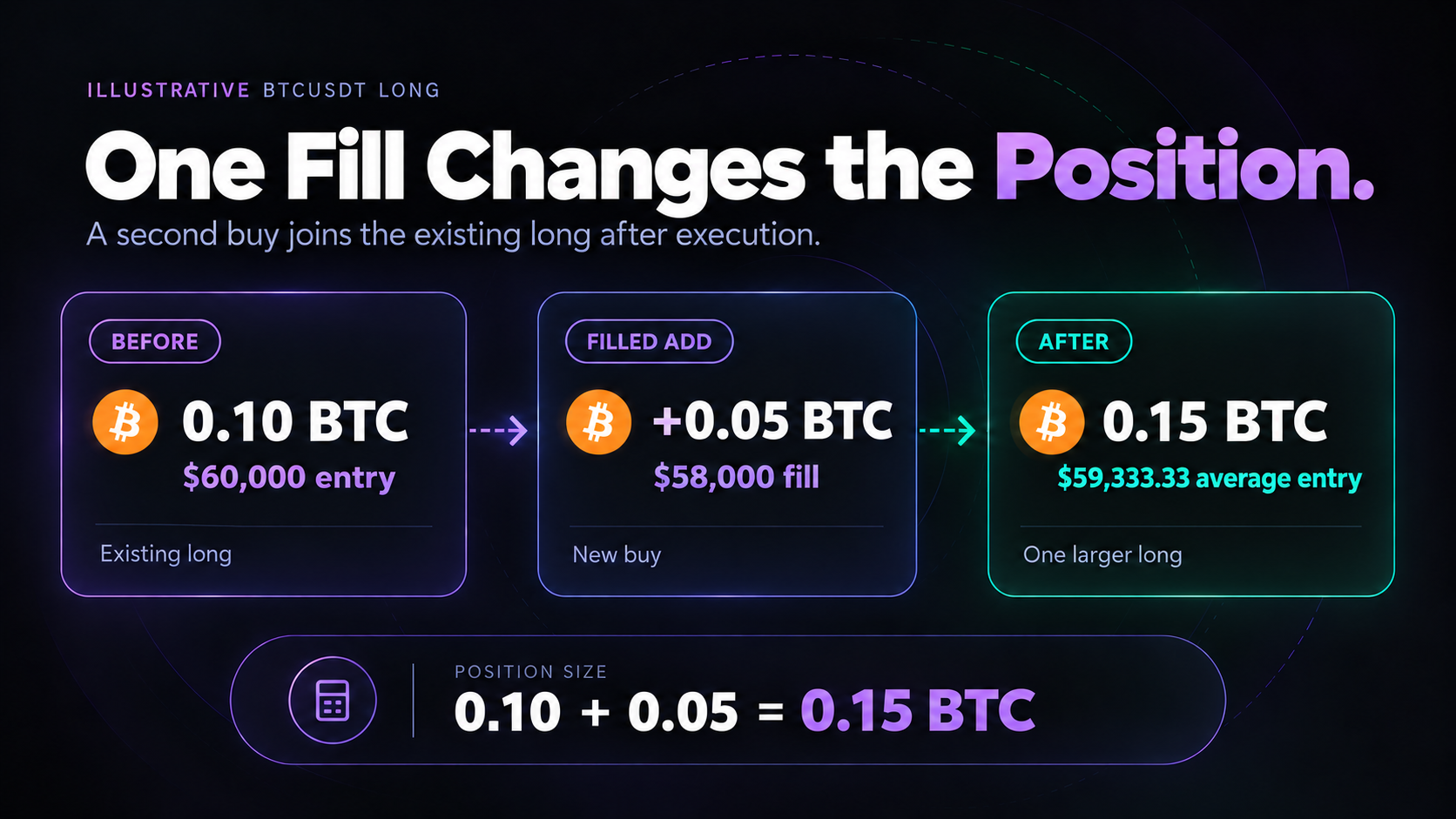
BEFORE
Long 0.10 BTC at $60,000

FILLED ADD
Buy 0.05 BTC at $58,000

AFTER
Long 0.15 BTC with a new average entry
The exchange generally represents those same-direction fills as one open position in one-way mode. You need the individual fills to explain the history; the combined row describes the current state.
The Average Entry Recalculates From the Fills
For this linear USDT-margined example, the quantity-weighted average entry is:
Original entry value   0.10 × $60,000 = $6,000
Added entry value      0.05 × $58,000 = $2,900
Total entry value                       $8,900

Total quantity          0.10 + 0.05 = 0.15 BTC
Average entry           $8,900 ÷ 0.15 = $59,333.33
The displayed entry falls from $60,000 to approximately $59,333.33. Bybit's average-entry documentation describes this quantity-weighted calculation for USDT perpetual and expiry contracts. It also documents different treatment for inverse contracts and some USDC settlement cases. Do not apply this one formula to every contract.
The lower average entry is a summary of two actual fill prices. It does not change the price of the first fill, undo an earlier loss, or tell you how much of the account is now at risk.
Why the Earlier Loss Does Not Disappear
At the $58,000 mark, the original 0.10 BTC long is approximately $200 down from its $60,000 entry. The new 0.05 BTC fill is executed at that same $58,000 reference price, so it starts with approximately zero price P&L.
Original fill: ($58,000 − $60,000) × 0.10 = −$200
Added fill:    ($58,000 − $58,000) × 0.05 =    $0
Approximate combined unrealized P&L       = −$200
The combined position can show a better average entry and the same approximate dollar loss immediately after the add. The numbers are consistent. The position now has more quantity, but the new quantity has not yet experienced a price move in this simplified instant.
The displayed P&L can differ if the fill price differs from the mark, the mark moves during execution, or the exchange includes other costs. Bybit's USDT-contract P&L guide explains how average entry and quantity enter its unrealized P&L calculation.
Also distinguish dollar P&L from a percentage figure. A percentage can change when the exchange changes the denominator after an add. A smaller-looking percentage loss does not prove the earlier dollar loss was recovered.
The Next Price Move Has a Larger Effect
The larger quantity changes sensitivity to the next BTC move. For this linear long, a $1,000 move in BTC corresponds to roughly:
Before the add: 0.10 BTC × $1,000 = $100 P&L change
After the add:  0.15 BTC × $1,000 = $150 P&L change
The position responds 50% more strongly because its quantity rose 50%. That applies in either direction, before fees and funding. An improved average entry describes the combined cost basis; it does not reduce the size of the next move's effect.
This is a different question from the one covered in What Happens to Liquidation Risk When You Add to a Futures Position?. That article focuses on liquidation and account risk. Here the first task is to reconstruct the event sequence and read each changed field correctly.
Position Value Rises Even if P&L Barely Moves
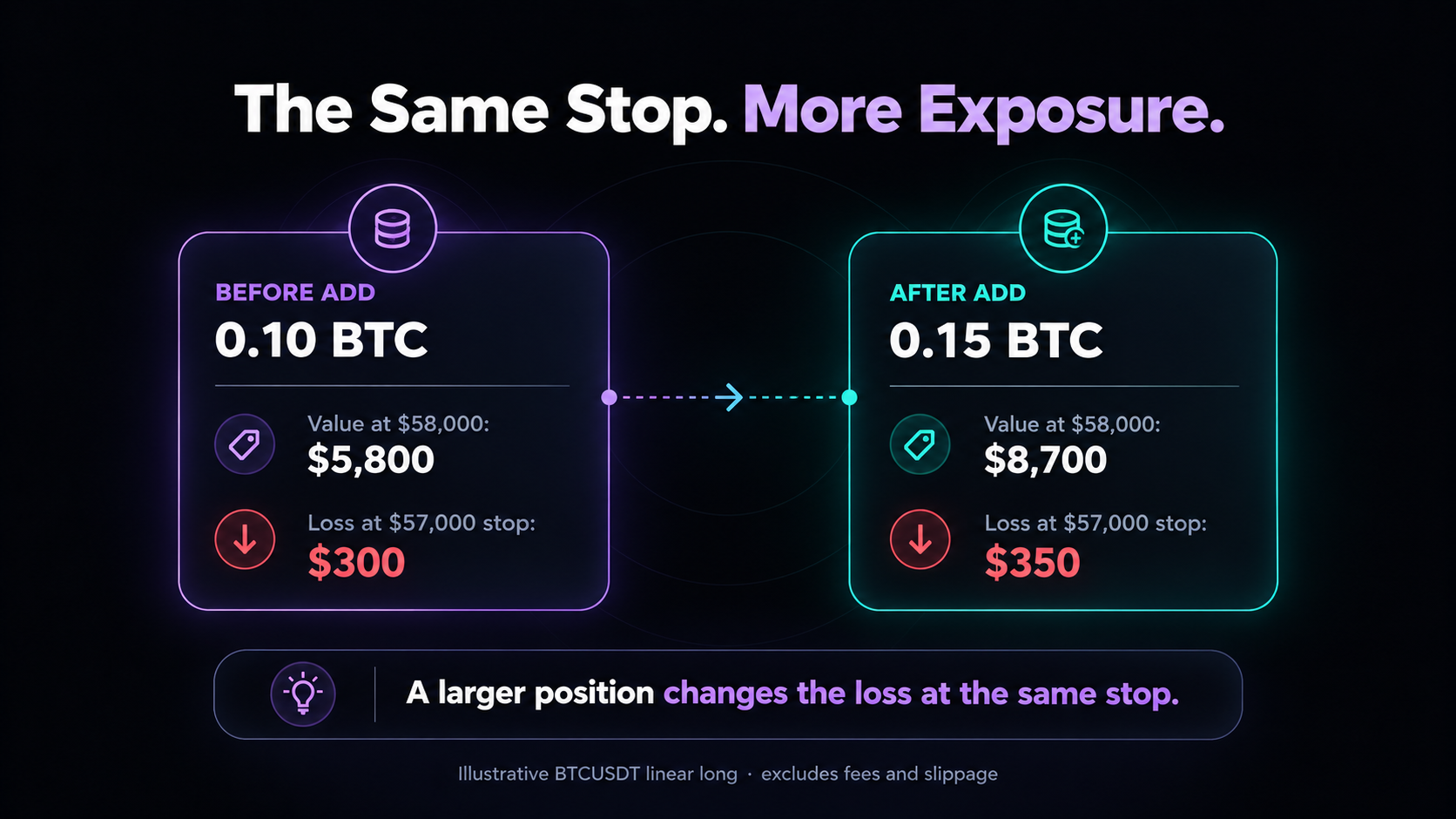
At a $58,000 mark, the position's simplified market value changes with its quantity:
Before: 0.10 BTC × $58,000 = $5,800
After:  0.15 BTC × $58,000 = $8,700
That is $2,900 more position value at the same mark. It is market exposure, not $2,900 of realized loss and not the amount of cash necessarily posted as margin.
Keep four numbers separate:
POSITION VALUE  How much market exposure exists now?
CURRENT P&L     What has the open position gained or lost so far?
MARGIN          What support does the exchange require or assign?
LOSS AT STOP    What loss might occur at a chosen protective exit?
For the account-wide version of that distinction, see How Much of Your Account Is at Risk Across Open Futures Positions?.
The Same Stop Price Can Mean a Different Planned Loss
Suppose the original long has a stop at $57,000. You add at $58,000 and leave the stop price unchanged. If a valid protective order covers the entire new position and executes at $57,000, the simplified loss measured from the fills is:
Original 0.10 BTC: ($60,000 − $57,000) × 0.10 = $300
Added    0.05 BTC: ($58,000 − $57,000) × 0.05 =  $50
Estimated combined loss                         = $350
Before adding, the same stop implied about $300 of loss. After adding, it implies about $350. The stop price did not move; the position size did.
That is why a trader can see a better average entry and still have more capital exposed to the planned exit. The calculation is an estimate. Fees, funding, trigger choice, slippage, gaps, and liquidation can change the actual result.
Check the Stop's Quantity, Not Only Its Price
The calculation above assumes the stop covers 0.15 BTC. But the live protective order may still cover only the original 0.10 BTC if it was created as a fixed partial-quantity order. In that case, 0.05 BTC may remain outside that order.
Some exchange settings track the entire position and adjust protective quantity as size changes; others use a set quantity. Bybit, for example, distinguishes entire-position and partial-position TP/SL behavior in its TP/SL documentation. Do not assume your exchange or order type behaves identically.
After the fill, inspect:
- the stop's live covered quantity;
- its trigger price and trigger reference;
- whether it is set for the whole position or a partial amount;
- whether the order remains active after the position changes.
An order can trigger yet execute at a different price. A stop is a protective plan, not a guarantee that the maximum realized loss will equal the neat calculation above.
Margin Requirements Need a New Check
The new quantity can require more initial margin and more maintenance margin. How much depends on leverage settings, margin mode, contract specifications, mark price, and the exchange's rules. The $2,900 increase in position value is not itself the extra margin required.
The exchange may also consider active orders. Before an add fills, reserved margin for the open order can affect available balance. After it fills, the larger live position can change margin requirements. Those are different events at different times.
If position and order value cross a risk-limit tier, the applicable maintenance requirement may change as well. Bybit's risk-limit documentation describes how its tiers relate to position and active-order value. A tier change is exchange- and account-specific; it cannot be inferred from average entry alone.
Liquidation Does Not Follow a Universal Direction
Averaging down moves the entry toward the current price in this example. That does not, by itself, tell you whether the liquidation condition became safer or more dangerous.
In isolated margin, allocated margin and maintenance requirements matter. In cross margin, shared account equity, other positions, unrealized P&L, and open orders may also affect the account. Bybit's liquidation FAQ describes its cross-margin displayed liquidation price as a dynamic reference; account maintenance margin rate governs liquidation in that setup.
AVERAGE ENTRY CHANGED
             ≠
LIQUIDATION RISK KNOWN
Read the exchange's recalculated margin and liquidation fields after the fill. Then connect them to the position and account changes that occurred. For a deeper treatment of this part of the question, read What Happens to Liquidation Risk When You Add to a Futures Position?.
Adding Contracts Is Different From Adding Margin
The phrase “I added more” can describe two different actions.
ADD TO POSITION
Another same-direction contract fill
→ quantity and market exposure change

ADD MARGIN
More collateral supports the position
→ quantity does not change by itself
Both may affect the account display and liquidation state. Only the first action increases the 0.10 BTC position to 0.15 BTC in this example. If the outcome looks surprising, identify whether the event was a fill, a collateral transfer, or only a pending order before interpreting the changed numbers.
A Complete Before-and-After Timeline
The same trade can look different at three moments. Suppose the 0.05 BTC order is placed at $58,000, fills in full, and the mark stays at $58,000 for this illustration.
T0 — BEFORE THE ORDER
Filled size:        0.10 BTC
Average entry:      $60,000
Mark:               $58,000
Unrealized P&L:     about −$200
Loss at $57k stop:  about $300 if fully covered

T1 — ORDER OPEN, NOT FILLED
Filled size:        still 0.10 BTC
New order:          0.05 BTC pending
Available margin:   may change as margin is reserved
Loss at $57k stop:  still about $300 on filled size

T2 — ORDER FILLED
Filled size:        0.15 BTC
Average entry:      about $59,333.33
Mark:               $58,000
Unrealized P&L:     still about −$200 before costs
Loss at $57k stop:  about $350 if all 0.15 BTC is covered
The pending order changes a possible future commitment. The fill changes the actual position. Then you must check whether protection and account support changed with it. A single final position row cannot show the entire sequence.
What to Inspect After an Add Fills
Rebuild the event from records, not memory.
- Execution: How much filled, at what price, and when? Was any quantity left open?
- Position side and size: Did the fill join the intended long or short under the current position mode?
- Average entry: Does the contract-specific calculation explain the displayed figure?
- Mark and P&L: Did price move between the fill and the screenshot? Are fees or funding included?
- Position value: How much exposure now responds to the next price move?
- Protective order: Does its current quantity cover the whole filled position at the intended trigger?
- Margin and account: Did required margin, available balance, tier, or liquidation state change?
Fibonomy's current product overview presents position-size, leverage, and protection changes with capital at risk. A history of those events helps explain when the position became larger. The latest average entry alone cannot show that path.
The Better Question
After adding, it is natural to ask:
“Is my new average entry better?”
It may be. But that is only one field.
The more useful review is:
“What filled, what changed in the position, and does my protection still cover the position I now hold?”
Compare the filled size, average entry, stop quantity, estimated loss to that stop, and account margin state before and after the event. Those are the numbers that tell the position's story.
The Bottom Line
When you add to a futures position, a pending order and a filled add have different effects. Once a same-direction add fills in a one-way linear position, quantity rises and average entry is recalculated. The earlier loss does not vanish. The next price move affects more quantity, the same stop price can imply a larger planned loss, and the live stop may need its covered quantity checked.
The exact margin and liquidation outcome is exchange- and account-specific. Recalculate it from the live position and account after the fill rather than inferring it from the new average entry.
See What Changed
The latest position size is the end of the story. See the sequence of position and protection changes with Fibonomy, alongside their account context and capital at risk.
Perpetual futures can produce rapid losses and liquidation. This article explains position and margin mechanics; it is not personalized trading or investment advice.