September 14, 2026
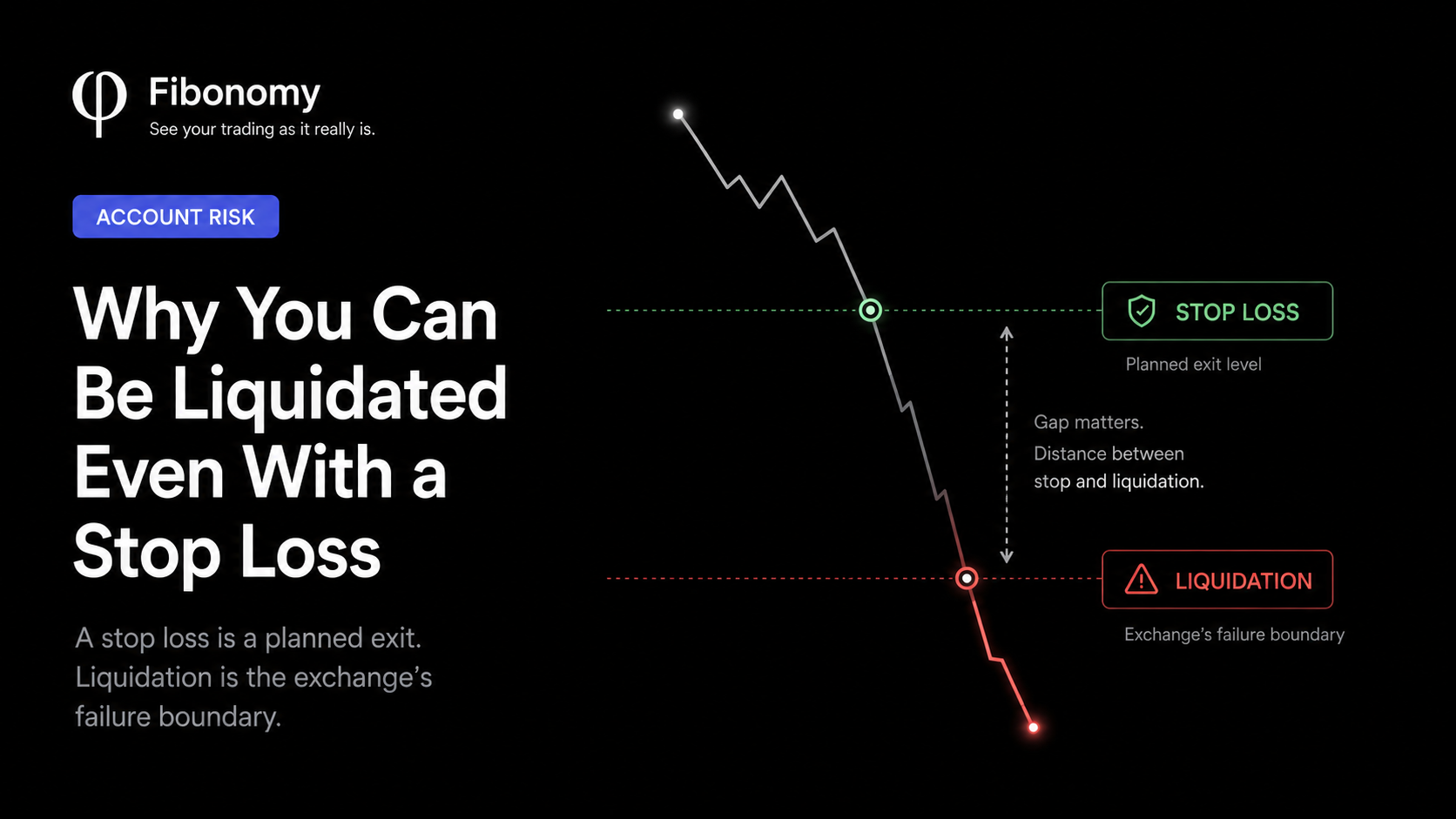
Why You Can Be Liquidated With a Stop Loss
Home – Position & Account Risk – Why You Can Be Liquidated With a Stop Loss
You set a stop loss.
You calculated your maximum loss.
You expected the position to close if the market moved against you.
Then something unexpected happens.
Your position is liquidated.
The first question most traders ask is:
“How could I be liquidated? I had a stop loss.”
The confusing part is that both events can happen around the same market move, but they are triggered by completely different systems.
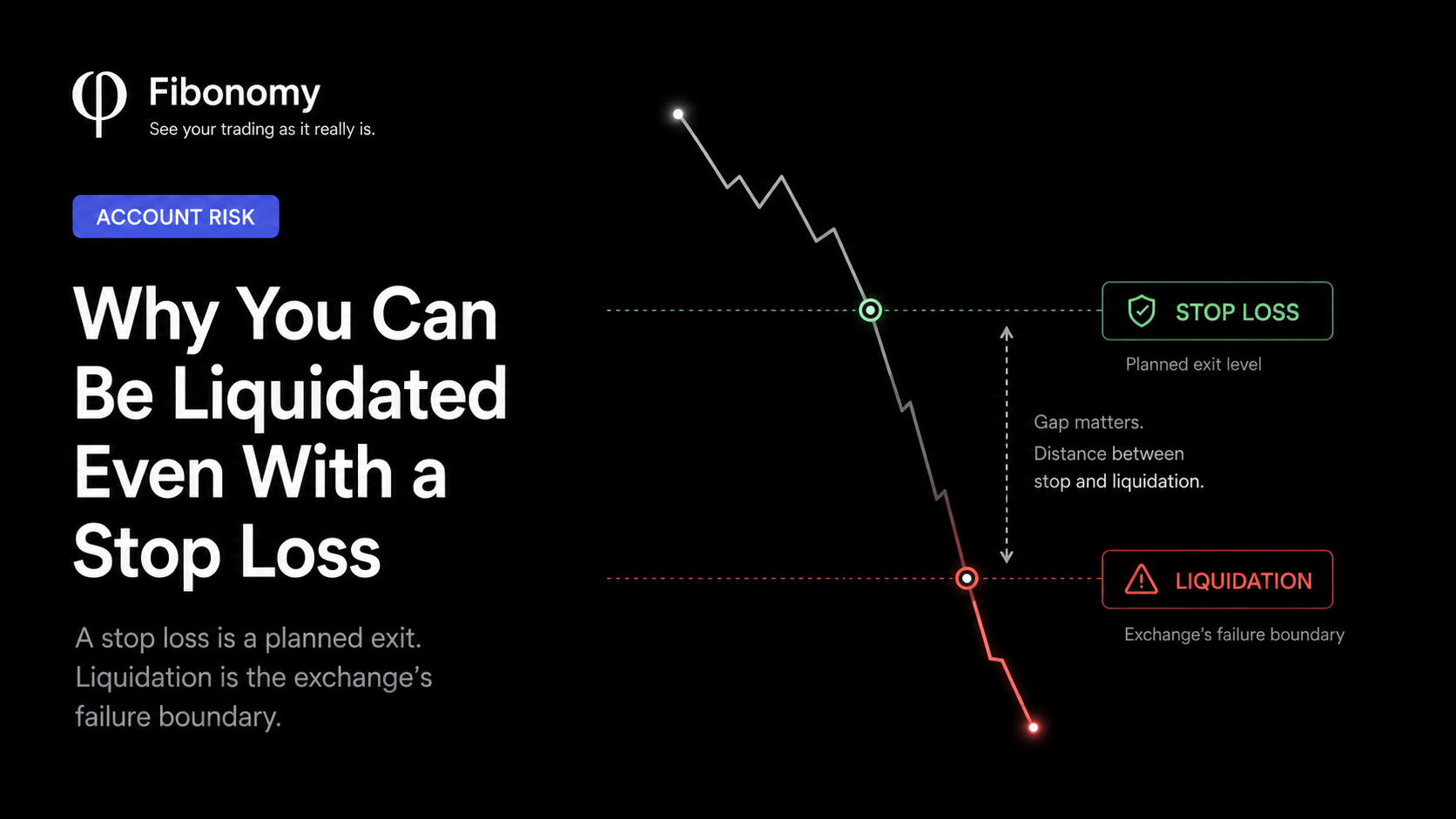
A stop loss is your decision.
Liquidation is the exchange protecting its risk system.
Understanding the difference is the first step toward understanding what actually happened inside your account.
Quick Answer
Yes, you can be liquidated with stop loss protection.
A stop loss reduces risk, but it does not guarantee that liquidation cannot happen first.
This can happen when:
- the liquidation threshold is reached before the stop executes,
- the Mark Price moves differently from the chart price,
- the market moves faster than the order can fill,
- slippage creates a larger loss than expected,
- position size creates excessive account exposure,
- cross margin effects from other positions reduce available equity,
- extreme volatility changes execution conditions.
The simple relationship:
Stop Loss
↓
Your planned exit
Liquidation
↓
Exchange forced exit
A stop loss answers:
“Where do I want to exit?”
Liquidation answers:
“Can this account still support this position?”
Table of Contents
- Quick Answer
- A Stop Loss Does Not Equal Maximum Loss
- Stop Loss and Liquidation Are Different Mechanisms
- Why You Can Be Liquidated With Stop Loss Protection
- Mark Price vs Last Price: The Hidden Difference
- Your Stop Loss Can Trigger Too Late
- Slippage Can Change the Actual Risk
- Position Size Can Make a Stop Loss Misleading
- Cross Margin Makes Stop Loss Risk More Complex
- Extreme Market Conditions Change Everything
- A Stop Loss Is Not Complete Risk Management
- How to Review a Liquidation That Happened Before Your Stop Loss
- 1. What price triggered liquidation?
- 2. When did the stop activate?
- 3. What was your margin mode?
- 4. What was your actual execution price?
- 5. What changed in your account?
- The Better Question
- The Bottom Line
- See What Actually Happened Inside Your Position
- Sources
A Stop Loss Does Not Equal Maximum Loss
Many traders think:
“I placed a stop loss, so my risk is fixed.”
That assumption is incomplete.
A stop loss only works if:
- The trigger condition is reached.
- The order activates.
- The order gets filled.
- The position still exists.
The real sequence is:
Market Movement
↓
Stop Trigger
↓
Order Execution
↓
Position Closed
Between these events, the market can continue moving.
The final result depends on what happens during that chain.
A stop loss is a protection mechanism.
It is not a guarantee.
Stop Loss and Liquidation Are Different Mechanisms
A stop loss and liquidation are often confused because they can happen near the same price.
But they belong to different systems.
| Stop Loss | Liquidation |
|---|---|
| Created by trader | Triggered by exchange |
| Planned exit | Forced exit |
| Based on chosen trigger | Based on margin requirements |
| Attempts to limit loss | Protects exchange from account deficit |
Example:
BTC Long
Entry:
$60,000
Position Size:
$20,000
Stop Loss:
$58,000
Liquidation Price:
$57,500
At first glance:
Stop Loss
↓
Liquidation
Everything looks safe.
But the original numbers are not frozen.
The account state can change because of:
- price movement,
- unrealized P&L,
- funding,
- fees,
- other positions.
Why You Can Be Liquidated With Stop Loss Protection
The important question is not:
“Did I have a stop loss?”
The better question is:
“What happened between my planned exit and the exchange’s forced exit?”
Because liquidation is usually not caused by one number.
It is the result of several connected events.
Mark Price vs Last Price: The Hidden Difference
One of the biggest reasons traders are confused is that the price shown on the chart is not always the price used for liquidation.
Many futures exchanges use Mark Price rather than only Last Price when evaluating liquidation conditions.
The difference:
Last Price
=
Latest traded market price
Mark Price
=
Exchange risk calculation price
Example:
BTC Last Price:
$60,000
BTC Mark Price:
$59,600
Your chart may show:
No stop loss triggered
But the exchange may evaluate:
Margin requirement is no longer satisfied
because liquidation calculations use a different price mechanism.
This becomes especially important during:
- high volatility,
- low liquidity,
- sudden market moves.
The chart price is not always the same price the exchange uses for liquidation calculations. That difference can matter in fast markets.
Your Stop Loss Can Trigger Too Late
Even if your stop condition is correct, execution is not guaranteed at exactly that price.
A stop order becomes an executable order after triggering.
The final fill depends on:
- available liquidity,
- market depth,
- volatility,
- order type.
Example:
You set:
BTC Stop Loss:
$60,000
The market moves quickly:
$60,000
↓
$59,400
↓
$58,900
Your final execution may happen around:
$59,400
instead of:
$60,000
The difference is called slippage.
Slippage Can Change the Actual Risk
Imagine:
Account:
$5,000
Position:
$25,000 BTC Long
Planned stop:
-$500
Expected account impact:
10%
But during a fast move:
Actual loss:
-$850
The stop existed.
The problem was the distance between expected execution and actual execution.
This is why reviewing only the stop price is incomplete.
You need the full event chain.
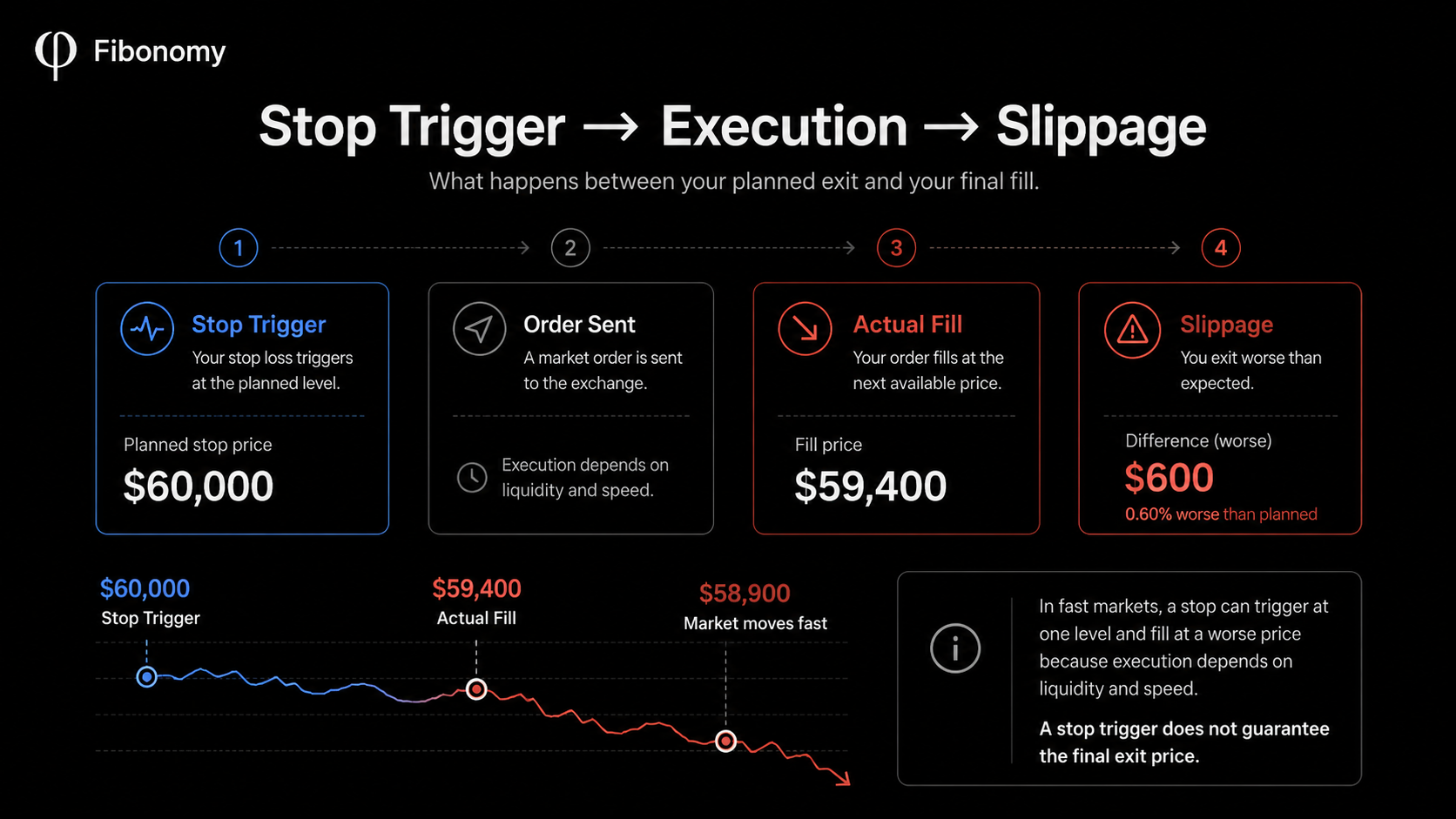
A stop loss trigger does not guarantee the final exit price. Execution depends on liquidity, market speed, and available prices.
Position Size Can Make a Stop Loss Misleading
A stop loss percentage alone does not tell the real account risk. Sizing up can widen that gap further — see What Happens to Liquidation Risk When You Add to a Futures Position?.
Example:
Account Equity:
$10,000
Position:
$100,000
Stop Distance:
2%
Many traders see:
Only 2%
But the actual calculation is:
Position Size
×
Price Movement
=
Potential Loss
Therefore:
$100,000 × 2%
=
$2,000 Loss
Which equals:
20% of Account Equity
The stop loss existed.
The problem was position size.
Cross Margin Makes Stop Loss Risk More Complex
In isolated margin:
Position
↓
Dedicated Margin
Risk is mostly contained.
In cross margin:
Account Equity
↓
Multiple Positions
↓
Shared Risk
A different position can change the account state.
Example:
BTC Long
Stop Loss Risk:
-$300
ETH Long
Unrealized Loss:
-$900
Even if BTC has not reached its stop:
Account Equity ↓
Margin Buffer ↓
Liquidation Risk ↑
For more detail on how open positions share account equity, see How Multiple Open Futures Positions Affect Your Liquidation Risk.
To measure planned capital at risk across those positions, see How Much of Your Account Is at Risk Across Open Futures Positions?.
For the account-level trigger itself, see What Actually Triggers Liquidation in Cross Margin?.
Extreme Market Conditions Change Everything
Under normal conditions:
Stop Trigger
↓
Execution
↓
Position Closed
During extreme volatility:
Fast Market Move
↓
Liquidity Changes
↓
Slippage
↓
Margin Deterioration
↓
Possible Liquidation
This does not mean stop losses are useless.
It means they operate inside a larger system.
A Stop Loss Is Not Complete Risk Management
A stop loss answers:
“Where do I exit?”
Risk management answers:
“How much of my account is exposed?”
These are different.
You can have:
Perfect Stop Loss Placement
Oversized Position
=
High Account Risk
Or:
Reasonable Position Size
Poor Exit Planning
=
Different Risk
A complete picture requires both.
How to Review a Liquidation That Happened Before Your Stop Loss
If you were liquidated despite having a stop loss, review these events:
1. What price triggered liquidation?
Check:
- Mark Price
- Last Price
- Index Price
2. When did the stop activate?
Compare:
Stop Trigger Time
vs
Liquidation Time
3. What was your margin mode?
Was it:
- Isolated Margin
- Cross Margin
4. What was your actual execution price?
Compare:
Expected Stop Price
vs
Actual Fill Price
5. What changed in your account?
Review:
- Unrealized P&L
- Funding
- Fees
- Other positions
- Available margin
The Better Question
Instead of asking:
“Why didn’t my stop loss save me?”
ask:
“What happened between my planned exit and the exchange’s forced exit?”
That question reveals the real chain.
Because liquidation is rarely one event.
It is usually:
Position Size
Market Movement
Margin Mode
Execution Conditions
Account State
=
Liquidation Outcome
The Bottom Line
A stop loss is one of the most important protection tools in futures trading.
But it does not make liquidation impossible.
You can still be liquidated with stop loss protection because:
- Mark Price differs from chart price,
- execution can happen later than expected,
- slippage can increase losses,
- position size can create excessive exposure,
- cross margin can change account-level risk,
- extreme volatility can break normal assumptions.
The goal is not only to place a stop loss.
The goal is to understand the complete state of your position before the exchange makes the decision for you.
Related reading: Why Does My Liquidation Price Keep Changing in Cross Margin? and Can Funding Fees Move Your Liquidation Price?.
See What Actually Happened Inside Your Position
Fibonomy reconstructs what changed inside your positions—price movement, funding, margin changes, risk exposure, and account impact—so you can understand what actually happened.
See What Changed Inside Your Position →
Sources
- Binance Futures Documentation — Mark Price and Liquidation Mechanicshttps://www.binance.com/en/support/faq
- Bybit Help Center — Liquidation Process and Mark Pricehttps://www.bybit.com/en/help-center/
- OKX Help Center — Futures Liquidation and Risk Managementhttps://www.okx.com/help