October 17, 2026Position & Account Risk
Crypto Futures Account Risk: How Your Open Positions Actually Affect Your Account
Understand how open futures positions affect account resources, margin and protection—with a worked example that separates current loss from further downside.
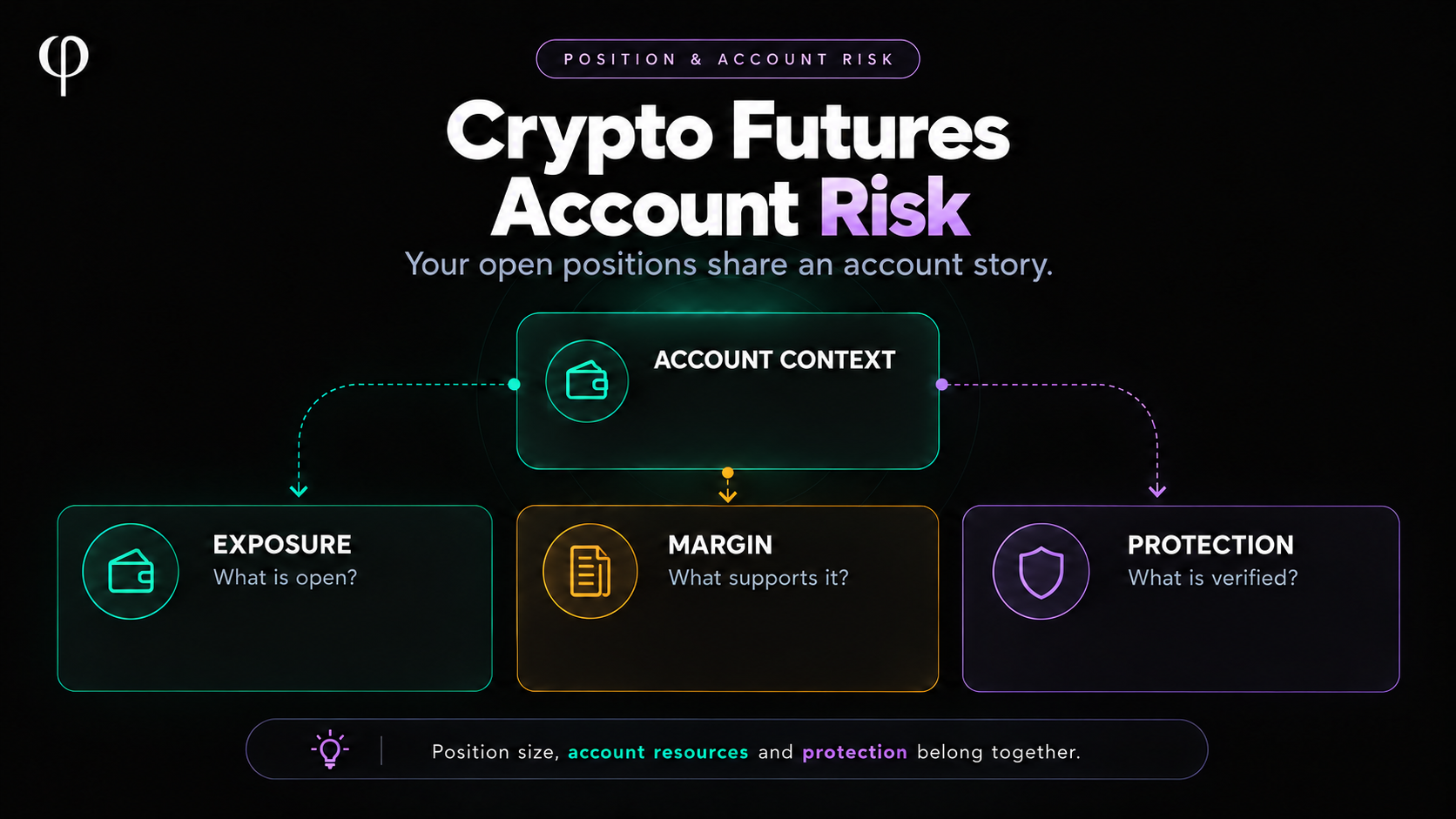
Your BTC position looks manageable. Your ETH position looks manageable too. Each has a stop, and neither uses the full balance shown in your futures wallet.
Then both markets move against you. The account's margin balance falls, available funds change, and the protection you checked on each individual position no longer explains the whole picture.
Crypto futures account risk starts with the relationship between open exposure, the resources supporting it, and the protection you can verify. A leverage label or a count of open positions cannot describe that relationship on its own.
This guide connects those pieces, using a worked account example and links to our detailed guides on liquidation, funding, stops, leverage, and position changes.
Quick Answer
Open futures positions affect an account through several channels: unrealized P&L, margin requirements, fees and funding, pending-order commitments, and changes in size or protection.
Start with three separate questions:
- What exposure is open, and in which account and margin mode?
- What balances and requirements currently support that exposure?
- Which loss scenarios can be calculated from verified protection, and which remain unknown?
A stop-based estimate is a scenario under assumptions. It is not a guaranteed maximum loss or the exchange's liquidation ratio. A position without verifiable protection should remain visible as unknown exposure rather than quietly contributing zero to a total.
1. Start With the Account Boundary
Before adding up positions, identify the exchange, account or subaccount, settlement assets, margin mode, and the balances actually available to support those positions.
Two positions visible on the same screen do not necessarily share the same margin resources. Conversely, two different symbols can draw on shared account resources under cross margin.
Do not combine balances from separate accounts into an apparent safety buffer unless the relevant funds are actually available under the exchange's rules. A transfer you could make later is different from collateral already supporting the position.
For this article's calculations, assume a simplified single-asset USDT futures account. There are no transfers, other assets, pending orders, settlement adjustments, or fees during the initial snapshot. These restrictions make the arithmetic inspectable; a real account needs its own definitions.
2. Separate Exposure, Margin, and Potential Loss
Exposure describes what contracts are open. For a linear position, quantity multiplied by current mark price gives a simple notional value.
Margin describes the resources and requirements involved in holding those contracts. Initial margin, maintenance margin, wallet balance, margin balance, and available balance answer different questions.
Potential loss requires a scenario or another explicit measurement basis. It cannot be read directly from notional value or initial margin alone.
For example, a position can have a large notional value but a relatively close proposed exit. That does not make its loss limited to the amount estimated at that exit, because execution and liquidation conditions still matter.
Keep the three descriptions alongside each other. Calling all of them “risk” without defining the number can create more confusion than a missing metric.
3. Read the Balance Labels Before Comparing Them
Binance's official futures account-balance guide distinguishes wallet balance, margin balance, and funds available for orders. It describes margin balance as wallet balance plus unrealized P&L, with unrealized P&L based on mark price.
The corresponding account API documentation exposes separate balance and margin fields. Their presence does not make them interchangeable.
When a value falls, first establish which field moved. An unrealized loss, a funding payment, and an additional order commitment can affect the account through different mechanisms.
Our guide Why Did My Futures Margin Decrease Without Changing My Position? explains that diagnostic distinction in more detail.
4. Work Through a Two-Position Account
Assume the simplified account has a 5,000 USDT wallet balance and these two open linear longs:
| Position | Quantity | Entry | Current mark | Gross unrealized P&L |
|---|---|---|---|---|
| BTCUSDT long | 0.10 BTC | 60,000 | 59,000 | −100 USDT |
| ETHUSDT long | 2 ETH | 3,000 | 2,900 | −200 USDT |
BTC unrealized P&L = 0.10 × (59,000 − 60,000) = −100 USDT
ETH unrealized P&L = 2 × (2,900 − 3,000)       = −200 USDT

Margin balance = 5,000 − 100 − 200
               = 4,700 USDT
Nothing in this calculation says either position has closed. The open losses already affect the account's current mark-to-market value under the example's balance model.
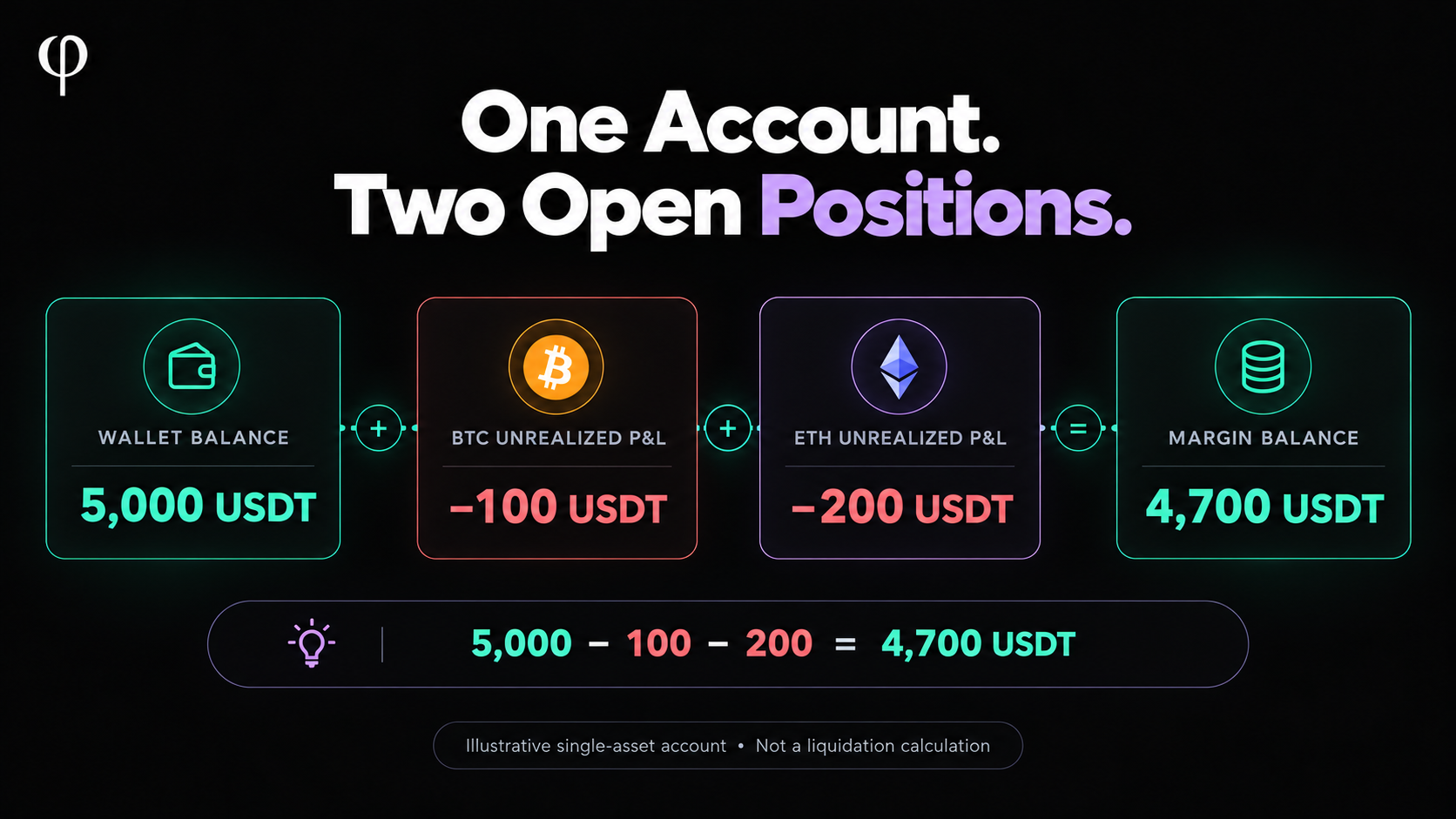
Illustrative single-asset snapshot. This is a balance reconciliation, not a liquidation calculation.
5. Gross Notional Shows a Different Part of the Picture
At the same marks, the open position values are:
BTC notional = 0.10 × 59,000 = 5,900 USDT
ETH notional = 2 × 2,900     = 5,800 USDT

Gross open notional = 11,700 USDT
The account has 11,700 USDT of gross long notional and a 4,700 USDT margin balance in this simplified snapshot. Neither figure is the amount already lost, the amount of margin reserved, or a verified maximum future loss.
Notional is still useful: it describes the scale of exposure to price movement. Keep quantities and directions visible too, especially when several contracts have different units or settlement models.
Bybit's USDT contract P&L guide explains the role of quantity and price movement in linear P&L. Do not apply these calculations unchanged to inverse or differently settled contracts.
6. Calculate Further Loss From the Current Snapshot
Now assume historical/current order evidence confirms stops covering the full remaining quantities: BTC at 58,000 and ETH at 2,800. For this scenario only, assume both positions can exit exactly at those levels.
The additional gross price loss from the current marks would be:
BTC: 0.10 × (59,000 − 58,000) = 100 USDT
ETH: 2 × (2,900 − 2,800)     = 200 USDT

Modeled further loss = 300 USDT
300 ÷ 4,700 × 100    = 6.38% of current margin balance
Under those assumptions and excluding costs, the account would move from 4,700 to 4,400 USDT. The 6.38% figure is our stated scenario percentage, not an exchange maintenance-margin ratio or a Fibonomy product calculation.
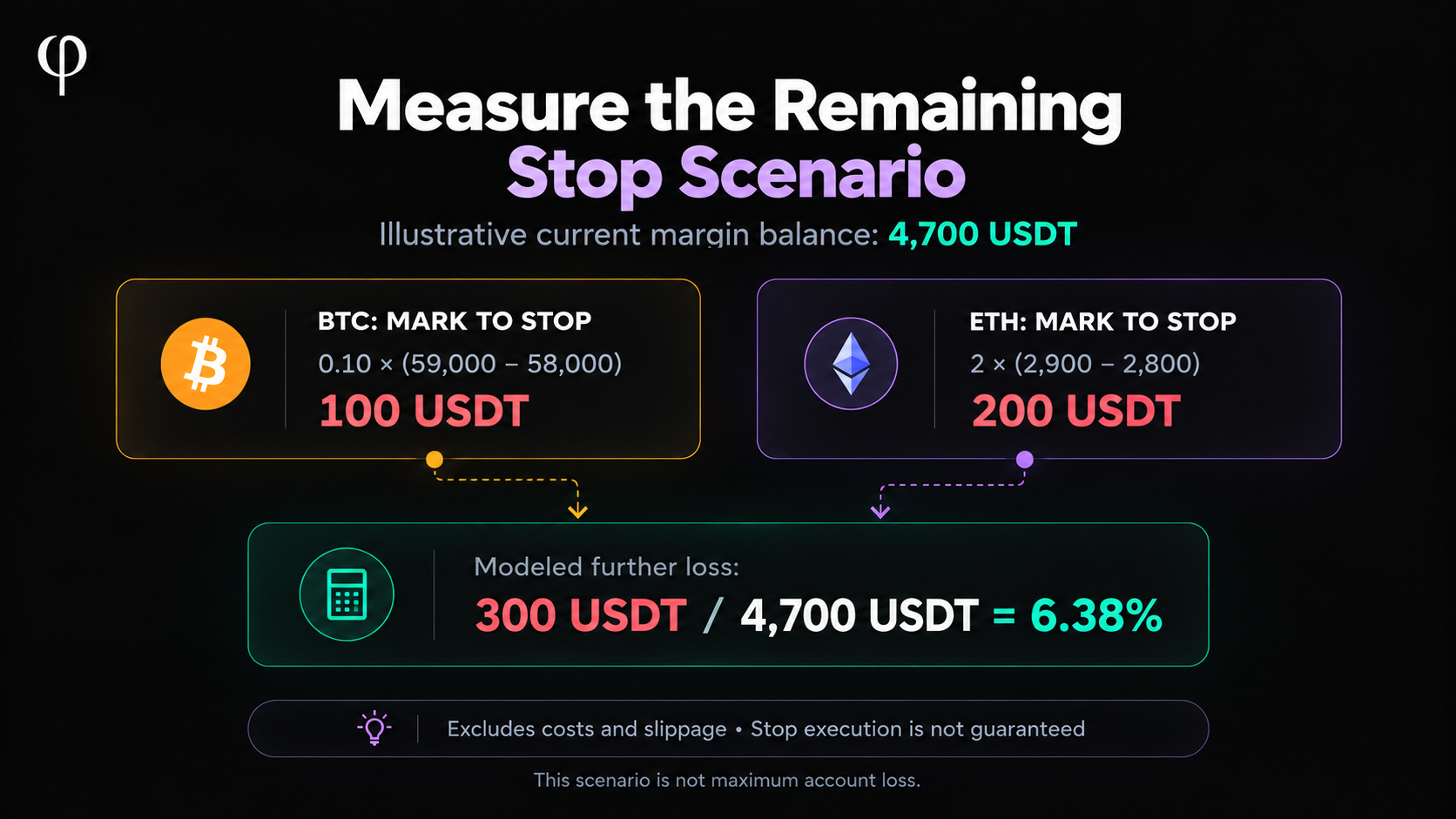
Hypothetical stop execution at the stated levels. Fees, funding, slippage, and liquidation effects are excluded; execution is not guaranteed.
7. Do Not Count the Existing Loss Twice
From the original entry prices to the same stops, the gross lifecycle price losses would be 200 USDT on BTC and 400 USDT on ETH: 600 USDT in total.
That 600 includes the 300 USDT of unrealized loss already reflected in the current 4,700 balance. Subtracting the full 600 again from 4,700 would double-count that existing loss.
Original wallet basis: 5,000 − 600 = 4,400 USDT
Current mark basis:    4,700 − 300 = 4,400 USDT
Both routes agree when the basis is consistent. A loss-from-entry percentage and an additional-loss-from-now percentage answer different questions and should be labeled accordingly.
For a deeper discussion of denominators and known protection, read How Much of Your Account Is at Risk Across Open Futures Positions?.
8. Missing Protection Is Missing Information
Suppose a third position is added but its protective exit cannot be verified. The known BTC and ETH scenario still totals 300 USDT. It does not establish that the entire account's future downside is 300 USDT.
Report a known scenario subtotal and a separate unknown exposure. Do not make an unprotected or unverified position disappear by assigning it zero loss.
The same issue arises when a stop covers only part of the remaining quantity, is already canceled, or belongs to a different side. A stop price without the correct order context can produce an attractive but unsupported total.
Keep coverage visible beside the number. “Two positions modeled; one unresolved” is more informative than a clean account percentage with an unexplained omission.
9. Stops and Liquidation Answer Different Questions
A stop-based calculation asks what happens under a proposed exit scenario. Liquidation follows the exchange's collateral, maintenance requirements, account mode, and applicable procedures.
Bybit's order-execution and liquidation FAQ distinguishes trigger prices from execution prices and explains that they can differ. It also identifies account MMR as the liquidation basis in its cross/portfolio modes, rather than treating a displayed stop as a guaranteed account limit.
Do not compare differently defined percentages as if they were the same ratio. Our 6.38% further-loss scenario is not a liquidation threshold.
For the mechanism, see What Actually Triggers Liquidation in Cross Margin? and Why You Can Be Liquidated With a Stop Loss.
10. Cross Margin Connects Positions Through Shared Resources
Under cross margin, a change elsewhere in the same margin pool can affect the resources supporting a position whose own quantity is unchanged.
The relationship does not require identical symbols. A loss on ETH can matter to the account supporting BTC, subject to the exchange's account and collateral rules.
That is why inspecting only each position's displayed liquidation price can miss the account relationship. A displayed estimate can change as other account inputs move.
Read How Multiple Open Futures Positions Affect Your Liquidation Risk and Why Does My Liquidation Price Keep Changing in Cross Margin? for the detailed links between position and account state.
11. Isolated Margin Changes the Resource Boundary
Isolated margin allocates margin to an individual position rather than sharing the same position-margin pool in the same way as cross margin. Bybit's margin-mode calculations guide describes this separation and distinguishes initial from maintenance margin.
That changes the analysis, but it does not make the position risk-free or guarantee a stop price. Funding, costs, permitted margin additions, and product-specific rules still need to be understood.
Keep isolated resources distinct when constructing an account view. A total wallet figure can be useful context without being freely available to every open position.
Check the actual mode and its settings. Do not infer isolation merely because a position row shows an individual margin amount.
12. Initial Margin Is Not a Complete Loss Budget
Initial margin supports opening exposure. Maintenance margin relates to keeping exposure open. They should not be treated as two names for the same number.
Requirements can depend on position value, risk tiers, order commitments, and contract rules. A change in a requirement does not necessarily mean a transfer or realized loss occurred.
Similarly, a leverage adjustment does not replace quantity in the linear P&L formula. With the same quantity and price movement, a different leverage label does not simply multiply the gross monetary result.
For that distinction, see Why Changing Leverage Doesn't Always Change Risk the Way You Expect. Read percentages with their definitions and denominators rather than ranking positions solely by their leverage labels.
13. Funding, Fees, and Pending Orders Can Change the Account
A position can remain open at the same quantity while funding or a trading commission changes recorded balances. Pending orders can also create requirements before they become filled exposure.
Separate these events in the review. An unfilled buy order is not yet an additional filled position, but it can still matter to available resources under the exchange's order-margin rules.
Use actual funding and fee records rather than applying a current displayed rate backward across the entire holding period. Check whether the P&L field already includes those costs before subtracting them again.
See Can Funding Fees Move Your Liquidation Price? and Where Did My Futures Funding Fee Go? for the cost and collateral relationship.
14. Correlation Can Make Several Positions One Larger Scenario
Different tickers do not prove independent exposure. Several long crypto positions can lose together during the same broad market move.
Review a simultaneous adverse scenario alongside position-by-position estimates. Adding hypothetical losses can be useful, but state that the calculation assumes those exits or prices occur together. It is not a probability forecast.
An opposite-side position also does not guarantee a perfect hedge. Quantities, contract types, price relationships, funding, liquidity, and the relevant margin rules can differ.
Do not turn a gross notional total into a precise portfolio-risk estimate without a documented model. Keep concentration and shared direction visible even when a reliable correlation estimate is unavailable.
15. Multi-Asset Collateral Adds Another Moving Part
The worked example uses only USDT. Accounts that accept multiple collateral assets can require conversions, eligibility rules, and valuation adjustments before arriving at usable margin resources.
The market value of an asset is not automatically the amount the exchange credits as collateral. The supporting asset can also change in value while the futures position remains unchanged.
Binance's Multi-Assets Mode guide describes the use of multiple collateral assets in supported cross-margin arrangements. Apply the current rules for the specific account rather than importing our single-asset arithmetic unchanged.
Keep asset units and reporting currencies explicit. Adding BTC, USDT, and a converted display total without explaining their basis can create an apparently precise number with no consistent meaning.
16. Risk Changes Along the Position Lifecycle
An add increases quantity; a partial close reduces it. A protection amendment can change a modeled exit scenario without another fill. Account resources may change at the same time.
Capture before-and-after states at the relevant moment. Using today's size with yesterday's stop or balance can describe a scenario that never actually existed.
Our guide What Happens to Liquidation Risk When You Add to a Futures Position? covers the connection between a filled addition and the surrounding margin context.
After the position closes, its final profit or loss cannot establish the highest account exposure carried earlier. Reviewing that path requires the supported historical records, not a story inferred from the result.
17. A Practical Account Review Sequence
Start with the account boundary and actual margin mode. List every open position, quantity, side, contract type, and timestamp used in the snapshot.
Next, reconcile the relevant wallet, margin, available-balance, and requirement fields. Keep realized cash flows separate from unrealized price changes.
Then inspect protection coverage and calculate only the scenarios supported by current evidence. Label whether a loss is measured from entry, current mark, or another stated basis. Keep unresolved positions beside the subtotal.
Finally, inspect shared direction, pending orders, collateral composition, and the exchange's actual liquidation indicators. Compare the chosen scenario with your own documented limit only after confirming that the numerator and denominator describe the same moment and question.
18. What a Useful Account View Should Make Visible
A useful view connects positions to account resources and shows how supported changes affect that relationship. It should make calculation assumptions inspectable and preserve unknown exposure.
Avoid collapsing everything into a single reassuring percentage. A balance reconciliation, a stop-based scenario, gross notional, and an exchange liquidation indicator can all be useful while remaining distinct measurements.
When historical coverage is incomplete, limit the conclusion accordingly. A current screenshot can establish what is observed now; it cannot prove the full history of leverage, protection, collateral, or account drawdown.
The objective is an account picture you can explain from the records, including the parts that remain uncertain.
A Better Question to Ask
Instead of asking only “Is this position safe?”, ask:
What is open across this account, what supports it, and how would the verified scenarios affect those resources?
That question connects the individual position to the account and makes room for unknown information. It also separates your planned exit scenario from the exchange's liquidation mechanism.
The Bottom Line
Crypto futures account risk is a relationship between exposure, account resources, requirements, protection, and the path those inputs take over time.
In our example, a 5,000 USDT wallet supported two positions with 300 USDT of current unrealized loss. The resulting 4,700 margin balance faced a separate modeled 300 USDT further loss to the stated stops, or 6.38% under strict assumptions.
Keep the basis consistent, avoid double counting, and make unsupported exposure visible. A complete-looking total is useful only when its coverage and meaning are clear.
See My Positions
Fibonomy is a read-only Trading Clarity Platform for understanding open positions and their surrounding account context. Its public preview illustrates account-level exposure and position changes. It does not execute trades or provide trading signals.
Explore how the product presents position and account context. Available calculations and historical coverage depend on supported product behavior and underlying data; the illustrative 6.38% scenario above is not a quoted product metric.
This article is educational and is not financial advice. All examples are illustrative. Stop execution is not guaranteed, and modeled stop losses are not maximum possible losses. Exchange definitions, collateral rules and liquidation procedures differ and can change.
Official Sources
- Binance Futures Account Balance
- Binance USDⓈ-M Account API
- Binance Multi-Assets Mode
- Bybit Margin Calculations Under Different Modes
- Bybit Order Execution and Liquidation FAQ
- Bybit USDT Contract P&L Calculations
Sources checked October 17–18, 2026.