October 20, 2026Position Mechanics
Why Is My Futures Available Balance Lower Than My Wallet Balance?
A lower futures available balance does not automatically mean money was lost. Separate open losses, position margin and order requirements with a clear USDT example.
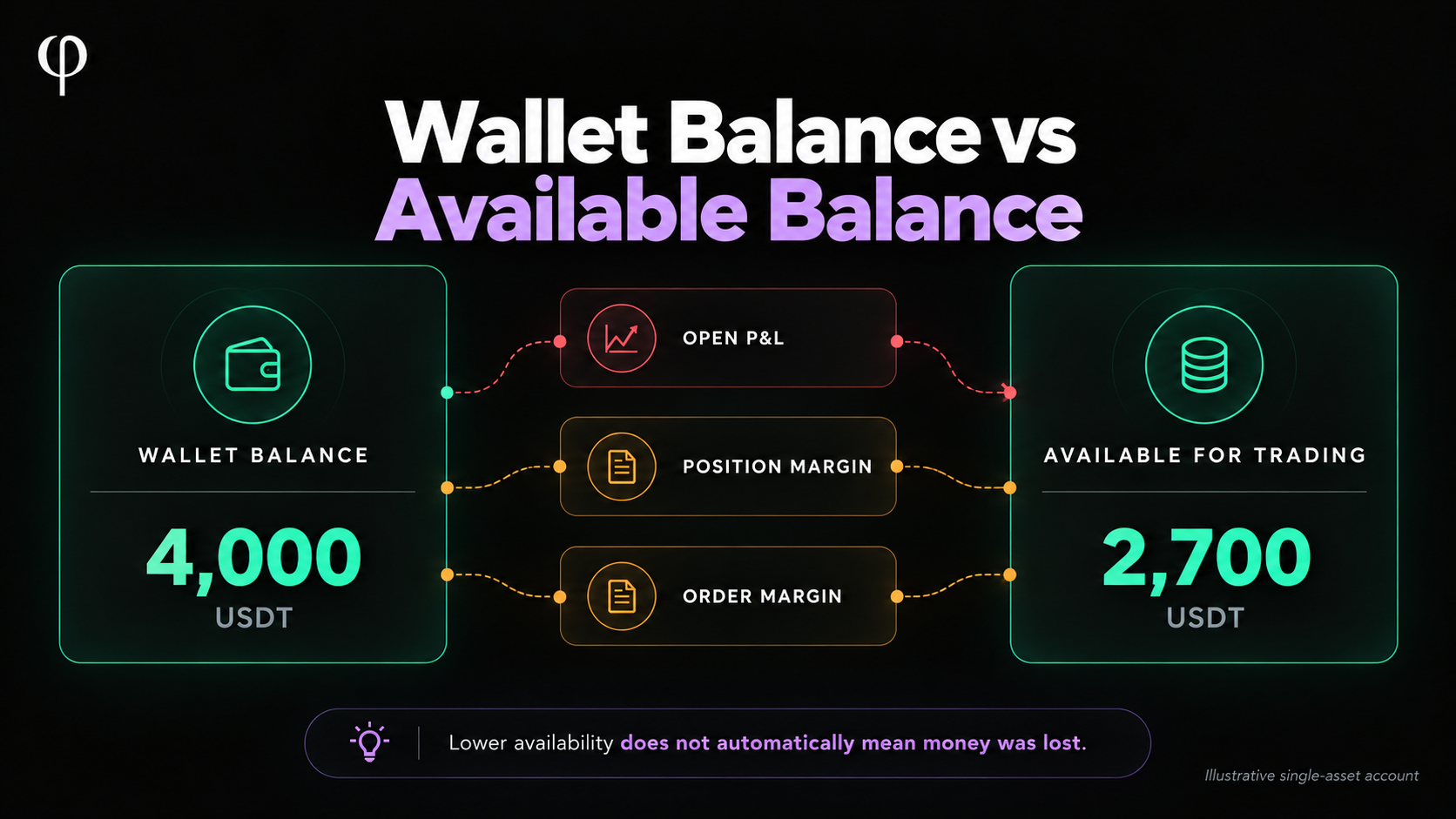
You open your futures account and see 4,000 USDT in the wallet. The order panel says only 2,700 USDT is available.
There is a 1,300 USDT difference. Before treating it as a loss, check what each balance measures.
A futures available balance can be lower than the wallet balance because open positions and pending orders require margin, while unrealized losses can reduce trading capacity. A margin commitment is not a realized trading loss. The exact calculation depends on the exchange, account mode and collateral.
This guide separates those effects using a simplified USDT example, then shows which records to check in your own account.
What is the difference between wallet balance and available balance?
Wallet balance tracks the account's settled balance under the exchange's rules. Available balance describes capacity for a particular action, such as placing a new order, after applicable margin requirements and adjustments.
The labels matter because they answer different questions:
| Balance or requirement | Question it helps answer | What it does not tell you by itself |
|---|---|---|
| Wallet balance | What settled balance is recorded in this futures wallet? | How much is free for another order |
| Unrealized P&L | What is the current marked gain or loss on open positions? | The final realized result after closing and costs |
| Margin balance or equity | What account value is recognized after relevant open P&L and adjustments? | How much can be withdrawn |
| Position initial margin | What margin requirement is associated with existing positions? | The maximum possible loss |
| Open-order initial margin | What requirement is associated with pending orders? | Whether an order has already filled |
| Available balance | What capacity remains for the action and account scope shown? | Whether using that capacity is within your risk limit |
For a concrete exchange example, Binance's futures wallet guide defines margin balance using wallet balance and unrealized P&L. Its available-for-order calculation also accounts for margin requirements. Do not assume another exchange uses every label or adjustment in the same way.
The broader diagnostic is covered in why futures margin can decrease. Here, the narrower question is how two balances can differ at the same moment.
Why does a 4,000 USDT wallet show only 2,700 USDT available?
In the example below, 250 USDT of unrealized losses and 1,050 USDT of margin commitments explain the difference. Only the first component is a current marked loss; the other two are requirements against trading capacity.
Assume one single-asset USDT futures account, with all figures taken at the same instant. This teaching model excludes borrowing, options, collateral haircuts, separate isolated pools and other charges or restrictions. It is a reconciliation example, not a universal exchange formula.
| Component | Amount | Role in this example |
|---|---|---|
| Wallet balance | 4,000 USDT | Starting settled balance |
| Unrealized P&L | −250 USDT | Reduces modeled margin balance |
| Margin balance | 3,750 USDT | 4,000 − 250 |
| Position initial-margin commitment | 800 USDT | Capacity committed to existing positions |
| Open-order initial-margin commitment | 250 USDT | Capacity committed to pending orders |
| Modeled available balance | 2,700 USDT | 3,750 − 800 − 250 |
The complete calculation is:
Modeled margin balance = 4,000 − 250 = 3,750 USDT
Modeled available balance = 3,750 − 800 − 250 = 2,700 USDT
Wallet-to-available gap = 250 + 800 + 250 = 1,300 USDT
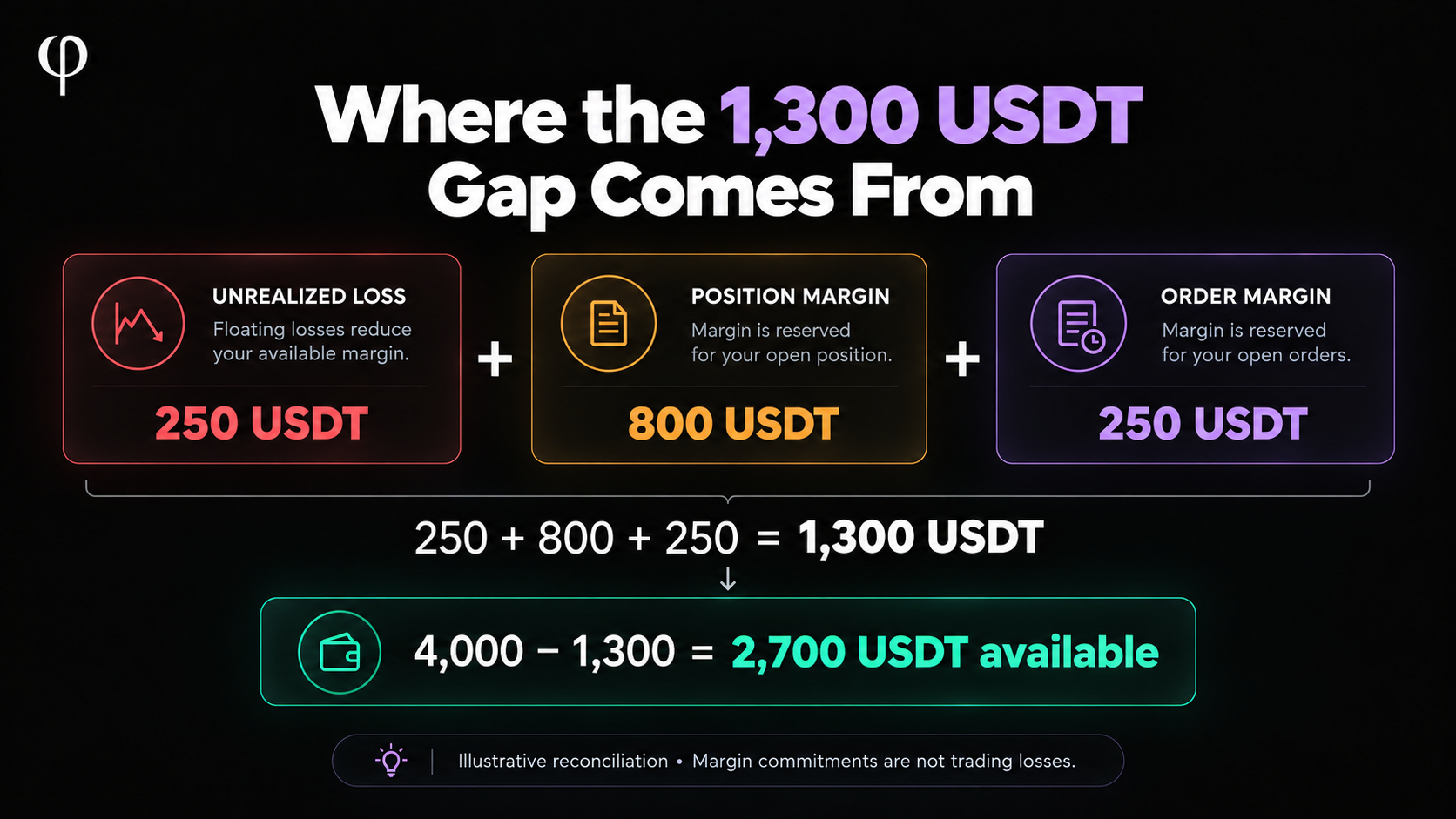
Illustrative reconciliation: margin commitments reduce available capacity without becoming realized losses.
Calling the entire 1,300 USDT a trading loss would misread this account. The 800 USDT and 250 USDT are commitments in the model, not closed-trade losses. The 250 USDT unrealized loss is still exposed to price changes while the position remains open.
Exchange data also separates these concepts. Binance's USDⓈ-M account API exposes distinct fields for position initial margin, open-order initial margin, available balance and maximum withdrawal amount. Use the exchange's returned values and current account rules for an actual reconciliation; do not replace its calculation with this simplified example.
Can an unfilled futures order reduce available balance?
Yes. A pending order can create a margin requirement before it becomes an executed position. That requirement can reduce capacity available for another order.
In the example, 250 USDT is associated with an unfilled order. If that order is canceled, no fill occurs, and every other input stays unchanged, the modeled requirement disappears:
| Figure | Before cancellation | After cancellation |
|---|---|---|
| Wallet balance | 4,000 USDT | 4,000 USDT |
| Unrealized P&L | −250 USDT | −250 USDT |
| Position margin | 800 USDT | 800 USDT |
| Order margin | 250 USDT | 0 USDT |
| Modeled available balance | 2,700 USDT | 2,950 USDT |
Available capacity increases by 250 USDT, but no profit is generated and no deposit arrives. The wallet balance stays at 4,000 USDT.
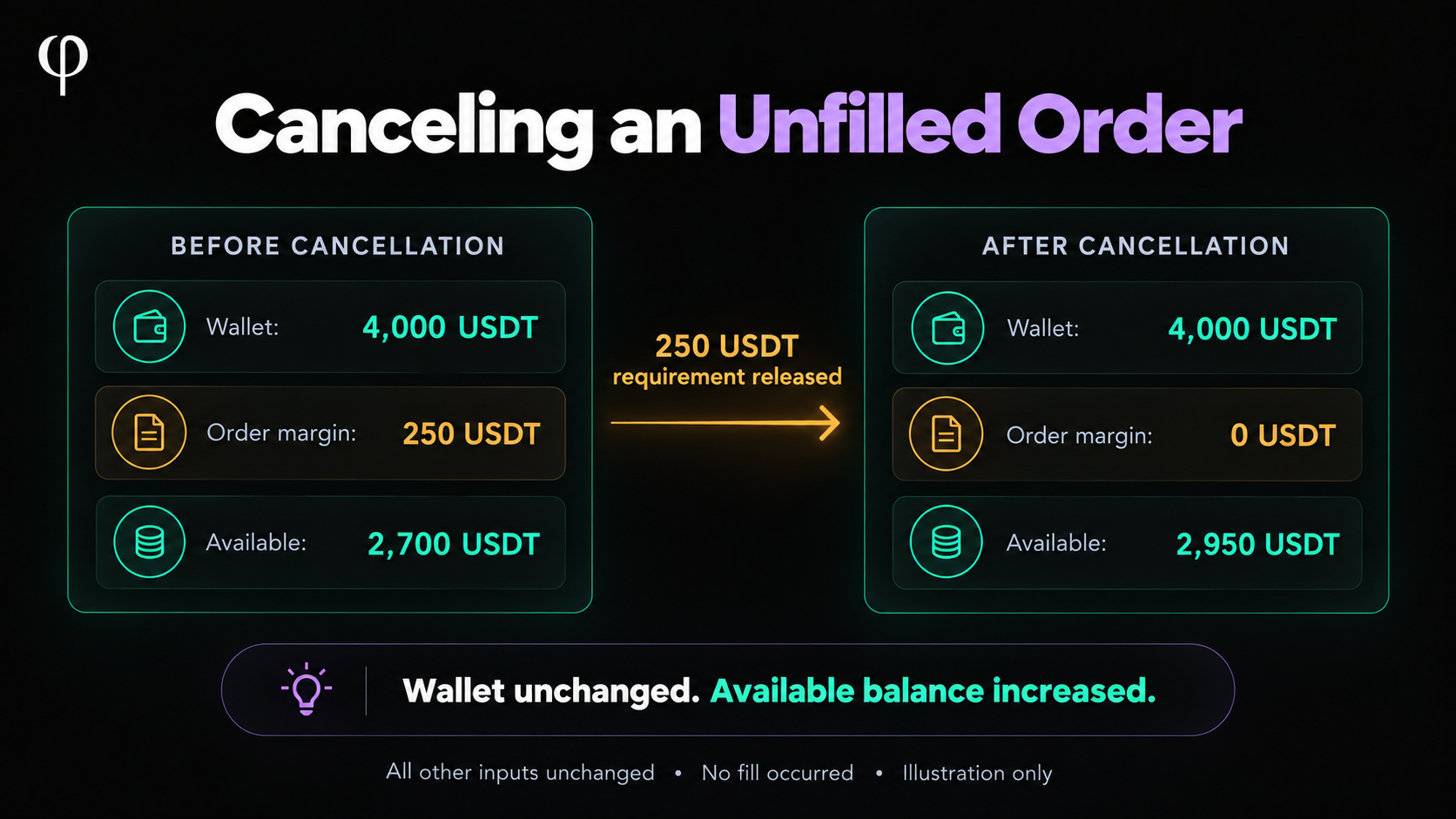
Cancellation-only illustration. No fill occurs, and all other inputs remain unchanged.
In a live account, verify the order's final status and the recalculated requirement. A partial fill, simultaneous price move or offsetting order rule can make the result different. Exposure-opening orders, reduce-only orders and protective orders are not interchangeable. This example is not a reason to remove protection just to increase a displayed balance.
Why can available balance change without a new trade?
An existing position can change in marked value while no new order fills. Account requirements and settled cash flows can also change independently of a new entry.
Start by separating two timelines: changes to the wallet and changes to current trading capacity. A settled funding payment belongs to the cash-flow review; a changing open loss belongs to the marked-position review. They can occur close together without being the same event.
For the cash-flow side, see how futures funding fees affect P&L. If a leverage setting changed, review what changing leverage in futures actually changes before interpreting the resulting margin movement as a profit or loss.
Compare records from matching timestamps. A wallet snapshot from a minute ago and an order panel from now may describe different account states. Also check whether one screen covers a single collateral asset while another summarizes the whole account.
Is available balance the same as withdrawable balance?
No. Capacity to place a trade and permission to transfer funds out of an account are separate questions. A value labeled available should not automatically be treated as cash you can withdraw.
For example, Bybit's Unified Trading Account asset guide distinguishes available balance from transferable amount. It explains that unrealized profits can support trading but cannot be transferred out, and that transferable amounts depend on the relevant margin mode and restrictions. This is a Bybit UTA example, not a rule to apply blindly to every futures account.
Likewise, the separate available and maximum-withdrawal fields in Binance's account API are a reason to read the correct field for the action you intend. A trading balance, a transferable amount and a withdrawal limit need not be equal.
If the discrepancy appears during a transfer, examine the transfer window's explanation and applicable account rules. Subtracting the position margin from a wallet balance may omit restrictions that matter specifically to transfers.
How do you check why your available balance is lower?
Reconcile the balance using one account scope, one timestamp and the exchange's definitions. Begin with observation rather than changing positions to make the numbers match.
| What you observe | What to inspect next | What the observation does not prove |
|---|---|---|
| Wallet stable, available lower | Open P&L, position requirements and pending orders | That settled money disappeared |
| Wallet lower too | Realized results, funding, fees and transfers in the account ledger | That all of the change came from one losing trade |
| Available rose after cancellation | Final order status and recalculated order requirement | That cancellation generated profit |
| No positions, but little available | Pending orders, other obligations and correct account or collateral scope | That a zero-position screen covers the whole account |
| Trading capacity exceeds transferable amount | Rules for transfers and treatment of unrealized gains | That both fields should have the same value |
| Values still do not reconcile | Margin mode, collateral valuation, other adjustments and update timing | That the simplified example is the exchange's full formula |
First identify the futures account, collateral and margin mode. Then save a matching snapshot of wallet balance, open P&L, margin balance, position requirements, pending orders and the available field you are trying to explain.
Next, label each difference as a settled cash flow, a marked gain or loss, a margin requirement, or another documented adjustment. Do not force an unexplained residual into the trading-loss category. If your account uses multiple collateral assets, borrowing or portfolio margin, use that account's documentation rather than extending this single-asset illustration.
If the exchange still shows an unexplained mismatch, keep the timestamps and transaction identifiers for support. A coherent record is more useful than repeatedly changing settings and creating new events during the investigation.
Does a higher available balance mean the account is safer?
A higher available balance alone does not establish that a futures account is safer. It describes capacity under applicable rules, not the loss a trader should accept.
In the cancellation example, the available figure rises while the existing position and its unrealized P&L stay unchanged. That change says something about an order requirement; it does not, by itself, establish better protection for the remaining position.
Evaluate existing exposure, protection, concentration and potential losses against your own account risk limit. The guide to crypto futures account risk explains that broader review. Keep that decision separate from whether the order panel permits another trade.
The better question: what is each part of the gap doing?
Instead of asking only why 1,300 USDT is unavailable, ask how much comes from current open losses, existing-position requirements, pending-order requirements and other documented adjustments.
Those categories lead to different explanations. A current loss is a market-value change. A margin requirement is a constraint on capacity. A settled fee is a cash flow. Combining them into a single label makes it harder to understand what actually happened.
Fibonomy brings open-position context and changes in position size, leverage and protection into a read-only review. It provides no trading signals and does not execute trades. Use it to understand the position story alongside the exchange's authoritative balance and margin records.
Frequently asked questions
Is the difference between wallet balance and available balance lost money?
Not necessarily. In the illustrative account, the 1,300 USDT gap includes 250 USDT of unrealized loss and 1,050 USDT of margin commitments. Requirements against trading capacity are not realized losses. Your actual breakdown depends on your account's rules and records.
Why is my futures balance unavailable when I have no open positions?
Inspect pending orders and confirm that the screen covers the correct account and collateral. Depending on the account type, other obligations or restrictions can also matter. A zero-position view alone does not explain every balance adjustment.
Does canceling an order return money to my wallet?
Canceling an unfilled order can release its margin requirement without adding money to the wallet. In the example, available balance rises from 2,700 to 2,950 USDT while wallet balance remains 4,000 USDT. Actual effects depend on order status and account rules.
Can unrealized profit be withdrawn?
Do not infer withdrawal permission from trading capacity. Bybit's UTA documentation, for example, treats unrealized profit as usable for trading but not transferable. Check the transfer or withdrawal amount and restrictions for your own exchange and account mode.
Which balance should I use to decide how much to risk?
No single balance replaces a risk decision. Review account capital, existing exposure, planned loss, protection and your own limit together. Available balance tells you about capacity; it does not set a suitable risk budget.
Sources and scope
Exchange documentation checked on 20 October 2026:
- Binance: USDⓈ-M futures wallet calculations.
- Binance Developers: USDⓈ-M account information and balance fields.
- Bybit: Unified Trading Account asset page and transferable amounts.
The figures and diagrams are an original simplified teaching example, not live account data or a complete exchange formula. Account modes and exchange rules can change; apply the current documentation for your own account.