October 12, 2026Position Reconstruction
Trade History vs Position History: What's Missing?
Trade history records fills. Position history connects size, protection and costs. See what each view can establish—and where historical evidence is still needed.
You open your futures trade history and find every buy and sell you expected.
The quantities match. The closing price looks right. The position made money.
But you also remember increasing the size and moving the stop farther away. Those changes mattered while the position was open. The final result does not explain when your exposure increased or how much protection remained.
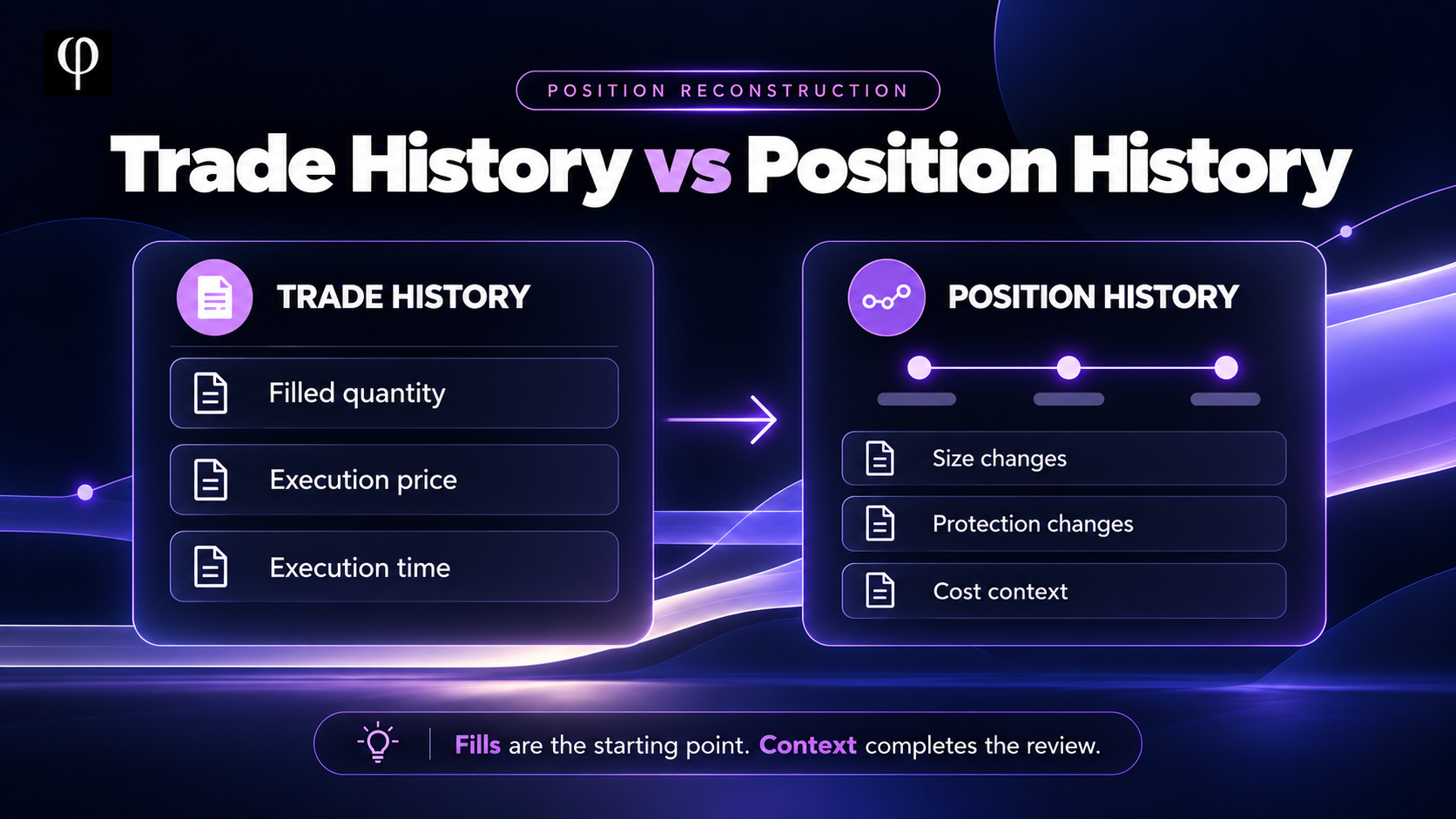
This is the gap behind trade history vs position history: executions describe what filled, while a position history connects those fills with the changing state and context of the position.
The difference becomes useful when you want to understand the path to an outcome, as well as the outcome itself.
Quick Answer
Trade history usually starts with execution records: filled quantity, execution price, side, and time. Depending on the exchange and export, it may also include fees, realized P&L, and other fields.
A position history organizes evidence around the lifecycle of an exposure: opening, adding, reducing, changing supported settings or protection, and closing. It may also connect relevant fees, funding, and account context.
Some position changes can be calculated from complete execution records. Others require separate historical evidence. You cannot reliably infer an old stop price, a leverage amendment, or a trader's original plan from a final entry-and-exit summary.
The practical question is: which parts of this position's story are recorded, which are reconstructed, and which are unknown?
1. What Trade History Actually Records
For this article, trade history means the exchange's execution or fill history. Exchanges use different names, so check the fields behind the tab rather than relying only on its label.
A fill records a completed execution. It can establish how much traded, at what price, and when. That makes it the foundation for reconciling a position.
For example, Binance's official Account Trade List documents quantity, price, trade and order identifiers, commission, realized P&L, and position side.
These records are valuable evidence. The limitation comes from asking a single record to answer questions about the whole period of exposure. One closing execution cannot describe every state the position passed through before that close.
2. Orders, Fills, Positions, and Snapshots Are Different
An order is an instruction. A fill is an execution against that instruction. A position is the exposure that remains after relevant executions. A snapshot describes a recorded state at a particular observation time.
An order to buy 0.10 BTC could fill in several pieces. Bybit's execution documentation explicitly notes that a single order can have multiple executions.
Conversely, several orders can increase or reduce the same continuing position. Counting each execution row as a separate completed trade can turn one lifecycle into several misleading observations.
A snapshot showing 0.20 BTC tells you the size at that observation. It does not, by itself, reveal whether the position opened at that size, grew into it, or was previously larger.
Keep these units separate before comparing results or calculating performance statistics.
3. What Position History Adds
In this guide, a position history is an evidence-based timeline for one account, contract, and relevant side. It describes how the exposure evolved and identifies the records supporting each change.
A useful timeline can include:
- The confirmed opening and final close.
- Filled additions and partial reductions.
- Running open quantity and supported average-entry calculations.
- Historically recorded changes to protection or settings.
- Relevant trading fees and funding, with clear definitions.
- Account context where historical records support it.
This is a working definition, not a promise that every exchange provides a single complete “position history” export. The information may be spread across several sources.
More rows do not automatically mean a better history. The value is in correct grouping, meaningful changes, and visible evidence gaps.
4. What You Can Learn From Each View
Use this comparison as a starting point. Actual coverage depends on the exchange, account mode, retained records, and the way a tool presents them.
| Review question | Execution history alone | Additional position context |
|---|---|---|
| What quantity filled, and at what price? | Usually available in the fill records | Connect fills to the relevant lifecycle |
| How did open quantity change? | Reconstructable with complete records and a known starting state | A running size timeline makes the sequence explicit |
| Was the position partially closed? | Reconstructable with correct grouping | Separate realized portions from the remaining exposure |
| Was the stop moved while size stayed unchanged? | A fill list generally cannot establish this | Historical protection or order evidence is needed |
| Which leverage setting applied earlier? | Do not assume it from fills | Historical settings evidence is needed |
| What was the net result after costs? | Fee coverage and P&L definitions vary | Reconcile the relevant cash flows once |
The important distinction is between information that is absent from one view and information that is unavailable altogether. Additional records can close some gaps. They cannot justify inventing the rest.
5. Three Fills Can Belong to One Position
Consider an illustrative BTCUSDT long on a linear USDT-settled contract. Assume the account has zero exposure on this side before the first fill and no intervening executions.
09:00   Buy 0.10 BTC at 60,000 USDT
10:00   Buy 0.10 BTC at 60,000 USDT
11:00   Sell 0.20 BTC at 60,500 USDT
The running position is:
After opening:   0.10 BTC
After adding:    0.20 BTC
After closing:   0.00 BTC
The second buy increased an already open position. The final sell closed the combined quantity. Under a zero-to-zero lifecycle definition, these three fills describe one continuing position.
For a practical method of assembling that ledger, read How to Reconstruct a Closed Futures Position From Exchange Data.
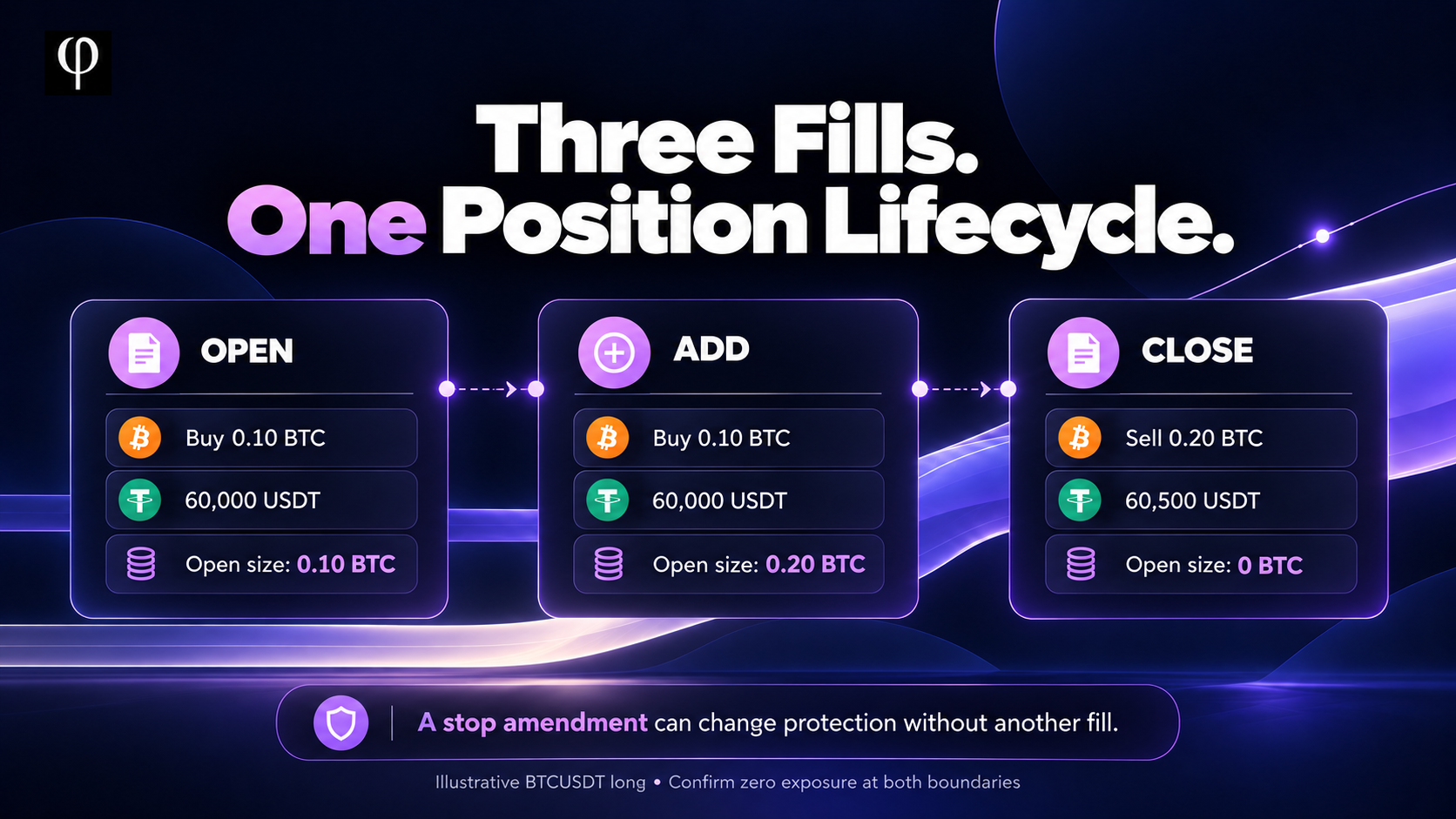
Illustrative execution sequence. Separate historical records are needed to establish protection changes between these fills.
6. The Average Entry Can Stay the Same While Size Doubles
Both buys in our example fill at 60,000 USDT. The quantity-weighted average remains 60,000, even though the open quantity increases from 0.10 to 0.20 BTC.
Average entry = (0.10 × 60,000 + 0.10 × 60,000) ÷ 0.20
              = 60,000 USDT
A summary focused on entry price would show no change. The quantity ledger shows that the position became twice as large.
At the same price movement, the larger linear position has a larger gross P&L change. A 500 USDT move per BTC corresponds to 50 USDT on 0.10 BTC and 100 USDT on 0.20 BTC, before costs.
This is why a stable average entry does not establish stable exposure. See What Happens When You Add to a Futures Position? for the broader effect of a filled addition.
7. Protection Can Change Without Another Fill
Now add a separate piece of illustrative historical evidence: the position initially had a stop at 59,000 USDT. After the add, a recorded amendment moved that stop to 58,000.
The amendment did not require another buy or sell execution. Quantity could stay at 0.20 BTC while the intended protective exit moved farther from the average entry.
That is a meaningful change in the position's context. It will be invisible in a view containing only filled trades unless the protection records are connected separately.
Do not infer this amendment from the final profit or from a later stop setting. In a real review, you need historical order, amendment, or other reliable protection evidence to place the change on the timeline.
8. Same Fills, Different Protection
Compare two illustrative histories with the same three fills. In History A, the stop remains at 59,000 after the add. In History B, it moves to 58,000.
For the 0.20 BTC long at a 60,000 average entry, the simplified gross price loss at each stop level would be:
History A: 0.20 × (60,000 − 59,000) = 200 USDT
History B: 0.20 × (60,000 − 58,000) = 400 USDT
Before the add, the corresponding calculation at the original stop was 100 USDT on 0.10 BTC. The larger size and the more distant stop affect different parts of the calculation.
These figures assume execution exactly at the stated stop level and exclude fees, funding, and slippage. They are neither guaranteed loss limits nor measured drawdowns. Liquidation and account conditions can also affect the outcome.
Both histories later close at 60,500 and produce the same 100 USDT gross position profit. Their final result does not distinguish the protection they carried along the way.
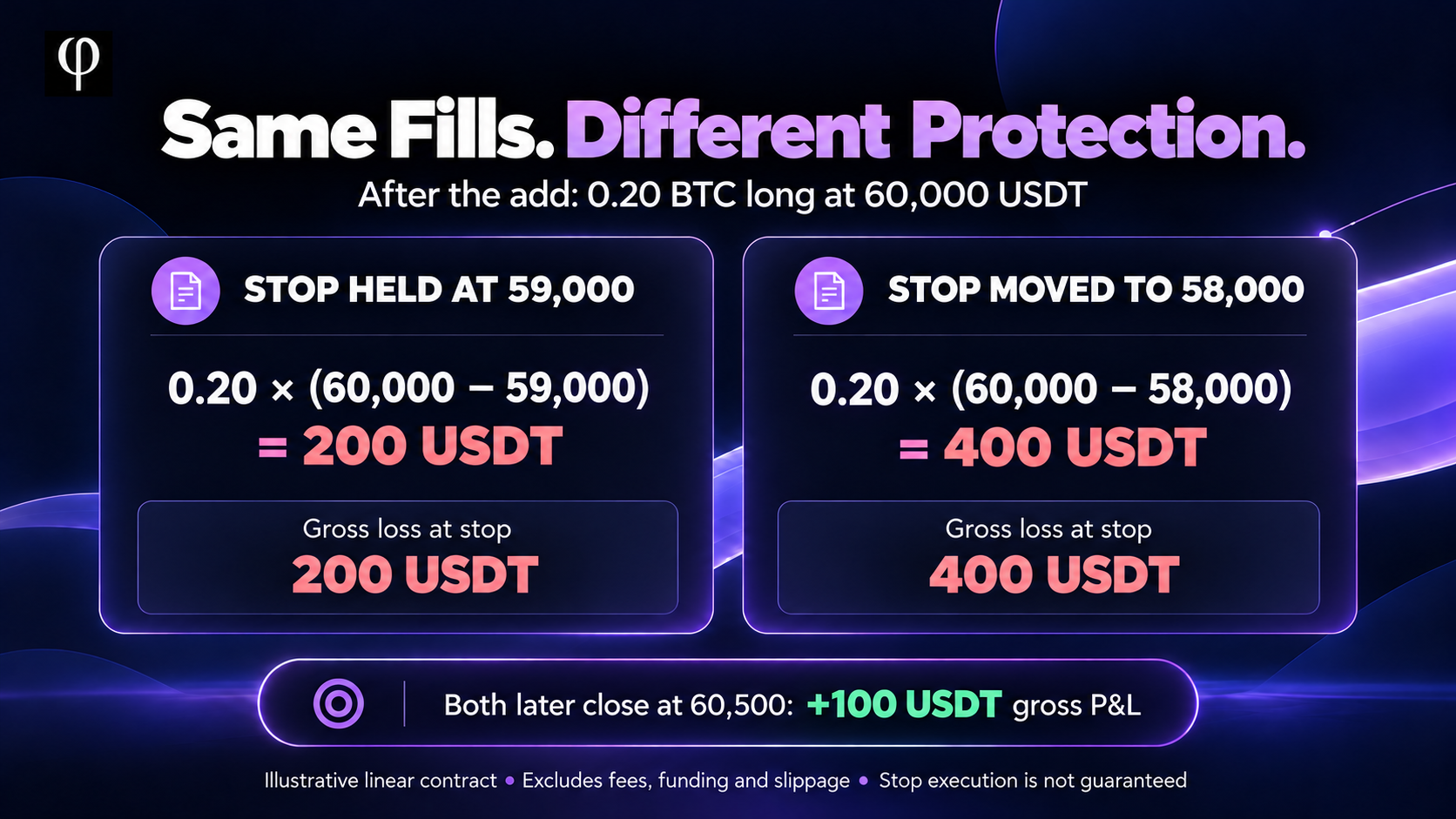
Illustrative comparison under stated assumptions. The stop calculations are hypothetical, and stop execution is not guaranteed.
For why an existing stop does not guarantee a protective exit before liquidation, see Why You Can Be Liquidated With a Stop Loss.
9. A Profitable Close Does Not Establish the Process
The gross result in the example is straightforward:
0.20 × (60,500 − 60,000) = +100 USDT
That result establishes what the closing price contributed under the example's assumptions. It does not establish whether the increase in size or the stop amendment followed the trader's plan.
To evaluate adherence, you need a plan that existed at the relevant time: intended size, protection, risk limit, or another explicit decision rule. A rule written after seeing the result is weak evidence of what was intended earlier.
Avoid treating either history as automatically good or bad. Establish the facts first, compare them with a documented plan, and make the interpretation visible as interpretation.
10. Partial Closes Can Hide the Remaining Exposure
A realized gain does not necessarily mean the position has finished.
If a trader holds 0.20 BTC and sells 0.05 BTC to reduce it, 0.15 BTC remains open in a simple long-only example. A profitable closing portion tells you about the quantity reduced, while the remainder continues to respond to price and applicable costs.
A position timeline makes both facts visible at the same point: a portion closed, and a portion remained.
When reviewing a final summary, check whether its quantity and average exit describe one closing order, several reductions, or the complete lifecycle. A useful display label cannot substitute for understanding how that figure was assembled.
11. A P&L Field Needs a Definition
“Realized,” “closed,” and “net” can refer to different calculations across products and interfaces.
Bybit's USDT contract P&L guide explains average entry and the treatment of trading and funding costs in its closed result. Read the relevant definition before subtracting those costs again.
A separate Closed PnL endpoint includes fields such as closed size, average entry and exit, and order identifiers. Establish the unit represented by its records before assuming one returned row equals the complete lifecycle you want to review.
In our example, 100 USDT is explicitly gross position P&L. Net proceeds would require the actual applicable fees, funding, and any other relevant adjustments. We have not assigned invented cost totals to that result.
12. Funding and Transfers Need Their Own Context
Not every balance movement is an execution.
Binance's Income History documentation separates categories including funding, commissions, realized P&L, and transfers. Those categories help explain why a balance change may differ from a sum of closing results.
Match funding using the relevant instrument, settlement time, and exposure evidence. Avoid assigning the same payment to several lifecycles or counting the same commission twice because it appears in two exports.
A collateral transfer is an account movement, not a trading gain created by the position. Keep that distinction visible when connecting position and account histories.
For the role of funding in the result, read Where Did My Futures Funding Fee Go?.
13. Today's Snapshot Cannot Prove Yesterday's Settings
A current position view can contain useful information without being a historical ledger.
For example, Bybit's Get Position Info documentation includes fields for size, leverage, and protection. Seeing a value in the current response does not establish every earlier value it replaced.
If your first saved observation shows a particular leverage setting, label it as observed at that time. Do not extend it backward to the opening unless other records support that conclusion.
The same rule applies to protection, margin settings, and account balances. A later snapshot can help reconcile a known state. It cannot recover a missing sequence simply by being detailed.
14. An Update Message Is Not Always a Meaningful Change
Even when you have a stream of observations, count changes carefully.
Bybit's official position-stream documentation states that creating, amending, or canceling an order can generate a position message even when the position has not actually changed.
A useful timeline compares relevant before-and-after values and preserves the supporting event. It does not label every repeated message as an increase in risk or a new trader decision.
Similarly, two identical snapshots with a gap between them do not prove that nothing changed inside the gap. Coverage and continuity matter as much as the values themselves.
These are evidence-handling principles, not a claim that a particular product captures every message or can backfill an unrecorded stream.
15. Grouping Errors Can Create a False Position Story
Keep exchange, account or subaccount, contract, and position side within the grouping rules.
In hedge mode, a buy can increase a long or reduce a short. Netting every buy and sell on the same symbol into one sequence can incorrectly make two simultaneous positions appear to cancel each other.
Even in one-way mode, an oversized opposite-side execution can close one lifecycle and start another by crossing zero. Preserve that boundary rather than treating the reversal as a normal reduction.
These details affect the meaning of your review. If grouping is uncertain, mark the timeline uncertain. A smooth chart built from the wrong records can be less useful than an incomplete table that clearly identifies its limits.
16. Position History Still Needs Account Context
A complete view of one position does not automatically establish the account's exposure at the same time.
Other open positions, available collateral, and account-level rules can matter. A position that looked small on its own may have existed alongside several exposures drawing on the same account resources.
Historical account snapshots can help establish that context. If they were not retained, avoid recreating a precise past account-risk percentage from today's balance.
For the wider relationship, read How Much of Your Account Is at Risk Across Open Futures Positions?.
Position history and account history answer connected questions. Keep their calculations distinct and state which historical evidence supports each one.
17. What to Check Before Trusting a Timeline
Look for an identifiable lifecycle, traceable records, and clear calculation assumptions.
Start with these questions:
- Are the opening and closing boundaries confirmed?
- Are execution records complete for the required period and account?
- Are adds and reductions reflected in running quantity?
- Are protection or settings changes backed by historical evidence?
- Are P&L and cost definitions explicit, without double counting?
- Are missing intervals, uncertain grouping, and inferred values visible?
A timeline should make these checks easier. It should also let you separate a confirmed fill from a calculated state or an unavailable setting.
If historical protection evidence is missing, you can still review the supported quantity and outcome. Narrow the conclusion to what the records establish instead of discarding useful evidence or overstating its coverage.
A Better Question to Ask
Instead of asking only “Can I see all my trades?”, ask:
Can I explain how this position changed, what evidence supports those changes, and what the final result leaves out?
Trade history is essential to that explanation. A position history connects the records into a sequence you can review, while keeping its assumptions and gaps visible.
The Bottom Line
The difference between trade history and position history is the unit of explanation.
A fill list records executions. A position timeline connects them to continuing exposure, supported changes, and relevant cash flows. Some of that story is reconstructable from fills; other parts need separate historical records.
In our example, the same entry, exit, and gross profit could coexist with different protection. Reviewing the path reveals a distinction the final result cannot establish on its own.
See the Full Story
Fibonomy is a read-only Trading Clarity Platform for understanding positions and their surrounding account context. Its public product preview illustrates position changes and account exposure. It does not execute trades or provide trading signals.
Explore the position story in Fibonomy.
Available history depends on supported product behavior and the underlying records. Connecting an account should not be interpreted as a promise to retrieve every past setting, amendment, or exchange event.
This article is educational and is not financial advice. All numerical examples are illustrative. Stop-based calculations exclude costs and slippage and do not guarantee execution or establish maximum possible loss. Exchange records and definitions can differ and change.
Official Sources
- Binance USDⓈ-M Account Trade List
- Binance USDⓈ-M Income History
- Bybit Get Trade History
- Bybit Get Closed PnL
- Bybit Get Position Info
- Bybit Private Position Stream
- Bybit USDT Contract P&L Calculations
Sources checked October 13, 2026.