31 أكتوبر 2026Education
Crypto Futures Trading Journal: What to Record Before, During and After a Position
Build a crypto futures journal that connects the original plan, position changes and closed-trade review. Includes a worked lifecycle and a practical recording checklist.
You close a crypto futures position in profit. The exchange gives you a result, an entry price and an exit price. A week later, you cannot remember why you added size, whether the stop changed, or how much of your account was exposed at the busiest point.
A journal becomes useful when it preserves those decisions.
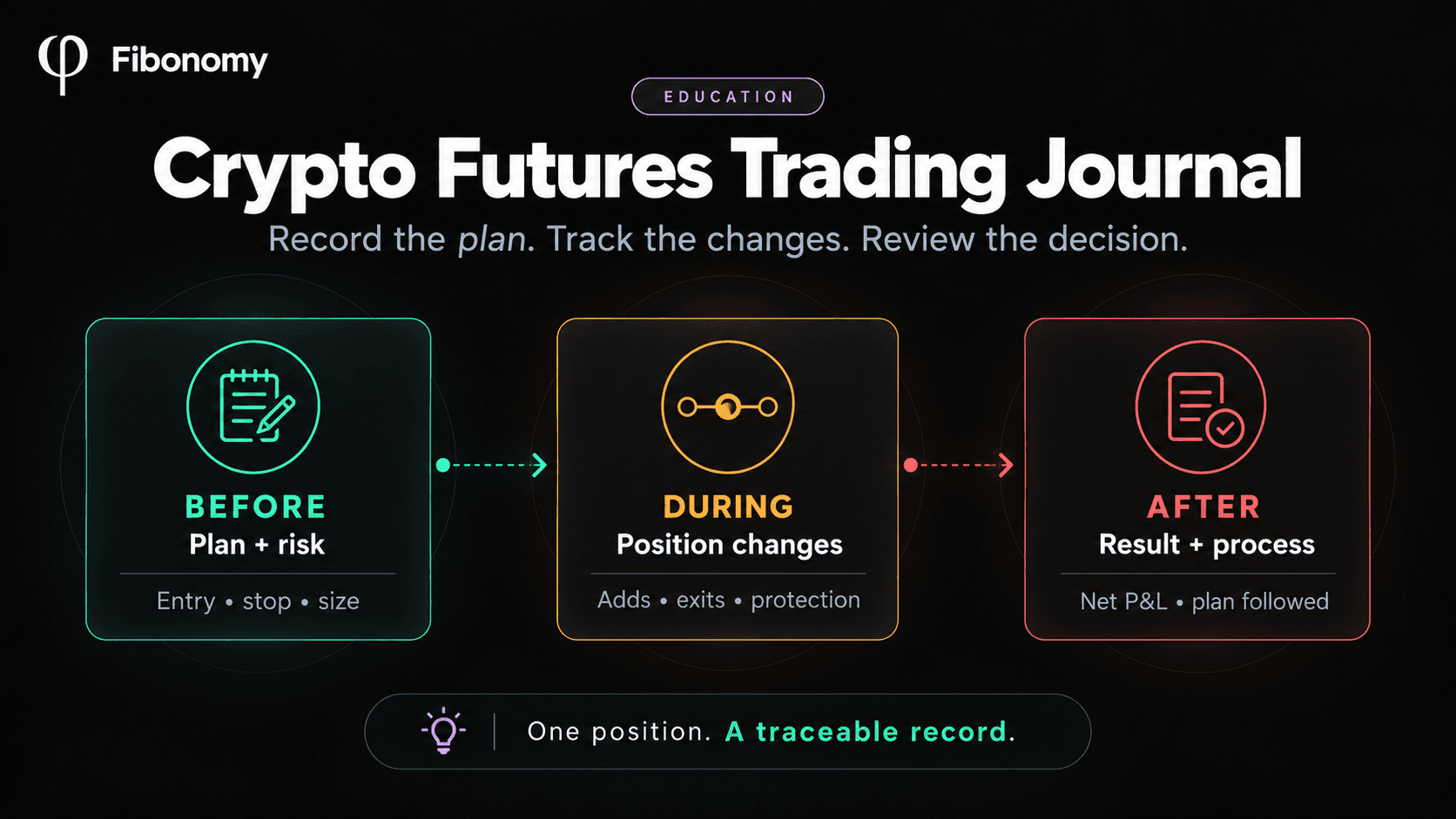
A crypto futures trading journal should connect three records: the plan written before entry, the changes made while the position is open, and the result reviewed after closing. Record actual fills, fees and funding alongside the original risk rule. Then assess whether you followed that rule separately from whether the position made money.
This guide is for active crypto futures traders building a repeatable recording and review process. The numerical example uses a synthetic linear USDT perpetual long. Its prices, fees and risk limits are teaching assumptions, not current exchange quotations or recommended risk levels.
What is a crypto futures trading journal?
A crypto futures trading journal is a structured record of your positions, the decisions attached to them and the evidence needed to review those decisions later.
The exchange history supplies part of that record: executions, quantities, prices and account events. Your journal adds the intended setup, invalidation, risk constraints and reasons for subsequent changes.
Binance Academy's trading journal guide introduces the combination of a trading record and written planning notes. For an active futures trader, the practical next step is to keep those notes attached to the position as it changes.
A spreadsheet, notebook or dedicated application can organize the record. The important question is whether you can reconstruct what you planned, what happened and what remains unknown.
Should you journal an order, a fill or a position?
Use a position lifecycle as the main case, with its individual fills and changes attached underneath. Define that lifecycle explicitly.
An order is an instruction. A fill is an execution. A position can contain several fills, additions and reductions before it becomes flat. Counting every fill as a separate completed trade can distort your review when one decision executes in pieces.
For a simple same-direction example, the case starts with the first opening fill and ends when that position is fully closed. Hedge-mode legs, reversals and overlapping strategies need documented grouping rules; do not assume one symbol always represents one case.
Keep the original execution records available. Your grouped journal should be traceable back to them. Our comparison of trade history and position history explains why those records answer different questions.
What should you record before opening a position?
Write the reason, invalidation and risk constraints before you know the outcome. Preserve the original version when the plan changes.
| Field | What to write | Why it matters later |
|---|---|---|
| Account and contract | Exchange, account label, symbol, settlement currency, margin mode and position mode | Prevents mixing different account and contract rules |
| Time boundary | Date, time and timezone | Makes fills, funding and notes comparable |
| Trade idea | Your setup, entry condition and the observation that would invalidate it | Gives the review a contemporaneous reference |
| Planned execution | Direction, intended entry, size and units, stop and target if used | Separates intention from actual fills |
| Risk budget | Account equity reference, this position's planned risk and existing open risk | Shows whether the idea fits your own account rule |
| Management rules | Conditions for adding, reducing, changing protection or cancelling the idea | Makes later decisions reviewable |
| Evidence | A timestamped note or relevant chart capture | Preserves what was available at the time |
Record the planned loss calculation and its assumptions, rather than only the leverage setting. CME's position-sizing lesson connects sizing to the stop location and the amount of account capital a trader chooses to risk. Its contract examples are not universal crypto formulas or a prescribed risk percentage.
For account context, read how open futures positions affect account risk. A position that fits an individual limit may still take the combined account beyond your rule.
If you do not use a stop, record that fact and the protection uncertainty. Do not fill a missing planned-loss field with zero.
What should you record while the position is open?
Record each material change with its time, the before-and-after values and the reason available at that moment.
Useful events include:
- Actual opening fills and any difference from the intended entry.
- Additions, reductions and the quantity remaining after each event.
- Stop or target changes, including protection being cancelled.
- Leverage or margin-mode changes where applicable.
- Fees and funding events attributable to the position.
- Changes in the position's planned risk and the account's combined open risk.
A short event note can be enough: “Added 0.05 BTC; stop unchanged; combined planned risk now exceeds my account rule.” That is more useful than rewriting the original plan after seeing a profitable close.
Keep observations and interpretations separate. An execution can establish that size increased. It cannot, by itself, establish fear, revenge trading or the reason you clicked.
When a position grows, attach the actual fills rather than the requested order size. The guide to average entry after adding to a futures position covers the weighted calculation.
Worked example: one lifecycle, several decisions
Consider an illustrative BTCUSDT perpetual long. All prices below are USDT per BTC. The account has 10,000 USDT of reference equity, and the trader has written a personal rule limiting total planned price risk across open positions to 400 USDT.
Other positions contribute 200 USDT under the same simplified risk convention. The BTC position initially opens with 0.10 BTC at 60,000 and a planned stop at 59,000.
Initial planned price risk is 0.10 x (60,000 - 59,000) = 100 USDT. Adding the other positions gives 300 USDT, within the written 400 USDT rule.
The plan says not to add if doing so would exceed that account rule.
| Event | Execution or change | Position quantity afterward | Journal evidence |
|---|---|---|---|
| Open | Buy 0.10 BTC at 60,000 | 0.10 BTC long | Original stop 59,000; planned price risk 100 USDT |
| Add | Buy 0.05 BTC at 62,000; stop unchanged | 0.15 BTC long | Recalculate risk before treating the addition as compliant |
| Partial close | Sell 0.06 BTC at 63,000 | 0.09 BTC long | Record realized price result and remaining quantity separately |
| Final close | Sell 0.09 BTC at 61,000 | Flat | Complete the lifecycle and reconcile all its costs |
These are synthetic executed prices, not a claim about a historical market path. The example assumes no intervening stop fill, reversal or other BTC position.
After the addition, the weighted average entry is:
(0.10 x 60,000 + 0.05 x 62,000) / 0.15 = 60,666.666... USDT per BTC.
With the stop still at 59,000, the position's planned price risk becomes:
0.10 x (60,000 - 59,000) + 0.05 x (62,000 - 59,000) = 250 USDT.
Combined with the other positions' assumed 200 USDT, the total is now 450 USDT: 50 USDT above the written account rule.
This is an illustrative entry-to-stop price-loss calculation before fees, funding and execution uncertainty. It is not a guaranteed maximum loss, an exchange liquidation formula or a complete portfolio stress test. The other positions are held constant only for this comparison.
The journal should preserve the breach when it occurs. A later reduction does not erase it.
How do you record the final result after fees and funding?
Reconcile the whole closed lifecycle using one consistent cost convention.
In this example, the partial close produces gross price P&L of 0.06 x (63,000 - 60,666.666...) = +140 USDT. The final close produces 0.09 x (61,000 - 60,666.666...) = +30 USDT.
Assume total trading fees across all four executions are 9 USDT and total funding paid is 2 USDT. These are hypothetical aggregate amounts, not current exchange rates.
| Lifecycle component | Amount |
|---|---|
| Gross price P&L on the partial close | +140 USDT |
| Gross price P&L on the final close | +30 USDT |
| Total gross price P&L | +170 USDT |
| All trading fees | -9 USDT |
| Funding paid | -2 USDT |
| Net lifecycle result | +159 USDT |
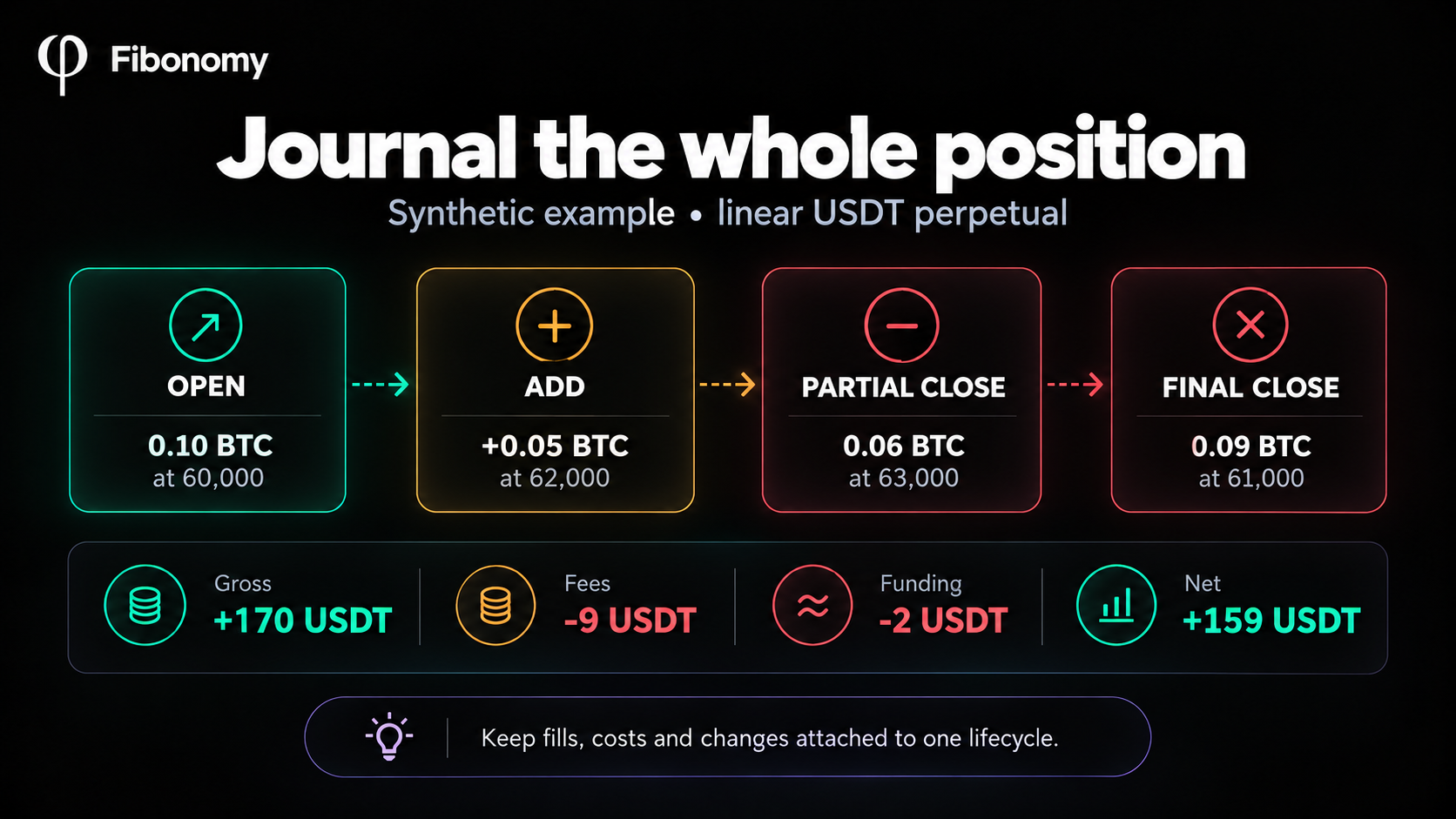
One complete synthetic lifecycle. The 9 USDT trading cost and 2 USDT funding payment are counted once.
Here, costs paid are negative and funding received would be positive. Record the reporting currency and conversion basis when an exchange charges costs in another asset. Do not subtract costs again from a field that already includes them.
Bybit's USDT P&L documentation distinguishes cumulative realized P&L from closed P&L, including cost allocation on partial closes. Check the exact exchange field before copying it into a journal.
Our guide to realized P&L versus position history explains reconciliation in more detail. For the cost component, see funding fees and futures P&L.
How do you review process separately from profit?
Ask two questions: what was the net result, and did the recorded decisions follow the rules that existed at the time?
The example ended at +159 USDT. It also contains a documented addition that took combined planned price risk from 300 to 450 USDT against a 400 USDT rule. Both facts belong in the review.
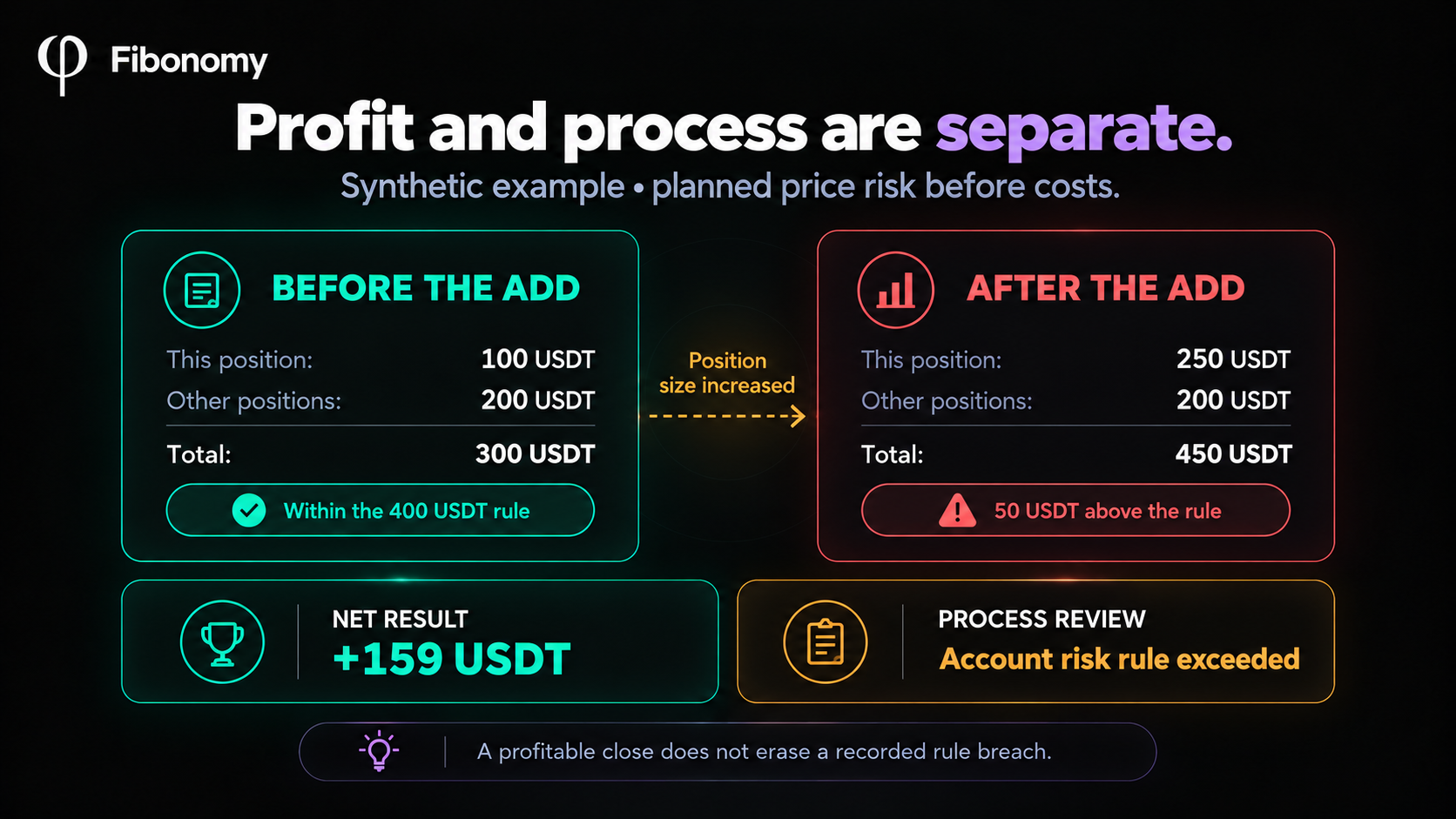
The account rule is illustrative. This comparison records a process exception without inferring the trader's motive.
| Outcome | Recorded process | Review focus |
|---|---|---|
| Profit | Rules followed | Preserve the evidence; profit alone does not validate a strategy |
| Loss | Rules followed | Check execution and assumptions without automatically declaring the decision wrong |
| Profit | Rule breached | Record the exception despite the favorable financial outcome |
| Loss | Rule breached | Separate the documented exception from other causes of loss |
| Either | Original plan or evidence missing | Mark the process assessment unknown where it cannot be established |
These are review categories, not proof of skill or a diagnosis of behavior. One winning or losing position cannot establish a repeatable trading edge.
A useful note for the example is: “The addition exceeded my written account-risk limit. Next review, check whether every proposed add includes a recorded combined-risk calculation.”
That next action is observable. “Be more disciplined” is harder to verify.
What should a short post-trade review contain?
Use a compact record you can complete consistently:
- Scope: account, contract, lifecycle start/end, timezone and included records.
- Original plan: reason, invalidation, size and risk rule as written before entry.
- Changes: additions, reductions, protection changes and their recorded reasons.
- Result: gross price P&L, costs and net result, with the calculation convention.
- Process: rules followed, documented exceptions and anything ungradable.
- Next action: one recording or review change, plus how you will check it.
Attach the underlying events rather than relying on a final screenshot. Our guide to reconstructing a closed futures position provides the record-building method; this journal workflow adds the original intention and the later review.
How should daily and weekly reviews differ?
Use the post-close review to capture details while you can still identify their evidence. Use a weekly review to compare completed cases under a consistent boundary.
Choose the account, dates, timezone and whether your weekly sample includes positions closed during the period. Keep still-open positions and their current risk visible separately.
Check missing records before comparing results. Group materially different setups or management rules separately where possible. A handful of cases may suggest something to investigate, but it does not prove a reliable pattern.
For the example, the weekly question could be: “Which additions had a combined-risk check recorded before execution?” Preserve the denominator, including cases with missing notes. Do not silently turn missing evidence into compliance.
What can Fibonomy add to this workflow?
Fibonomy connects position data with account context. Its public product preview shows open-position risk, changes in size and protection, and closed-position review that separates plan-related process from financial outcome.
That supports a useful journal workflow: inspect the position record, trace material changes and compare what happened with the rule you recorded.
Fibonomy uses read-only connections and does not place trades or provide signals. The decision journal guide explains this role.
The field lists and review questions in this article are an educational framework. They do not imply that every suggested field, spreadsheet calculation or analytical method is an automated Fibonomy feature.
Explore Fibonomy and review your positions.
Frequently asked questions
Is exchange trade history enough for a trading journal?
It provides execution evidence, but usually not your complete intended setup, invalidation or reason for changing a position. Keep the exchange records and the contemporaneous decision notes connected.
How should I journal a partially closed position?
Record the closed quantity, its realized result and costs, while keeping the remaining quantity open in the same documented lifecycle. Do not label the entire position complete until your grouping rule says it is closed. See what happens when you partially close a futures position.
Can I add emotional notes?
Yes, as your own contemporaneous observations. Keep them separate from verified execution facts. A losing trade or size increase alone does not establish what you felt or why you acted.
Does journaling make a strategy profitable?
A journal organizes evidence and makes review more traceable. It does not create an edge, remove leverage risk or guarantee improved returns. Results depend on the strategy, execution, costs, market conditions and the quality of the records.
Can I use this example for inverse contracts?
Not unchanged. Inverse contracts have different settlement and P&L mechanics. Record the actual contract type, units, exchange definitions and conversion rules before applying calculations.
Sources and scope
Primary references checked on November 1, 2026:
- Binance Academy: What Is a Trading Journal and How to Use One? — general recording and planning context.
- CME Group: Proper Position Size — the relationship between stop placement, size and a chosen risk budget.
- Bybit: P&L Calculations for USDT Perpetual and Expiry Contracts — exchange-specific result definitions and cost treatment.
The numerical lifecycle and the review framework are Fibonomy teaching examples. They are not real customer records, trading recommendations, a tax ledger or evidence that a strategy will be profitable.