October 31, 2026Position Mechanics
Average Entry Price After Adding to a Futures Position
Calculate a futures position's new average entry from actual filled quantities and prices. See partial-fill examples and why a changed entry does not establish lower risk.
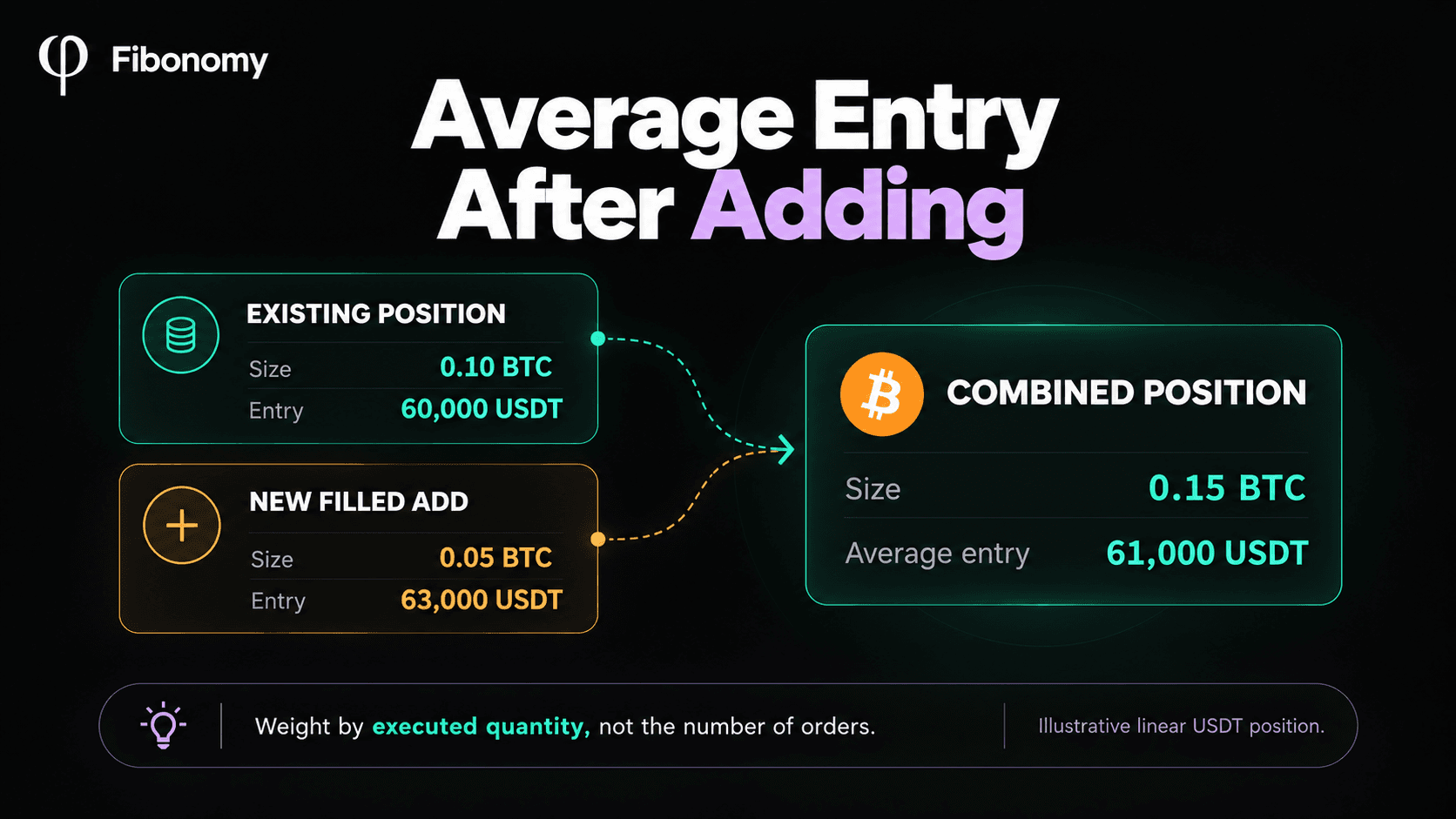
You add to a futures position and the average entry moves. The new number is not the simple midpoint between the old entry and the latest fill unless the quantities happen to be equal.
For a linear USDT position increased in the same direction, average entry is weighted by executed quantity: combine the remaining position's entry value with the value of the new fills, then divide by the new total quantity. Use actual fills, not the requested order size, leverage or margin added.
This guide calculates the new entry step by step and separates that calculation from break-even price, profit and account risk.
What is the formula for average entry after adding?
For an unchanged entry basis and a same-direction addition to a linear position:
New average entry =
(Existing quantity x Existing average entry
 + Sum of each new fill's quantity x fill price)
 / (Existing quantity + Total newly filled quantity)
The numerator is entry value in USDT. The denominator is quantity in BTC for a BTCUSDT example. The result is USDT per BTC.
Bybit's average-entry guide documents quantity-weighted calculations for USDT contracts and distinguishes contract types. The examples here use a linear USDT position with no settlement reset.
For the wider position changes that accompany an addition, see what happens when you add to a futures position. This article focuses on the entry calculation itself.
Example: add 0.05 BTC to a 0.10 BTC position
Assume a hypothetical BTCUSDT long of 0.10 BTC with an average entry of 60,000 USDT per BTC. A new same-direction order fills 0.05 BTC at 63,000 USDT.
| Component | Quantity | Entry or fill price | Entry value |
|---|---|---|---|
| Existing position | 0.10 BTC | 60,000 USDT | 6,000 USDT |
| Executed addition | 0.05 BTC | 63,000 USDT | 3,150 USDT |
| Combined position | 0.15 BTC | Calculated below | 9,150 USDT |
New entry value = 6,000 + 3,150 = 9,150 USDT
New quantity = 0.10 + 0.05 = 0.15 BTC

New average entry = 9,150 / 0.15
                  = 61,000 USDT per BTC
The new entry is closer to 60,000 than to 63,000 because twice as much quantity came from the original position.
Simply averaging the two prices would give 61,500 USDT. That would incorrectly give the 0.05 BTC addition the same weight as the 0.10 BTC existing position.
A useful arithmetic check is that a positive-quantity weighted average lies between its component prices. Here, 61,000 sits between 60,000 and 63,000. That check can flag a mistake, but it does not replace verifying the fills.
How do partial fills change the calculation?
Include only the quantity actually executed, at its actual execution prices. Unfilled quantity has not entered the position.
Consider a separate illustration with the same starting 0.10 BTC at 60,000 USDT. The addition executes in two fills:
| Component | Quantity | Price per BTC | Entry value |
|---|---|---|---|
| Existing position | 0.10 BTC | 60,000 USDT | 6,000 USDT |
| First addition fill | 0.02 BTC | 62,000 USDT | 1,240 USDT |
| Second addition fill | 0.03 BTC | 64,000 USDT | 1,920 USDT |
| Combined | 0.15 BTC | Weighted result | 9,160 USDT |
Average entry = (6,000 + 1,240 + 1,920) / 0.15
              = 61,066.666... USDT per BTC
              = approximately 61,066.67 USDT per BTC
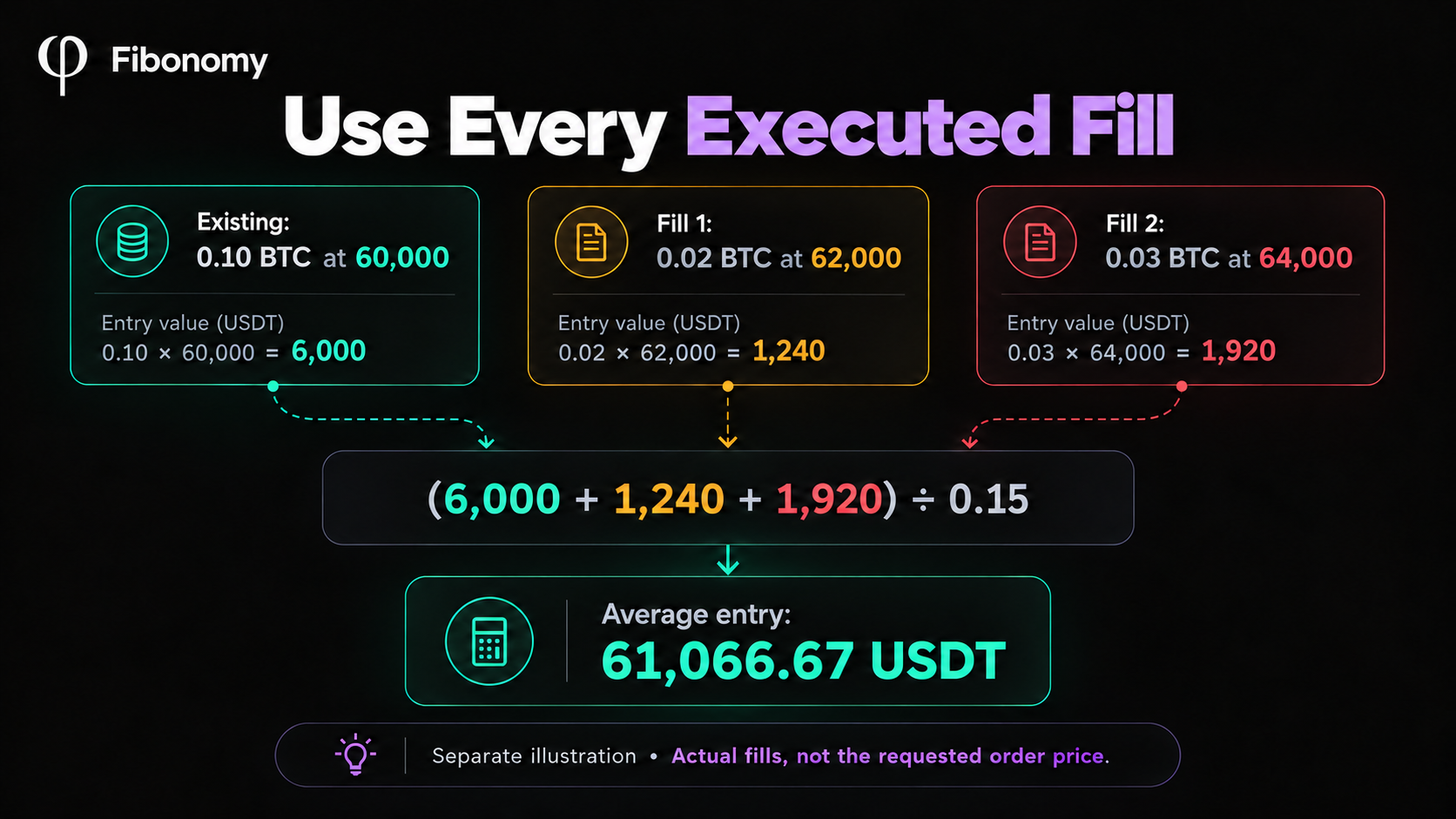
Separate partial-fill example. The displayed average is rounded; retain full precision when reconciling records.
This result differs from the single-fill example because the actual added entry value is 3,160 USDT rather than 3,150 USDT.
If only the first 0.02 BTC has filled, stop there: quantity is 0.12 BTC and average entry is 7,240 / 0.12, or approximately 60,333.33 USDT per BTC. Do not include the second fill before it occurs.
Bybit's trade-history API documentation notes that one order can produce multiple executions. The executed quantities and prices, rather than the order's intended values, are the appropriate evidence for this calculation.
Does adding margin or changing leverage alter average entry?
Adding collateral is not an executed addition to position quantity. Neither collateral nor a leverage setting belongs in the weighted-entry numerator.
For the same position basis, a new entry calculation needs a change in executed quantity or another contract-specific accounting event. Do not divide a deposited margin amount by leverage and treat the result as an entry fill.
For example, increasing margin while the position remains 0.10 BTC does not create a new quantity purchased at the current market price.
Similarly, changing a leverage setting without a new fill does not insert a new price into this average. The distinction between leverage and exposure is covered in what changing leverage in futures actually changes.
Why can unrealized P&L stay the same even though average entry changes?
An addition filled at the same price used for valuation initially contributes zero gross P&L. The new average entry and the increased quantity can therefore leave the existing gross marked result unchanged at that instant.
Return to the first example. Assume the valuation price is 63,000 USDT both immediately before and immediately after the 0.05 BTC fill, with no intervening movement:
Before adding:
0.10 x (63,000 - 60,000) = +300 USDT

After adding:
0.15 x (63,000 - 61,000) = +300 USDT
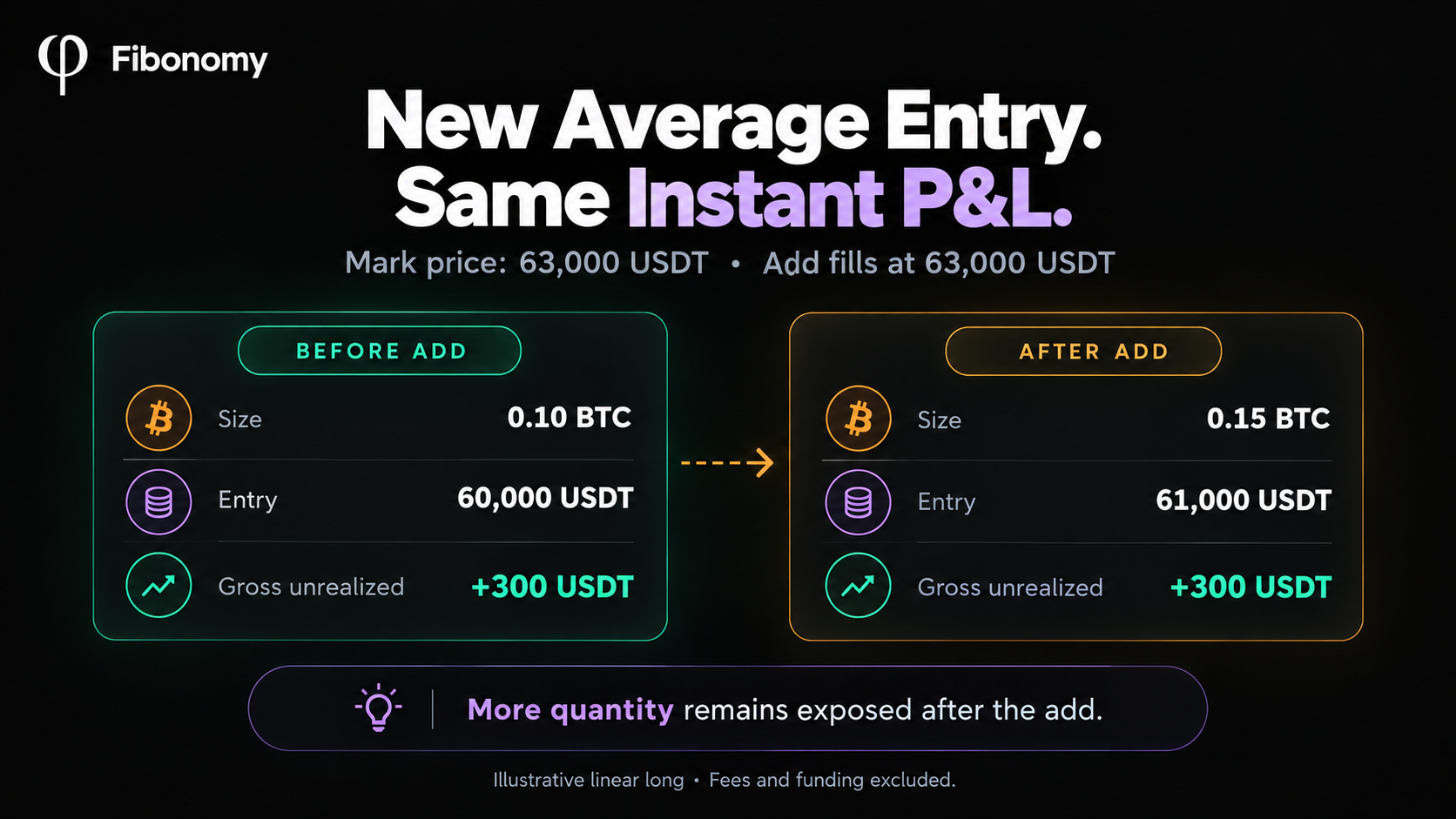
Illustrative linear long. The addition fills at the valuation price. Fees and funding are excluded.
The unchanged gross P&L is not evidence of unchanged risk. After the add, each 100 USDT move in the valuation price changes gross P&L by 15 USDT instead of 10 USDT. More quantity remains exposed.
A fill away from the valuation price, a moving market or incurred costs can produce a different immediate result. The 300 USDT comparison deliberately holds those inputs constant.
Review account risk when adding to a futures position before interpreting a more attractive entry price as a safer position.
Is average entry the same as break-even price?
No. Average entry is the position's price basis under the relevant accounting rules. A cost-adjusted break-even estimate considers the gains and costs included in its scope.
The weighted-entry calculation above does not incorporate trading fees or funding. Do not silently add those cash flows to the entry numerator and call the result the exchange's average-entry field.
Bybit's P&L FAQ describes its break-even price in terms of opening and closing trading fees. Its definition should be checked separately from average entry.
For a numerical cost example, see why a stop at entry does not guarantee break-even. A matched entry and exit price need not mean a zero net result.
What if you partially closed before adding again?
Start with the remaining quantity and its current applicable entry basis. Do not restore quantity already closed to the open-position average.
In a simple average-cost illustration, an original 0.10 BTC at 60,000 USDT is reduced by 0.04 BTC, leaving 0.06 BTC at the same entry basis. If a later addition fills 0.03 BTC at 63,000 USDT:
Remaining entry value = 0.06 x 60,000 = 3,600 USDT
New fill entry value = 0.03 x 63,000 = 1,890 USDT

New average = (3,600 + 1,890) / (0.06 + 0.03)
            = 5,490 / 0.09
            = 61,000 USDT per BTC
The earlier closed result remains a realized component. It is not another open quantity and is not automatically a deduction from the new average-entry numerator.
The guide to partially closing a futures position explains that separation. If the prior position was fully closed, or a reversal created a new position in your account mode, identify the new lifecycle before calculating.
Does this formula work for every futures contract?
No. Identify the contract and its accounting conventions before applying the linear quantity-weighted formula.
Bybit's inverse-contract guide uses a different average-entry calculation based on inverse contract value. A BTCUSD inverse contract should not be treated as a BTCUSDT linear position.
Bybit also documents a USDC session settlement mechanism that realizes marked P&L and updates average entry at settlement. An entry change in that context need not mean a new addition filled.
These are scoped exchange examples. Check the exact contract, settlement and position mode rather than extending one formula to every product.
How do you investigate a different average on the exchange?
Reconcile the same position state using complete fills and the applicable basis.
| Check | What it can explain |
|---|---|
| Remaining starting quantity | An earlier reduction changed the base being averaged |
| Executed versus requested addition | The order only partially filled |
| Multiple execution prices | One requested price does not describe all fills |
| Same-direction versus opposing activity | A reduction, hedge or reversal is being mixed with an addition |
| Contract and settlement mechanism | The assumed linear basis does not apply or was reset |
| Timestamp and precision | The snapshot precedes a fill or rounds the underlying result |
Retain the full calculation precision and compare the final displayed rounding separately. Do not invent an unseen fill to force a match.
For a broader evidence workflow, see reconstructing a futures position from exchange data.
The better question: which executed quantities produced this entry?
An average entry becomes useful when it is connected to the fills and quantity changes that created it. The final price alone does not show whether size grew, protection changed or the position was previously reduced.
Fibonomy provides read-only context for changes in position size, leverage and protection. It provides no trading signals and does not execute orders. Use that history alongside the exchange's actual fills to understand the position behind the average.
Frequently asked questions
Can I average the old entry and new fill price directly?
Only if their quantities are equal under the applicable linear calculation. Otherwise use quantity weights. In the example, 0.10 BTC at 60,000 plus 0.05 BTC at 63,000 averages to 61,000, not 61,500 USDT.
Do unfilled orders change average entry?
Not as executed additions. Use the filled quantities and prices. A pending order may affect account requirements without having added to the position.
Does adding margin lower average entry?
Adding collateral alone does not create an entry fill. Keep margin and executed quantity separate.
Does a lower average entry mean less risk?
Not by itself. Adding quantity can move entry toward the new fill while increasing the position's price sensitivity and exposure.
Why did entry change without an addition?
Check contract-specific accounting, including settlement resets, and confirm that the field is average entry rather than break-even price. Do not assume every entry change proves a new purchase.
Sources and scope
Primary documentation checked on 1 November 2026:
- Bybit: average entry price by contract type.
- Bybit API: execution records.
- Bybit: P&L FAQ and break-even field.
- Bybit: inverse-contract calculations.
- Bybit: USDC session settlement mechanism.
The prices and quantities are original hypothetical examples, not current market data. Linear examples assume same-direction additions and no settlement reset. Gross P&L illustrations exclude fees and funding.