October 22, 2026Position Mechanics
What Happens When You Partially Close a Futures Position?
A partial close splits a futures position into a realized result and remaining exposure. Follow the quantities, P&L, entry basis and protection with a worked example.
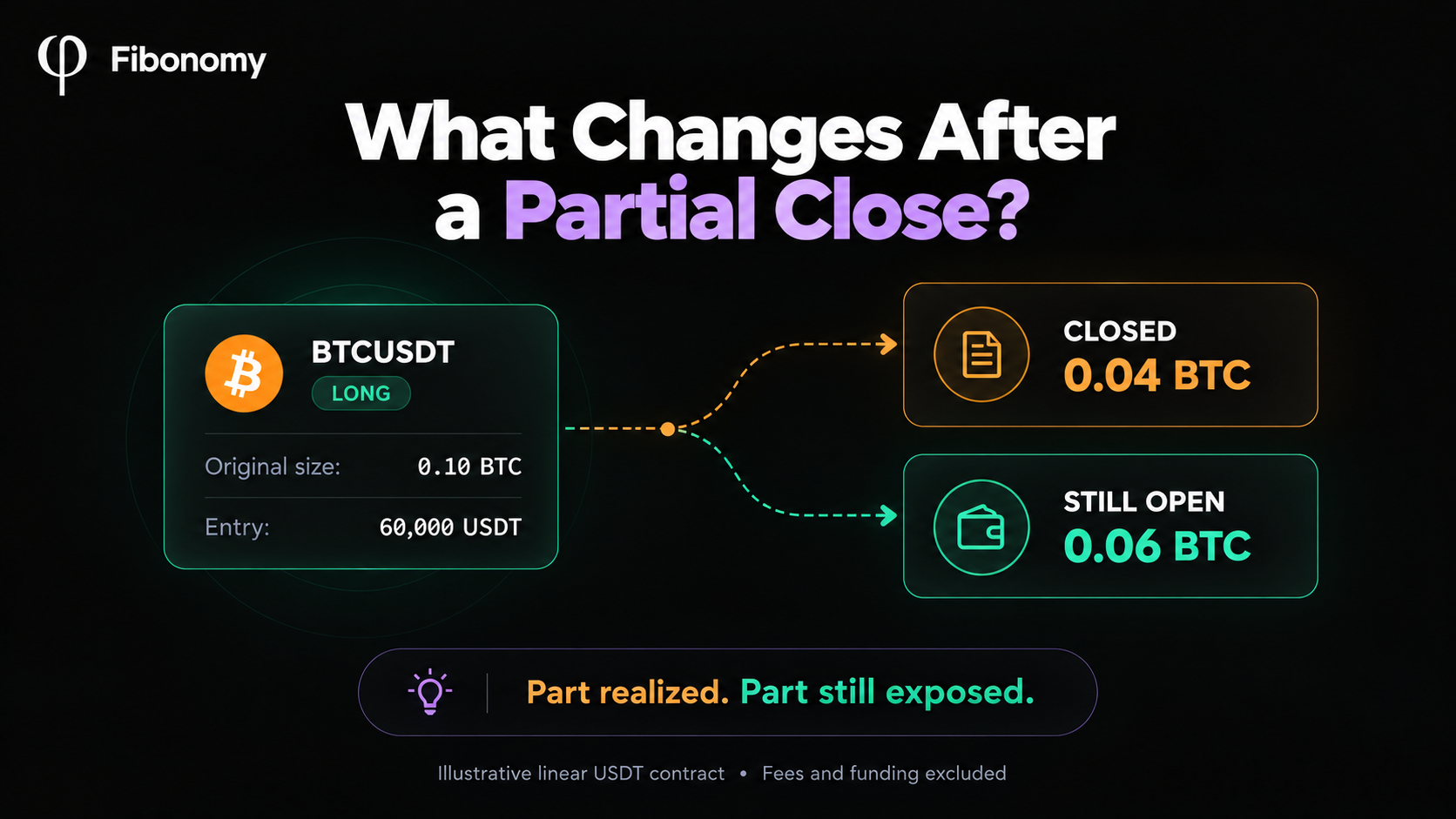
You close part of a profitable futures position. The realized P&L increases, but the unrealized profit on the position screen drops.
Did the profit disappear? Did the rest of the position become safe?
Partially closing a futures position realizes the result on the quantity actually closed and leaves a smaller quantity exposed to price changes. A lower unrealized P&L immediately afterward can reflect that smaller open size. It does not, by itself, mean profit was lost or that the remaining position is risk-free.
The useful distinction is between the completed part of the position and the part that is still open. This guide follows both through one worked example.
What changes when you partially close a futures position?
A partial close reduces an existing position without bringing its remaining quantity to zero. Only executed closing fills count; submitting an order or reaching a trigger price is not proof that the requested quantity has closed.
| Item | What to check after the fill |
|---|---|
| Open quantity | Original quantity minus the quantity actually closed |
| Realized trading result | Result attributable to completed closing fills, with costs treated according to the field's definition |
| Unrealized P&L | Current marked result on the remaining open quantity |
| Average entry | Entry basis of the remaining position under the contract's accounting rules |
| Margin and available balance | Recalculated account requirements and capacity |
| Stop and take-profit orders | Active status, covered quantity, direction, trigger basis and execution method |
For the opposite action, see what happens when you add to a futures position. An executed reduction and an executed addition change the position in different ways; neither can be understood from entry price alone.
Example: close 0.04 BTC from a 0.10 BTC long
Start with a hypothetical linear BTCUSDT long of 0.10 BTC entered at 60,000 USDT per BTC. It has no additions or earlier reductions.
For this illustration, the closing fill and the price used to value the open position are both 63,000 USDT. Fees and funding are excluded from every gross figure below. These are teaching assumptions, not live prices or an exchange statement.
Before the close:
Open quantity: 0.10 BTC
Entry: 60,000 USDT per BTC
Valuation price: 63,000 USDT per BTC

Gross unrealized P&L:
0.10 x (63,000 - 60,000) = +300 USDT
Now an order actually closes 0.04 BTC at 63,000 USDT. The remaining quantity is 0.06 BTC.
| Component | Calculation | Gross result |
|---|---|---|
| Closed part | 0.04 x (63,000 - 60,000) | +120 USDT realized |
| Remaining part | 0.06 x (63,000 - 60,000) | +180 USDT unrealized |
| Combined at this instant | 120 + 180 | +300 USDT |
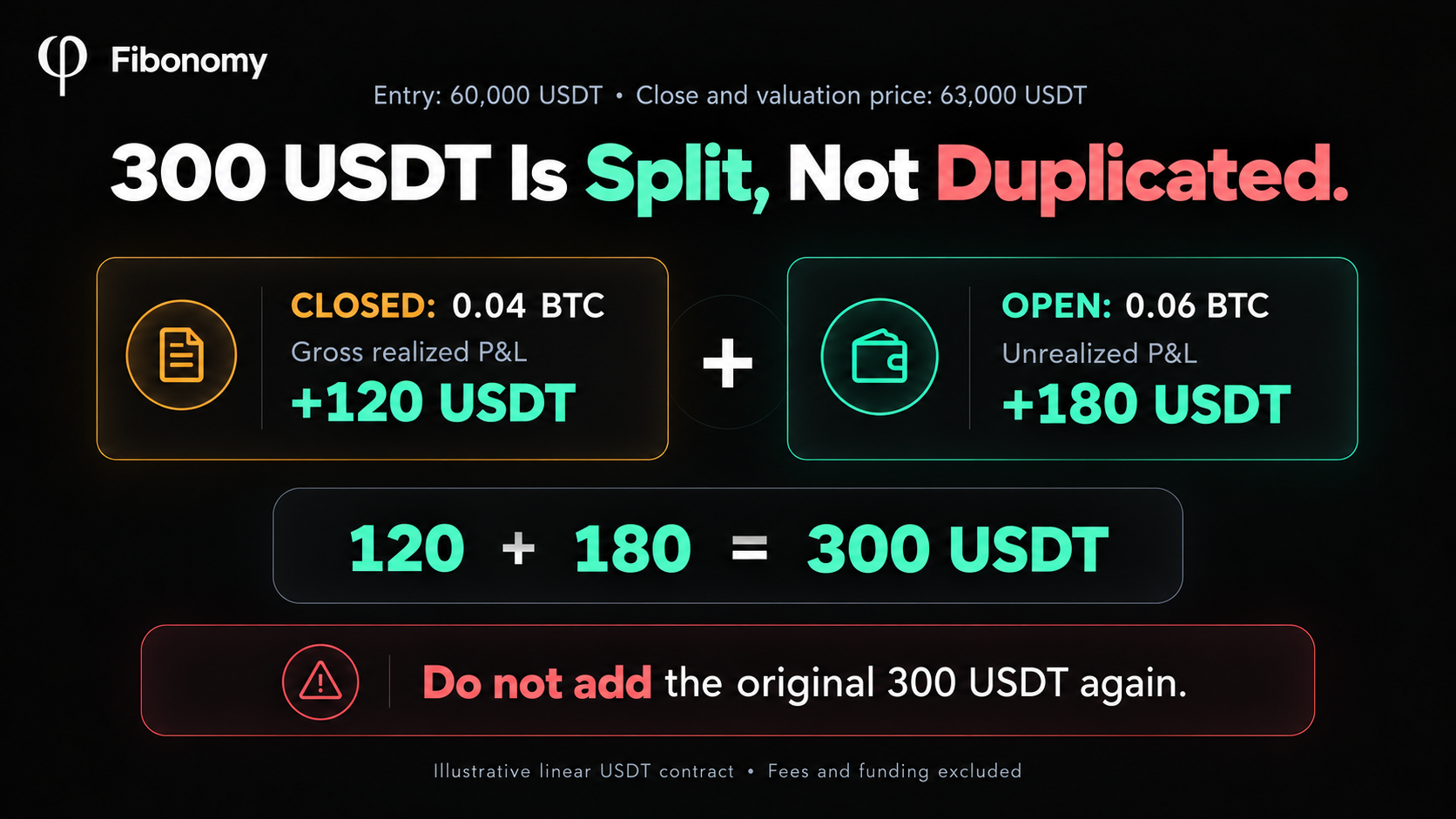
The original 300 USDT is divided between closed and open quantities. It is not added again.
The remaining position's unrealized profit falls from 300 to 180 USDT because less BTC remains open. In this controlled example, no price movement or execution difference caused that change.
For comparison with a real exchange, Bybit's USDT contract P&L guide documents quantity-based P&L, costs and partial-close accounting. Our figures are an original illustration of a linear long. Do not apply this USDT calculation directly to inverse contracts.
Why did unrealized profit fall after taking profit?
The unrealized field describes the quantity still open. The realized component has moved outside that open-position calculation.
In the example, comparing 300 USDT before the close with 180 USDT afterward omits the 120 USDT gross result on the completed part. That comparison uses different quantities while treating them as the same position state.
The opposite error is double counting:
Incorrect:
Original unrealized 300 + realized 120 = 420 USDT

Correct at the unchanged valuation price:
Current unrealized 180 + realized gross 120 = 300 USDT
The 300 USDT before the close already included the value attributable to the 0.04 BTC later closed. Keep a historical snapshot separate from a current component.
This is also why trade history and position history answer different questions. The closing fill proves what executed. A position timeline shows how that event connects to the quantity and result that remain.
Does a partial close change the average entry price?
In this simple average-cost example, the remaining 0.06 BTC keeps its 60,000 USDT entry basis. Selling part at 63,000 USDT realizes a result; it does not create a new entry purchase for the remaining quantity.
The entry basis attributed to the remaining position is 0.06 x 60,000 = 3,600 USDT. That is a cost-basis illustration, not the margin required to maintain the position.
Do not subtract the 120 USDT profit from the displayed entry price. Those quantities have different units: one is a result in USDT, the other a price in USDT per BTC.
If an exchange shows a different price, identify the exact field and contract. Average entry, break-even price and average exit are different measures. Additional fills, settlement resets and contract-specific accounting can change what a screen reports. This example assumes none of those events.
The broader limitation of price-only review is covered in why entry and exit prices do not tell the full position story.
What happens if the remaining position moves against you?
The closed gross result stays fixed if there are no further fills, while the open result continues to change with the valuation price. A profitable partial close does not secure the result of the whole lifecycle.
Suppose the valuation price later falls to 61,000 USDT per BTC. The remaining position is still 0.06 BTC:
Closed gross result: +120 USDT
Remaining unrealized: 0.06 x (61,000 - 60,000) = +60 USDT
Combined gross at the later instant: 120 + 60 = +180 USDT
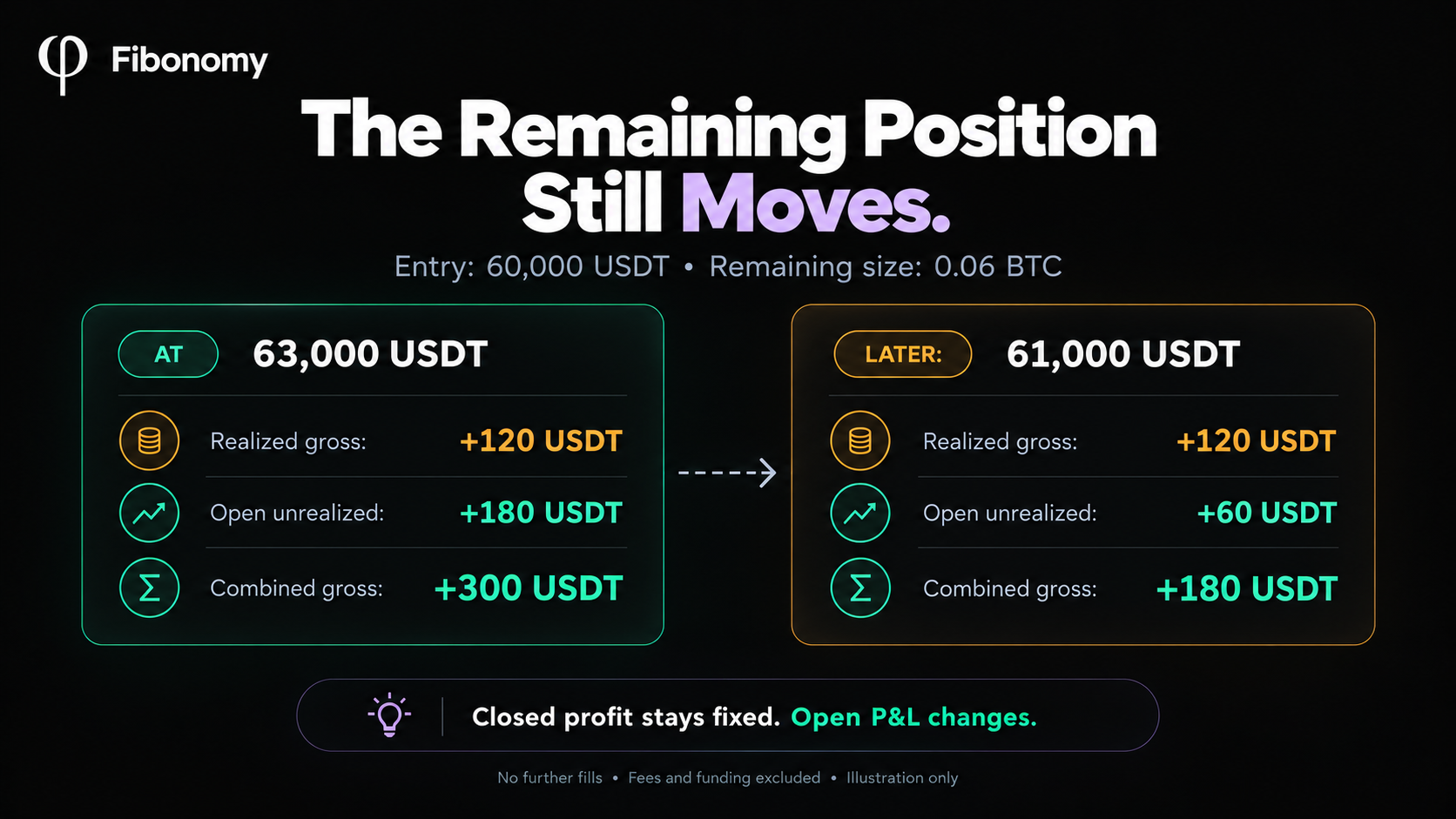
No further fills occur. Gross realized plus current unrealized is a snapshot, not a final net result.
The 120 USDT decline in the combined figure comes from the remaining 0.06 BTC moving down by 2,000 USDT per BTC. The earlier closing fill was not undone.
Under the same fee-free model, if the remaining 0.06 BTC were later closed at exactly 58,000 USDT, that part would realize a 120 USDT loss. It would offset the earlier 120 USDT gross profit. This is a hypothetical exact fill, not a promised stop execution or a recommended exit price.
A positive realized result therefore does not establish a positive final result. Future movement, execution and costs still matter.
Is the realized figure the same as net profit?
Not necessarily. Read the definition of the specific P&L field before reconciling it with gross price-based arithmetic.
In its USDT documentation, Bybit distinguishes cumulative realized P&L from closed P&L. It describes fees and funding in those calculations and prorates opening and funding fees for partial-close closed-P&L records. A position's cumulative realized field and an individual closing record can therefore have different scopes. Bybit P&L definitions.
Our +120 USDT figure is deliberately labeled gross trading result. It is not a claim that a live account's net realized field must increase by exactly 120 USDT.
For an actual reconciliation, match the closing executions and quantity, collect their fees, and check how the exchange allocates opening costs and funding. Keep the field's reporting period consistent. Do not deduct a cost again if the displayed realized result already includes it.
If funding is part of the difference, trace funding fees separately from price P&L. A profitable closing fill and a cash-flow adjustment are different events.
Does a partial close automatically reduce account risk by the same percentage?
It reduces this position's quantity, but that percentage alone does not measure the change in total account risk.
In the example, 0.04 BTC is 40% of the original 0.10 BTC. With the same contract and unchanged valuation conditions, the remaining position responds to a 100 USDT price move by 6 USDT rather than 10 USDT. That is a statement about this position's linear price sensitivity.
It is not a statement that the account is 40% safer. Other positions, protection, collateral and shared margin can still matter. Review crypto futures account risk across open positions to put the remaining exposure into account context.
Likewise, do not identify released margin with earned profit. Account capacity and trading result are separate measures. See futures available balance versus wallet balance for that distinction.
What should you check about stops and pending orders afterward?
Check the actual protection on the remaining position: active order status, correct side, quantity covered, trigger reference and execution type. Do not assume that every exchange or order type adjusts identically.
Bybit's futures TP/SL guide distinguishes an entire-position instruction, based on the current position size, from partial-position instructions with specified quantities. It also explains that a triggered limit instruction still needs a matching execution. These are Bybit-specific behaviors, not universal guarantees.
Bybit also documents reduce-only orders as a way to prevent a closing limit order from unintentionally increasing exposure. Its rules can reduce or cancel quantities. Verify the resulting orders rather than inferring their status from an earlier setup.
| Question after the partial close | Evidence to inspect |
|---|---|
| Did the intended amount actually close? | Executed fills, not only the submitted order size |
| Is the intended side still open? | Current direction and remaining position quantity |
| How much is protected? | Current stop scope and covered quantity |
| Can another pending order create exposure? | Reduce-only or equivalent behavior for the actual account mode |
| Does the total result reconcile? | Closing results, current open P&L and correctly scoped costs |
This is a review checklist, not an instruction to remove protection or a guarantee that a stop will fill at its trigger price.
The better question: what remains after taking profit?
Ask how much is still open, what result has actually been realized, which costs are included, and what protection remains active.
A partial close is one event in the position's lifecycle. Recording only the profitable exit can hide the exposure that continues afterward. Recording only the remaining open row can hide the result already realized.
Fibonomy provides read-only context for changes in position size, leverage and protection. It does not provide trading signals or execute trades. Use that position context alongside the exchange's execution and account records.
Frequently asked questions
Can I take profit without closing the entire futures position?
An executed partial close can realize the result on part of a position while leaving the rest open. An unfilled take-profit order has not yet realized that result. Available order settings depend on the exchange and account mode.
Why did my unrealized P&L drop immediately after a partial close?
It may now cover a smaller open quantity. In the example, 0.10 BTC with 300 USDT unrealized becomes 0.06 BTC with 180 USDT unrealized, plus 120 USDT realized gross, at the same valuation price.
Does closing part of a position lower my average entry?
Not in the simple average-cost reduction illustrated here. The remaining quantity keeps the same entry basis. Do not confuse realized profit with a change in entry price or assume all contracts use identical accounting.
Is the rest of the position risk-free after I take some profit?
No. The remaining quantity can still lose value, and its losses can offset earlier realized gains. Review current exposure, protection and costs rather than relying on the fact that one closing fill was profitable.
Should I add realized P&L to unrealized P&L?
For a coherent snapshot, combine realized and current unrealized components with matching scope and consistent treatment of costs. Do not add a pre-close unrealized snapshot to the result realized from that same quantity.
Sources and scope
Official documentation checked on 22 October 2026:
- Bybit: USDT perpetual and expiry contract P&L calculations.
- Bybit: reduce-only orders.
- Bybit: futures take-profit and stop-loss settings.
All numerical examples and diagrams are original illustrations of a linear USDT long, excluding fees and funding. The assumed fill and valuation prices are explicitly stated. Actual exchange fields, settlement conventions, order execution and account rules may differ.