November 10, 2026Education
How to Review a Losing Futures Trade: A Post-Trade Checklist
Use a six-step checklist to review a losing futures trade. Compare two trades with the same net loss and turn the evidence into one action for your next trade.
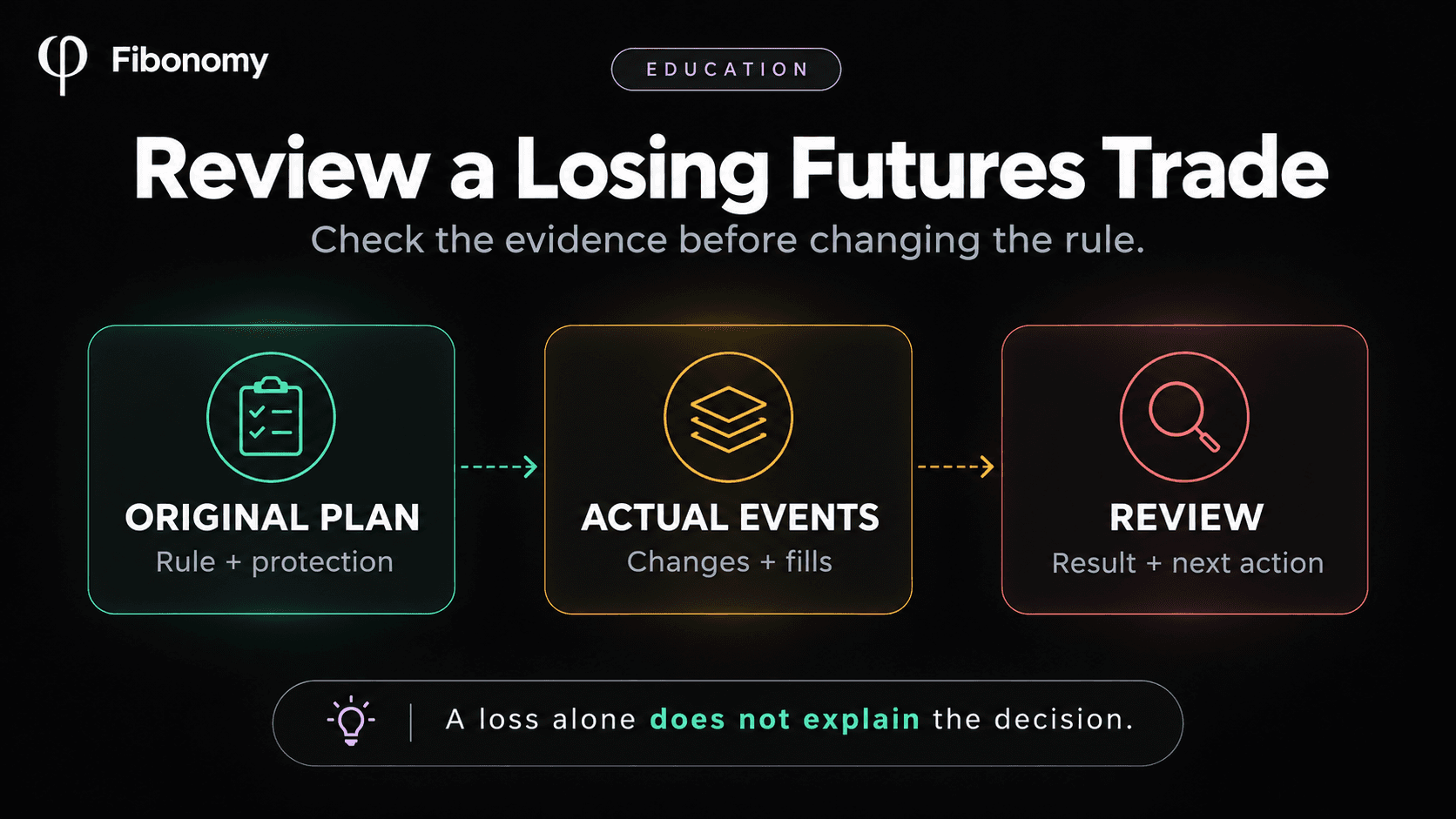
To review a losing futures trade, first reconcile the position and its costs. Then compare the recorded sequence of fills and order changes with the plan you wrote before entry. Classify whether the trade followed the plan, broke a specific rule, or lacks enough evidence. Finish with one action you can verify on your next trade.
Two trades can lose the same amount and deserve different reviews. A loss within a documented plan raises a different question from a loss after the trader widened a stop against a written rule.
The six-step post-trade checklist
| Step | Evidence to check | What to write |
|---|---|---|
| 1. Reconcile the result | Fills, fees and signed funding | Net result for the full position |
| 2. Recover the plan | A timestamped note, order or screenshot | Entry thesis, original stop and permitted changes |
| 3. Rebuild the timeline | Executions and order amendments | What changed and when |
| 4. Compare with the rule | The written rule and the matching event | Followed, breached or unclear |
| 5. Separate facts from explanations | Records and contemporaneous notes | What happened and what remains unknown |
| 6. Choose a next action | The point where the process broke down | One action and the evidence that will show it happened |
Keep one review for the full position. If you added size or took a partial exit, include those fills before interpreting the final close. Start with the crypto futures trading journal guide if you need a consistent record before, during and after the trade.
1. Reconcile what the trade actually lost
Start with executed entry and exit prices, size, trading fees and funding attributable to the position. For the single-entry, single-exit linear USDT long below, gross P&L equals quantity multiplied by exit price minus entry price. Net P&L subtracts trading fees and adds signed funding, where paid funding is negative and received funding is positive.
Check how your exchange defines the figure it displays. If a closed P&L figure already includes fees and funding, subtracting them again double-counts costs. If you need to reconstruct a position with multiple fills, see how realized P&L differs from position history and what happens after a partial close. The worked calculation here applies to a linear contract and the specific fills shown.
2. Recover the original plan
Look for a timestamped note or screenshot made before entry. Record the planned stop, the size it applied to and the conditions that allowed you to change it. An order record can verify a stop level. A note can verify that you had a rule against widening it.
If the only record is a note written after closing, label it as a recollection. If a rule is missing, record “original rule unverified.” That gives you a precise gap to fix in the next trade.
3. Rebuild the order and fill timeline
Record entry fills, position changes, protective order amendments, the stop trigger if available, and the actual exit fills. Keep the trigger and fill in separate columns. A conditional market order can execute at a different price after triggering. A conditional limit order can trigger and remain unfilled. See entry and exit prices in a futures position for the distinction between a planned price and an executed price.
Use one timezone. If the available history shows a stop changed but gives you no reliable sequence, mark the sequence as uncertain. A price chart alone cannot show when your order was amended.
4. Compare the same loss against two different plans
These examples are synthetic. Each BTCUSDT long opens 0.10 BTC at 60,000 and fully exits at 59,000. Each has 5 USDT in total trading fees and zero funding. Both traders documented a rule to keep the stop from moving farther from entry after opening the position.
| Review item | Case A | Case B |
|---|---|---|
| Original stop | 59,000 | 59,500 |
| Original planned price risk | 100 USDT | 50 USDT |
| Recorded stop change | None | 59,500 to 59,000, before the original trigger |
| Planned price risk after the change | 100 USDT | 100 USDT |
| Gross P&L | −100 USDT | −100 USDT |
| Net P&L | −105 USDT | −105 USDT |
| Finding on the written stop rule | Followed | Breached |
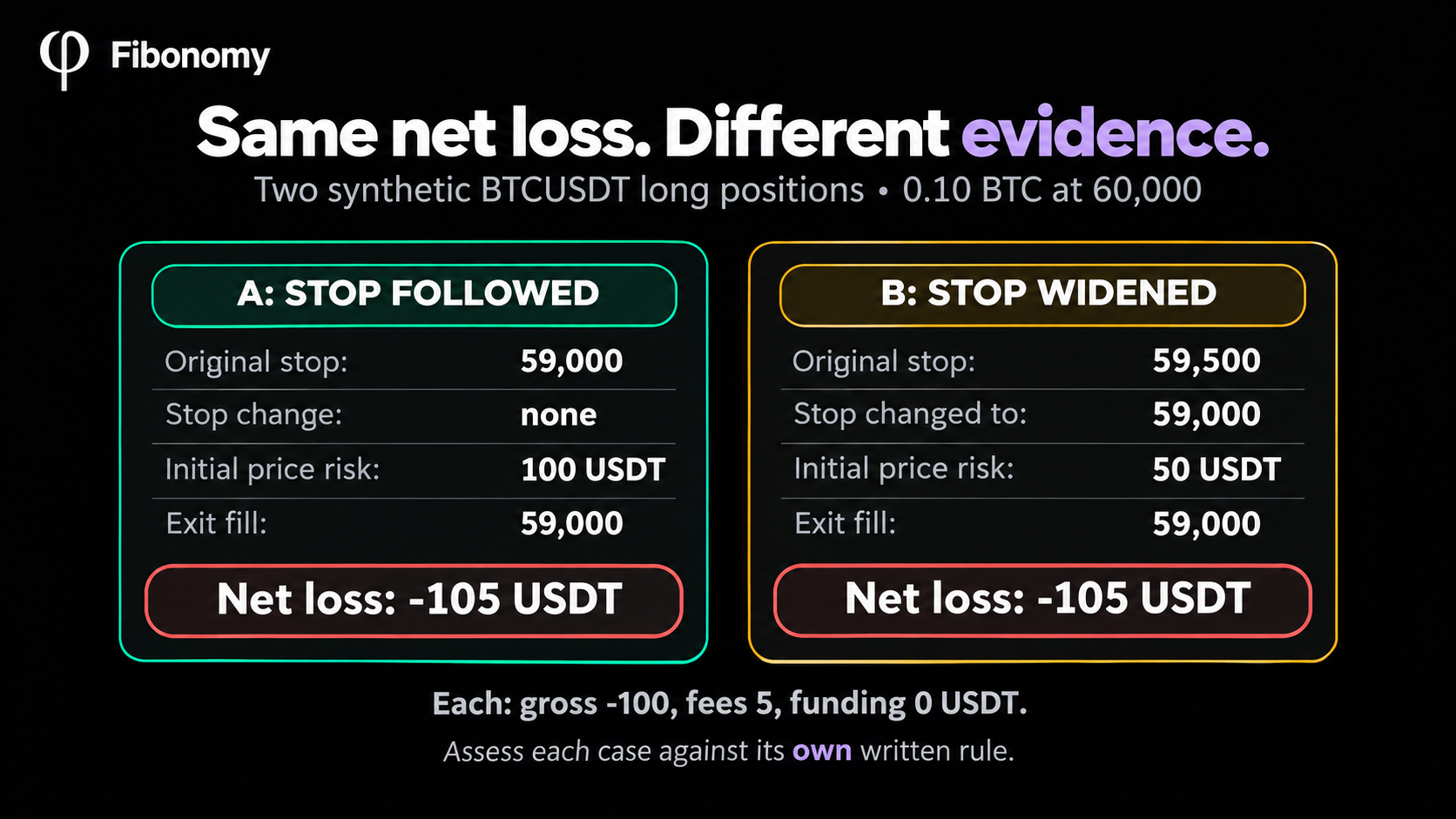
Each case is assessed against its own written rule. The examples do not recommend either stop distance.
The gross loss is 0.10 × (59,000 − 60,000) = −100 USDT. With 5 USDT of fees and no funding, the net loss is 105 USDT. Case B's planned price risk rose by 50 USDT when the stop moved. Planned price risk here is the distance from entry to stop multiplied by quantity, before costs and any difference between the stop and actual fill.
Case A followed the recorded stop rule. Case B broke it. That finding applies to the stop rule specifically. Other parts of the plan may need separate review. If the plan explicitly allowed the amendment under a condition, check whether the evidence shows that condition was met.
5. Separate what the record proves from what it suggests
For Case B, the verified event is that the stop moved from 59,500 to 59,000. The supported conclusion is that the stop moved farther from entry and breached the written rule. The reason for the amendment remains unknown unless a contemporaneous note or other record supports it.
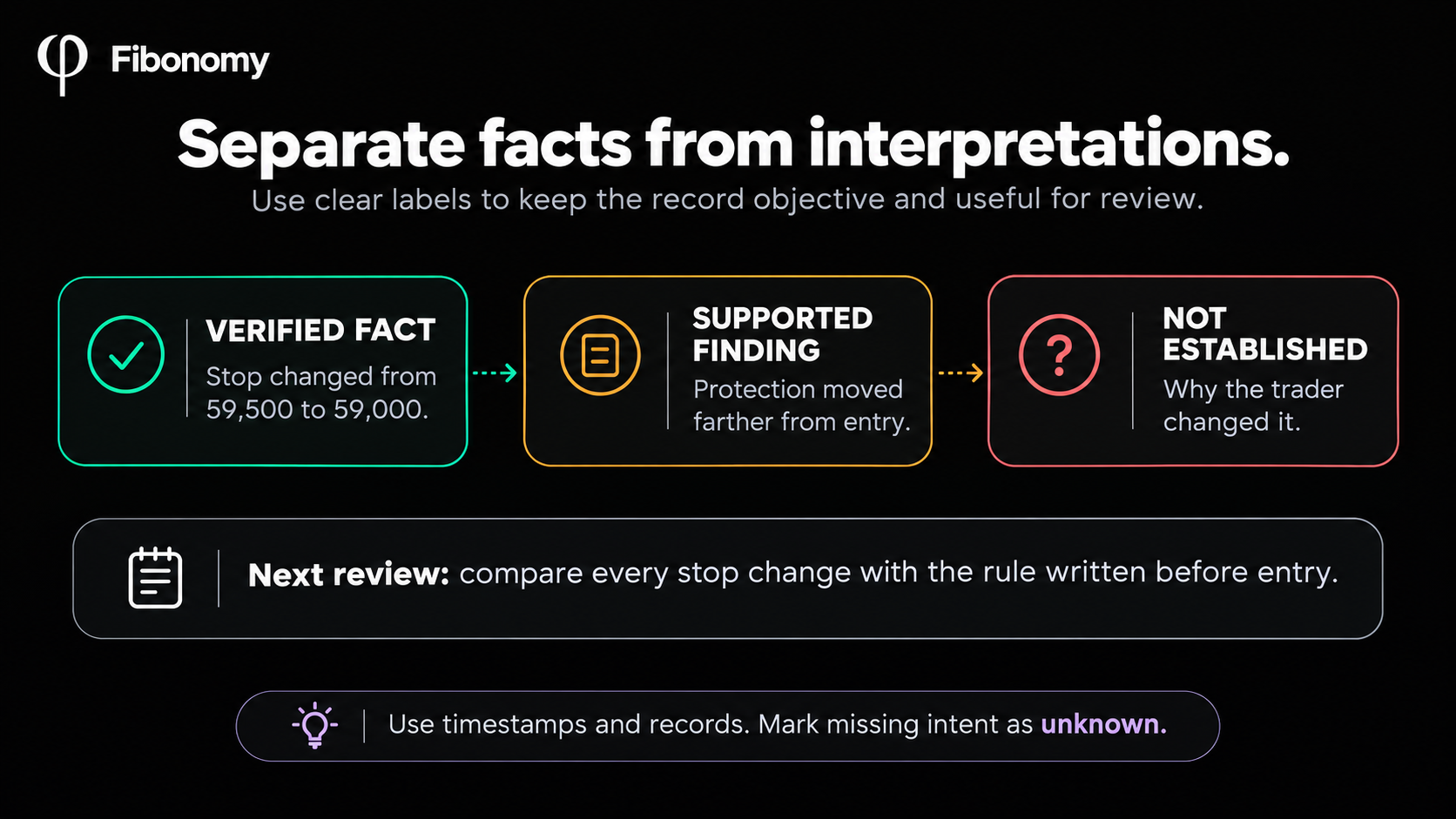
Use the recorded sequence for the process assessment. Missing intent stays unknown.
Write each part separately. For example: Event: stop amended from 59,500 to 59,000. Finding: amendment breached the recorded stop rule. Reason: no note recorded. This makes the finding useful in a later review without turning a guess into journal data.
6. Choose one action you can check next time
Tie the action to the evidence gap or the recorded breach. For Case B, a review note could read: “At my next entry, save the original protective order and the rule for amendments. At close, compare that record with the order history.” The proof is the timestamped entry record and the comparison after close.
For Case A, keep the stop-rule finding and choose any other check that the evidence calls for, such as whether the exit fill differed from the trigger. Review repeated observations across comparable trades before drawing conclusions about the strategy. A single outcome tells you how that position ended.
Log the review in Fibonomy Decision
Use Decision to keep the review with the position. Start with the original plan and the key events, record your finding, then write the next action. Keep the supporting order or fill record available so the finding can be checked later.
For the fields and layout, use the Fibonomy crypto futures journal template. The checklist above works as a review sequence for one closed position.
Frequently asked questions
Does a losing trade mean I broke my trading plan?
A loss describes the financial result. To assess the process, compare the executed trade and order changes with the documented rules. A loss can occur even when the trader follows those rules.
What if I forgot to record my stop before entry?
Check timestamped order history and any contemporaneous notes. If you can verify the stop level but cannot verify the rule for changing it, record both facts separately and classify rule compliance as unclear.
Is my stop trigger the price I should use to calculate P&L?
Use the actual execution prices. The trigger is an order event, while the fills establish the realized entry or exit price. Include the applicable costs once when reconciling the net result.
What should I change after a single loss?
Start with one process action supported by the record, such as saving the original stop before entry. Evaluate strategy changes using a series of comparable trades.
Sources
- CME Group — Keep a Trade Log covers recording trades and reviewing them afterward.
- Bybit — P&L Calculations (USDT Contract) documents the linear-contract calculation and cost treatment on that venue.
- Bybit — Close On Trigger Order distinguishes conditional market and limit behavior on that venue.