November 1, 2026Education
Crypto Futures Journal Template: Review Trades in Fibonomy
Apply a repeatable journal workflow in Fibonomy: preserve the plan, inspect position changes and costs, and use Decision to review process separately from profit.
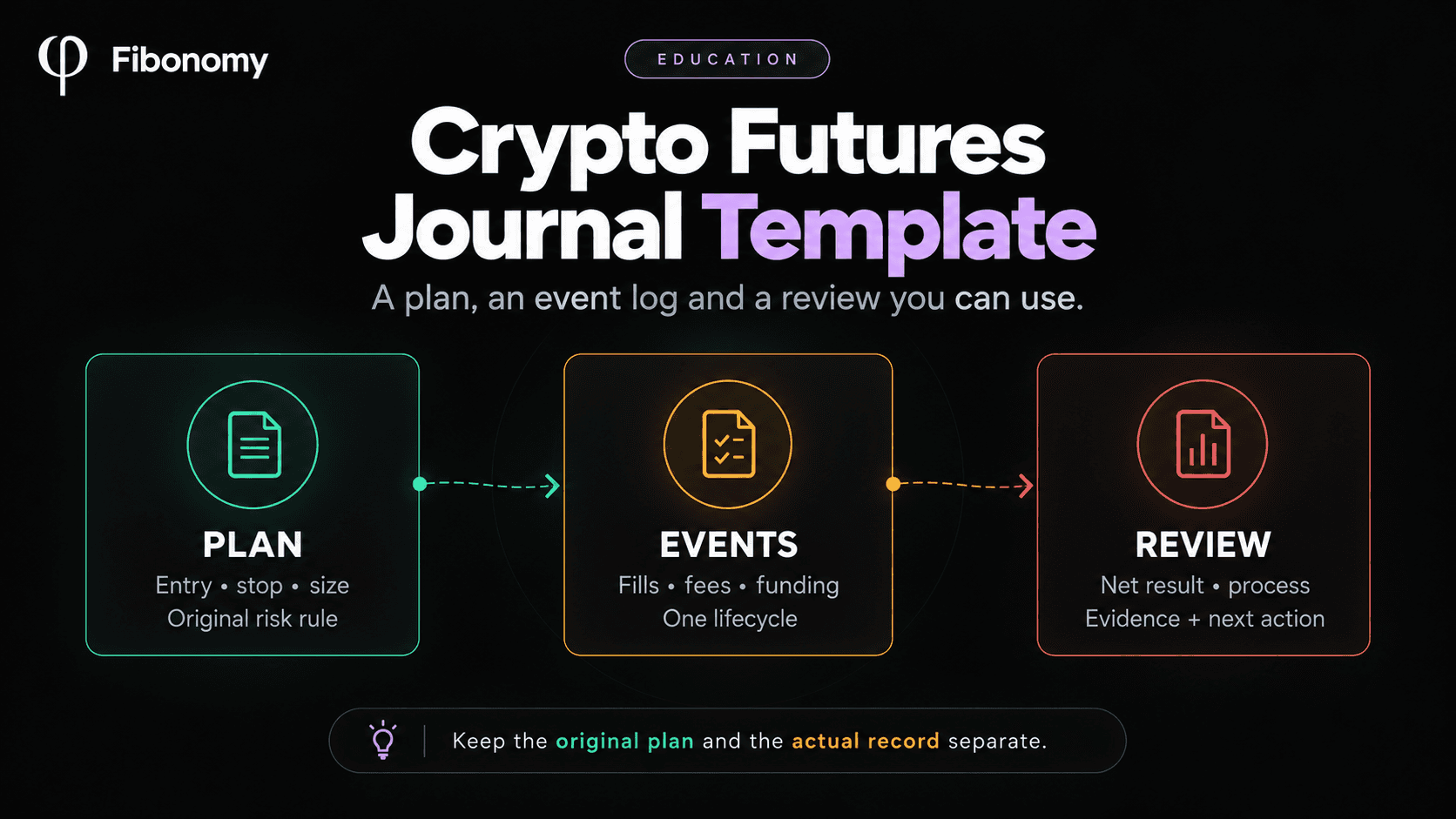
A useful crypto futures journal connects the original plan, changes to the position and the review after closing. That structure matters more than the format used to hold it.
Use this journal template as a repeatable review workflow in Fibonomy: preserve the original reason and risk rule, inspect the position's actual lifecycle, reconcile the result and costs, and review process separately from profit. Start in Decision to see closed trades in that context.
The framework below is a set of recording and review questions. It does not mean every suggested note or personal rule is automatically captured or graded by the product.
Start with Decision in Fibonomy
Open Decision in the Fibonomy dashboard. If an account is not connected, the page offers supported exchange connections and a clearly labelled sample account.
Connect your own supported account using the read-only connection flow when you want to review your records. Fibonomy checks exchange permissions and does not place trades or provide signals.
Decision brings together a process summary and closed-trade records. Its current interface includes outcome/process categories, category filters and a list of closed trades, with controls for inspecting a trade and its costs.
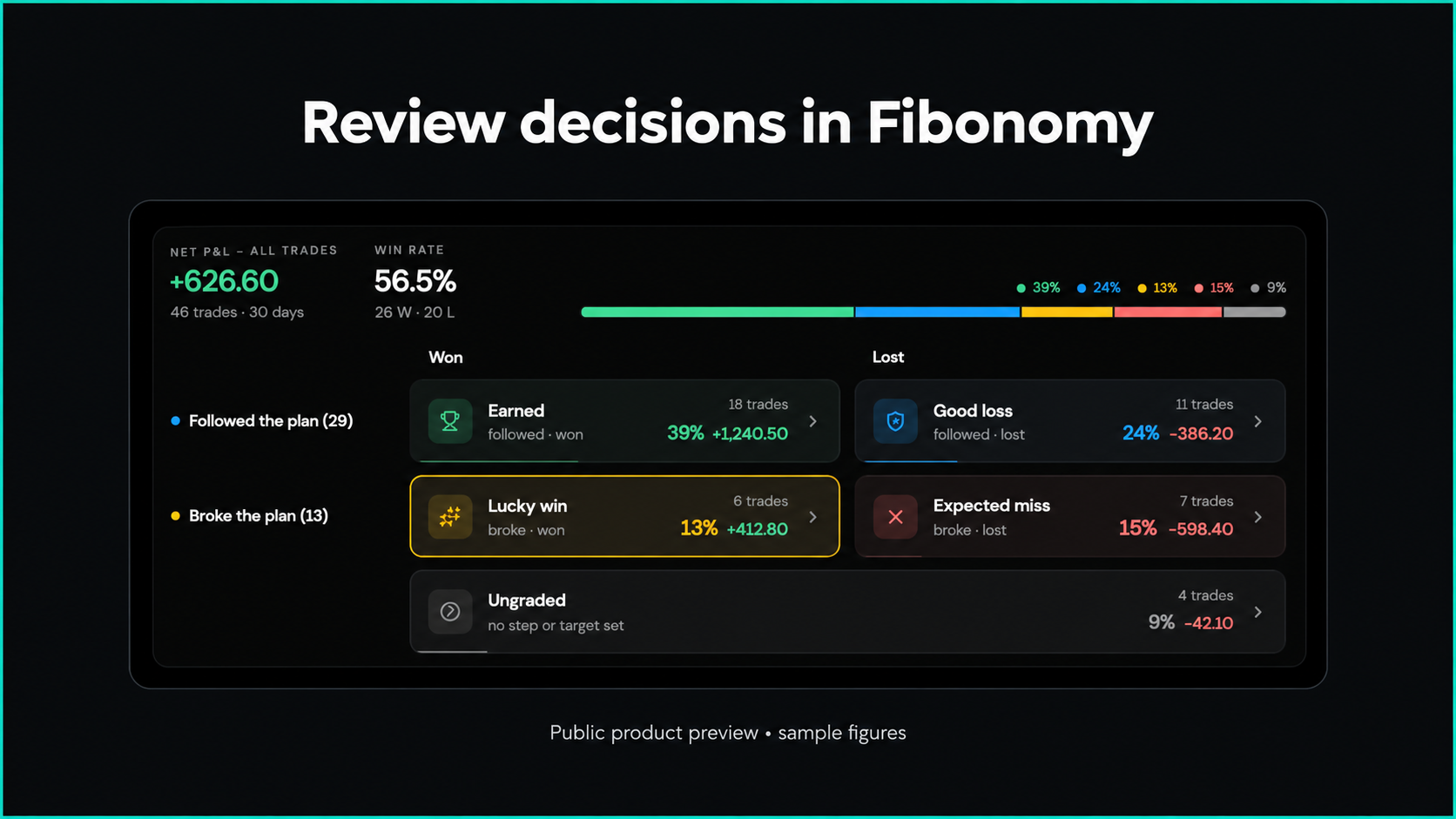
Presentation adapted from Fibonomy's public Decision preview. The displayed figures are sample data, separate from the teaching example below.
Start with one closed position whose records you can verify. A complete review of one case is more useful than a conclusion drawn from a headline percentage without its underlying events.
For the broader recording method, read what a crypto futures trading journal should contain.
What should your journal template contain?
Keep three parts attached to the same position: the original plan, the actual record and the post-close assessment.
| Part | Record or inspect | Question it should answer |
|---|---|---|
| Original plan | Reason for entry, invalidation, intended size, protection and personal risk rule | What did I intend before the outcome? |
| Position lifecycle | Actual fills, additions, reductions and changes in protection | What did I actually do? |
| Financial result | Realized price P&L, fees, signed funding and any quantity still open | What does this result include? |
| Process review | Evidence of compliance, exceptions and missing information | Did the decisions match the relevant rule? |
| Next action | One observable recording or review change | What will I check next time? |
Identify the exchange, account label, contract type, settlement currency, margin mode, position mode and timezone in your supporting record. A symbol alone may not identify the correct case.
These fields are an educational checklist. Use the information the product and source records actually provide, and keep additional context where you can retrieve it later.
Preserve the original plan before judging the result
Write down the reason for taking the position, what would invalidate it and the risk constraints you intended to follow before you know how it ends.
Include entry, intended size and units, stop or other protection, and any rule for adding or reducing. Preserve that original version when the position changes.
For example, “Do not add if combined planned price risk would exceed my account rule” gives a later review something concrete to examine. “This looked good” usually does not.
A position's own risk and its effect on the account are different questions. Our guide to crypto futures account risk explains why another open position can matter to that review.
Do not retrofit an original plan around a profitable close. If the contemporaneous reason or rule is missing, mark that part of the assessment unknown.
Inspect what changed inside the position
Review actual executions and material changes rather than relying only on the final entry and exit prices.
Useful events include:
- Opening fills and differences from the intended execution.
- Additions, reductions and the quantity remaining afterward.
- Stop or target changes, including protection being cancelled.
- Applicable leverage or margin changes.
- Costs and funding attributable to the same lifecycle.
Keep execution facts separate from your interpretation. An increase in quantity establishes that size changed; it does not establish the trader's motive.
A position may contain several fills before becoming flat. Define the grouping rule, especially for hedge-mode legs or reversals. Trade history versus position history explains why these records are not interchangeable.
When records are fragmented, use the method for reconstructing a closed futures position before assigning a lesson to it.
Reconcile costs before interpreting net P&L
Check whether the displayed result is gross price P&L or already includes fees and funding. Use one consistent definition for the same position and time boundary.
For the teaching example here, paid fees are positive costs and funding is signed: positive when received, negative when paid.
Net result = gross realized price P&L - fees paid + signed funding.
| Component | Synthetic amount |
|---|---|
| Gross realized price P&L | +170 USDT |
| Fees paid | 9 USDT |
| Signed funding paid | -2 USDT |
| Net result | +159 USDT |
The calculation is 170 - 9 + (-2) = 159 USDT.
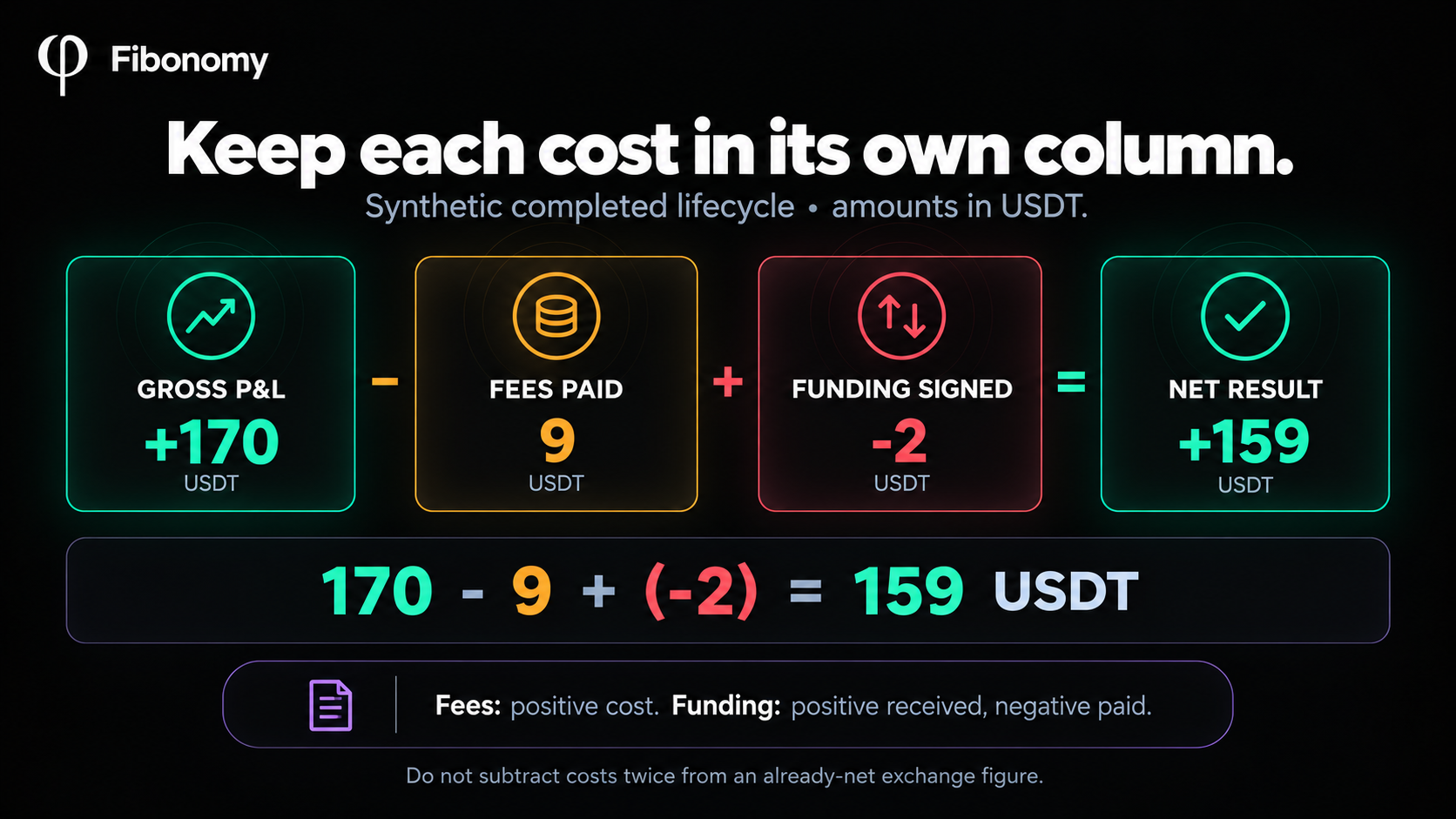
An illustrative accounting convention, not an exchange fee schedule or a screenshot of a Fibonomy calculation.
Do not subtract costs a second time from an already-net result. Bybit's USDT P&L documentation distinguishes cumulative realized and closed P&L, including cost allocation for partial closes. Confirm the field and contract before comparing it with another view.
See realized P&L versus position history for reconciliation and funding fees in futures P&L for holding costs.
Worked record: a profitable close with a process exception
Consider a synthetic linear BTCUSDT perpetual long. Prices are USDT per BTC; fees and the personal risk rule are teaching assumptions.
| Event | Executed quantity and price | Position afterward |
|---|---|---|
| Open | Buy 0.10 BTC at 60,000 | 0.10 BTC long |
| Add | Buy 0.05 BTC at 62,000 | 0.15 BTC long |
| Partial close | Sell 0.06 BTC at 63,000 | 0.09 BTC long |
| Final close | Sell 0.09 BTC at 61,000 | Flat |
The weighted entry after the add is 60,666.666... USDT per BTC. The two closes produce gross price results of 140 and 30 USDT. With hypothetical fees of 9 and funding paid of 2, the complete lifecycle's net result is 159 USDT.
The original stop was 59,000 and stayed unchanged during the addition. Planned entry-to-stop price risk rose from 100 to 250 USDT. Assuming other positions contributed 200 under the same simplified convention, combined planned price risk rose from 300 to 450 against a written 400 USDT personal cap.
The record therefore contains both a profit and a documented exception to the personal rule. The calculation excludes costs, execution uncertainty and portfolio stress; it is not a guaranteed maximum loss or an exchange liquidation formula.
That personal-rule assessment is a teaching review. Do not assume Fibonomy automatically knows every personal rule or will assign this example a particular grade. Product grading depends on supported criteria and available evidence.
For the quantity still open after a reduction, see what happens when you partially close a futures position.
How do Decision categories help a review?
Use the categories to choose cases worth examining, then inspect the underlying position. The category is a starting point for review, not proof of a trading edge.
The current Decision interface shows:
| Category | Process and outcome distinction shown |
|---|---|
| Earned | Followed the plan and won |
| Good loss | Followed the plan and lost |
| Lucky win | Broke the plan and won |
| Expected miss | Broke the plan and lost |
| Ungraded | Insufficient grading context; the current preview labels cases with no stop or target set |
The interface lets you filter these groups and inspect closed-trade records. Review what the available history supports. A profitable result does not erase a documented protection change, and a loss does not automatically mean the decision was poor.
The example above illustrates a separate personal account-risk rule. The public Decision preview illustrates the product's supported process/outcome distinctions; their numbers are not the same dataset.
What should you examine in an individual closed trade?
Choose a closed trade in Decision, inspect its position record and review its costs. Compare the original setup and protection with the changes that occurred.
Use a short checklist:
- Does the record cover the correct account, contract and lifecycle?
- What protection was present at entry?
- Did size or protection change, and when?
- Is the result gross or net, and are the costs reconciled?
- What documented behavior supports the process assessment?
- What remains unknown?
Where the interface offers a position sheet or cost details, use those to inspect the case rather than inferring the whole story from the summary.
The sample account is useful for exploring the workflow. It is demonstration data, not your trading history or evidence of expected performance.
How should you handle missing information?
Keep an unknown amount or missing intention distinct from a verified zero or a documented rule.
If a cost has not been established, resolve it before treating a net result as complete. If the original reason is absent, do not infer it from the outcome.
A missing note does not prove a rule was broken. Equally, the absence of recorded evidence does not establish compliance. Limit the conclusion to what can be checked.
The template questions in this article are review guidance. They do not assert that the app has a matching input field, completeness status or automatic calculation for every item.
Finish with one observable next action
End the review with something you can check on the next relevant case.
For the synthetic example, a next action could be: “Before another addition, record the combined-risk calculation and compare it with my written account rule.”
For a case with missing evidence, the action might be to preserve the original plan before entry. Keep the action specific enough to examine later; avoid changing an entire strategy on the basis of one position.
Open Decision in Fibonomy and review a closed trade.
Fibonomy uses read-only connections. It does not execute trades, provide signals or guarantee improved results.
Frequently asked questions
Is this template a set of review questions or an automatic trading strategy?
It is a recording and review framework you can apply alongside Fibonomy's position records and Decision view. It does not select entries, execute orders or establish profitability.
Can a profitable trade still deserve review?
Yes. Decision separates process from outcome, including a Lucky win category. Examine the evidence behind the label rather than treating profit as proof that every decision was sound.
Should every losing trade be treated as a mistake?
No. A loss can occur while the supported plan was followed. Inspect protection, execution, costs and the original assumptions before deciding what to change.
What if my own risk rule is more detailed than the app's grading?
Keep that rule explicit and assess it against the relevant evidence. Do not assume an automated grade covers every personal constraint.
Can this numerical example be used for inverse contracts?
Not unchanged. The example uses a linear USDT perpetual with base-asset quantities. Inverse contracts and other settlement structures need their own definitions and calculations.
Sources and scope
Checked on November 2, 2026:
- Fibonomy's Decision journal interface and its labelled sample account — current navigation, category labels, filters, closed-trade records and cost/position controls.
- Fibonomy's public product preview — the source of the sample Decision presentation.
- Bybit's USDT P&L documentation — exchange-specific result definitions and cost allocation.
The numerical lifecycle is a teaching example. The framed Decision image is adapted from public sample content. Neither represents customer records, a promise of returns or validation of a trading strategy.