November 18, 2026Education
Weekly Trading Review: A Checklist for Crypto Futures Traders
Use a weekly trading review to reconcile crypto futures P&L, track decisions across closed positions, and choose one action to check next week.

At the end of the week, your futures journal shows a profit. It also shows two positions where you broke a rule and two where the original plan is missing. The weekly review should capture all three facts, so you can choose a specific change for next week.
A weekly trading review is a check of your closed-position results, costs, and decisions over a consistent seven-day window. Define which positions count, reconcile their net P&L, review one rule across comparable trades, and finish with one action you can verify the following week.
What should a weekly trading review include?
| Check | Record |
|---|---|
| Scope | Start, end, timezone, accounts, contracts, and inclusion rule |
| Closed positions | Count, gross P&L, trading fees, signed funding, and net P&L |
| Evidence gaps | Missing fills, costs, order changes, or timestamped plans |
| Rule review | One written rule and the count followed, breached, or unclear |
| Next action | When to do it, what to record, and how to check it next week |
A post-trade review reconstructs one position. The weekly review compares several positions to find a recurring decision or a recurring gap in the record. A useful review covers wins as well as losses.
1. Set the week and count full position lifecycles
Pick an exact window, such as Monday 00:00 UTC through the following Monday 00:00 UTC, with the end excluded. For a closed-position review, include each position that fully closed inside the window. A position opened the previous week still qualifies if it fully closed this week. Use the same rule each week so you can compare like with like.
Keep one row per position lifecycle. Multiple exit fills and partial closes belong to the same row. Flag a position still open at the cutoff in a separate carryover note, along with the remaining size and protection you can verify. An account cash-flow report uses event timestamps and may include funding or partial-close proceeds from those still-open positions. Label the two totals by their respective scope. Realized P&L vs. position history
2. Reconcile results and costs once
For a review limited to USDT-settled positions, work in USDT throughout. Across the included lifecycles, add gross realized trading P&L, subtract trading fees, and add signed funding. Funding received is positive. Funding paid is negative. Include the costs associated with those positions across their lifecycles, even if an entry fee was paid before the weekly window.
An exchange's closed P&L may already reflect fees and funding. Check the field definition and use either the documented net amount or a gross-to-net calculation for that position. Bybit's USDT closed P&L documentation, for example, includes trading and funding fees and describes cost allocation on partial closures. If an amount is missing, label the financial total incomplete and record which positions it covers. Bybit P&L calculations for USDT contracts
3. Review one rule across comparable positions
Select a rule that actually applied to the positions, such as “Keep the protective stop from moving farther from entry after opening.” Use the original plan and order history to classify each applicable position as followed, breached, or unclear. An order amendment can establish what changed. A timestamped plan establishes which rule governed the change.
Count unclear positions separately. If a rule applied to eight positions and the evidence supports a classification for six, coverage is six of eight. Four followed among those six implies four of six classified positions followed the rule. Keep the two unclassified positions visible when you report that figure. If none can be classified, record zero coverage and leave the compliance rate blank.
For rules that apply only to certain setups, write down the setup and eligible count. A trade outside that rule's scope belongs outside the denominator. Preserve the notes that support each finding. CME Group on keeping a trade log
4. Turn a recurring observation into one checkable action
Look for a repeated exception you can trace to specific positions, or a recurring piece of missing evidence. Choose an action you can observe at a specific point in the next week. If stop plans were often missing, record the intended stop and amendment rule before each qualifying entry. Next week, count how many qualifying entries have that timestamped note.
If the evidence is complete and two trades broke the same rule, look at what was recorded immediately before each change. Use that sequence to choose a check you can perform before amending protection. A profitable position can still contain an exception worth reviewing. Keep the trigger for your action and the proof that you completed it in the same note.
Worked example of a weekly trading review
This synthetic week covers one account and eight fully closed USDT-settled perpetual positions. All eight have complete financial records. The same stop rule was intended to apply to all eight, and six have sufficient evidence to classify compliance.
| Financial measure | Amount |
|---|---|
| Gross realized trading P&L | +160 USDT |
| Trading fees | −24 USDT |
| Net funding paid | −6 USDT |
| Net closed-position P&L | +130 USDT |
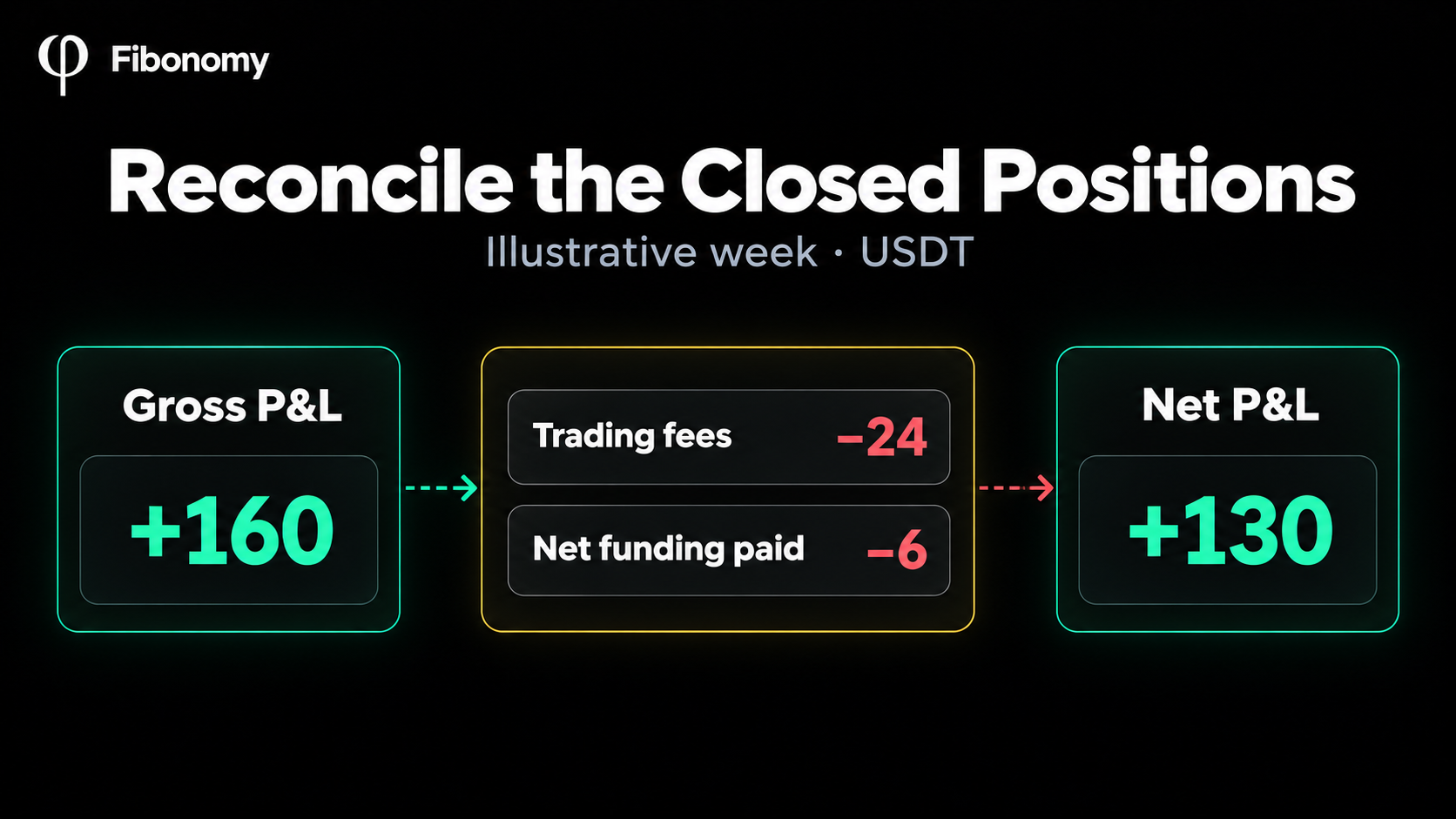
Illustrative closed-position totals. Costs are included once.
| Decision review | Position count |
|---|---|
| Rule followed | 4 |
| Rule breached | 2 |
| Unclear because evidence is missing | 2 |
| Review coverage | 6 of 8 |
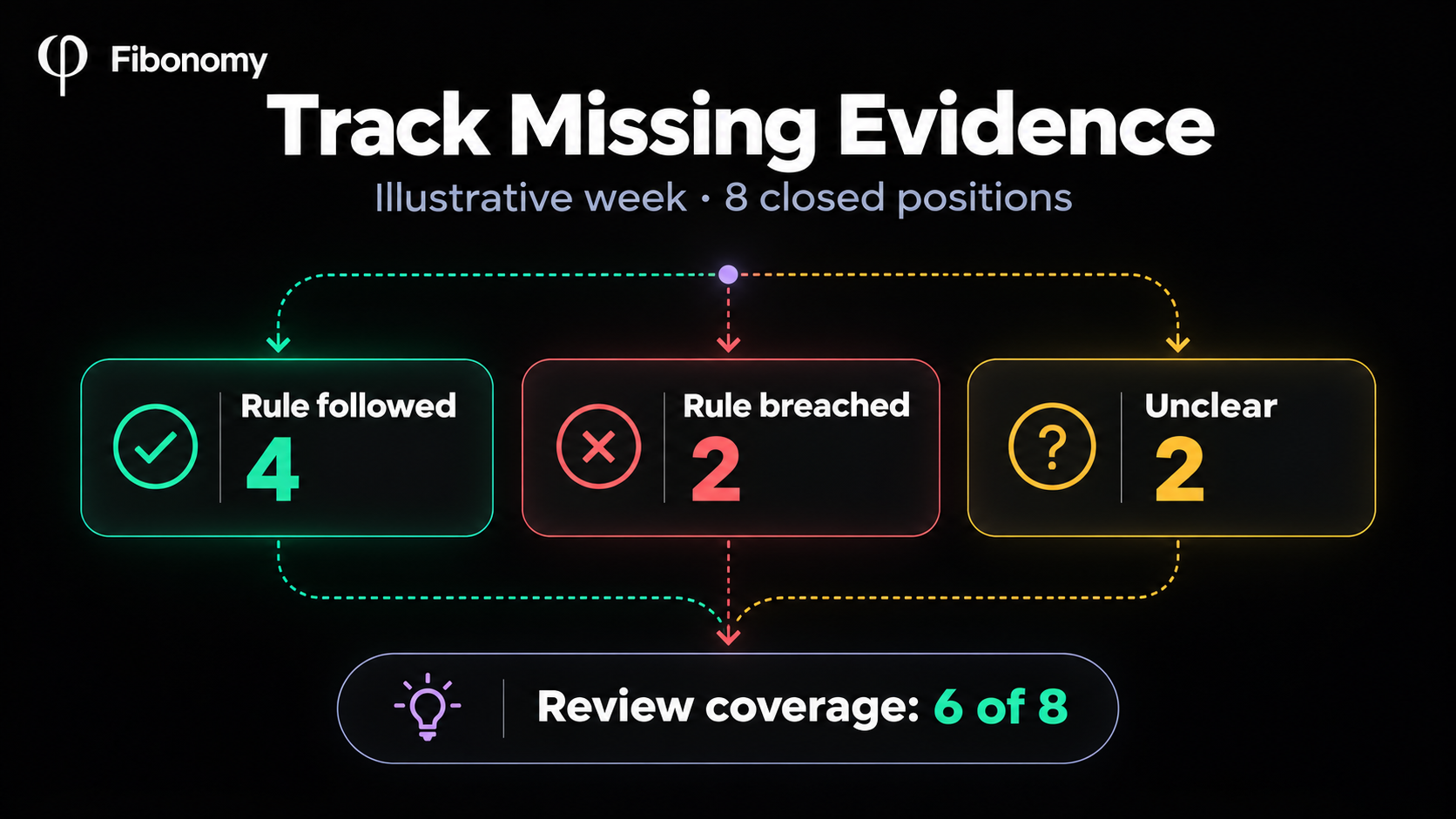
The process review uses six classified positions. The P&L total covers all eight.
The week produced +130 USDT net. Two stop changes breached the recorded rule, and two original stop records were missing. To address the missing records, the reviewer chooses to save the intended stop and amendment rule before every qualifying entry next week. At the next review, the reviewer counts timestamped plans against qualifying entries. That checks whether the recording habit improved. The effect on trading results requires more observations.
A weekly review template you can copy
Keep this note alongside your position reviews:
- Week and scope — start, end, timezone, account, contracts, and inclusion rule.
- Position totals — full closes, open positions carried forward, gross P&L, trading fees, signed funding, and net P&L.
- Evidence gaps — position IDs and the missing fields. State which totals are complete.
- One rule — applicable position count, followed, breached, unclear, and review coverage.
- Recurring observation — the repeated event and the position records that support it.
- One action — when you will do it, what proof you will keep, and what you will check next week.
Use Fibonomy Decision to revisit the positions behind the weekly note. The journal template for reviewing trades in Fibonomy shows how to organize the plan, changes, and finding for each position. If plans are often missing, start with the crypto futures trading journal guide.
Frequently asked questions
Do I review a week with no closed positions?
Record zero fully closed positions, then check any open carryovers and whether entry plans or order changes were documented. Leave closed-position compliance rates blank when there are no eligible trades.
What if I use USDT and coin-settled contracts?
Keep separate currency totals unless you have a consistent conversion rule with a recorded rate and timestamp. Keep the original currency values so you can reconcile them against the source records.
Should I compare compliance rates across weeks?
Compare periods that use the same rule and comparable positions. Include both the eligible count and review coverage, especially when the sample is small or a different proportion of the records is missing.
Sources
- CME Group, Keep a Trade Log describes recording trade details and revisiting them during regular reviews.
- Bybit, P&L Calculations for USDT Perpetual and Expiry Contracts explains venue-specific closed P&L, trading fees, and funding.
Sources checked November 18, 2026.